Sunday’s Cut opens with a bourbon label doing more work than most buyers realize.
Four Roses is the only major Kentucky distillery that prints the complete production recipe on every single-barrel store pick — a four-character code identifying the exact mash bill and yeast strain before the cork comes out. This week, independent retailers in Ohio, Illinois, and Texas are receiving selections on two recipe codes: OESQ (low-rye, floral, honeysuckle-forward, the clearest on-ramp from wheated bourbon into recipe-code territory) and OBSV (high-rye, citrus and stone fruit, the recipe that most consistently builds toward Four Roses’ annual limited releases). Both arrive barrel-proof between 108 and 116 at $65–$75 MSRP.
Also in today’s edition: the community debate on whether Buffalo Trace is still the right first recommendation for a new bourbon drinker, a walk-in access window at Wilderness Trail Distillery in Danville with both founders on the floor, and the First Sip on distillery house styles — what makes each major Kentucky campus produce bourbon you can recognize blind.
Listen to the full Cut at chasingtheunicornpodcast.com. Full American Whiskey Industry Brief at patreon.com/ChasingTheUnicornPodcast.
The Cut podcast runs Monday through Friday — catch tomorrow’s episode on Spotify and everywhere you listen at chasingtheunicornpodcast.com/podcast.
The Cut Daily
The pulse of American whiskey: What moved — and why it matters.
Chasing the Unicorn Podcast Edition · A Drunken Unicorn Production
Report Date: June 7, 2026
Reporting Period: June 5, 2026 through June 7, 2026
Classification: Free Edition · Share with Attribution
Free Edition · The Cut Daily · Chasing the Unicorn Podcast · A Drunken Unicorn Production · Drunken Unicorn Productions, LLC. The Cut Daily is the free gateway brief to the American Whiskey Industry Brief. Share, quote, and repost freely with attribution. Required attribution: “The Cut Daily · June 7, 2026 · Chasing the Unicorn Podcast · A Drunken Unicorn Production.” The full AWIB is a paid subscriber edition on Patreon. Permissions and inquiries: chasingtheunicornpodcast.com.
Informational and entertainment purposes only. Nothing here is investment advice. Verify before buying, trading, or bidding. We are not liable for errors or financial losses.
What Is The Cut Daily? — The Cut Daily is the free written brief from Chasing the Unicorn. Every weekday we translate the biggest moves in American whiskey into plain English, teach one bourbon concept you can use at the shelf today, flag one bottle under $60 worth knowing about, and curate three Hunt picks across three price tiers. Knowledge-first chase. No FOMO. Just what moved and why it matters.
The full American Whiskey Industry Brief — every story, every Hunt entry, every debate, every auction — is published daily for subscribers on Patreon. If you want the full pour, not just the taste, join us at patreon.com/ChasingTheUnicornPodcast.
The Cut Daily is the free written companion to today’s American Whiskey Industry Brief.
IN TODAY’S CUT
The fast read on what’s happening before you walk into a store.
You’re buying bourbon blind. Stop that. Four Roses labels every store-pick bottle with the exact recipe code — the mash bill and yeast strain that predict flavor direction before the cork comes out. This week’s batch arrives at retail in Ohio, Illinois, and Texas at $65 to $75. Here’s how to read it.
The biggest bourbon story of this Father’s Day Sunday is sitting on a retail shelf right now, waiting for you to read the label. Four Roses is the only major Kentucky distillery that prints the complete production recipe on every single-barrel bottle — the mash bill, the yeast strain, the barrel number — and a fresh batch of store picks is clearing into retail this week. That’s today’s lead. Also in today’s edition: a community debate with real heat on whether “start with Buffalo Trace” is still the right gateway recommendation in 2026, and a walk-in opportunity at Wilderness Trail Distillery in Danville where both founders are on the floor today with no reservation required.
THE BIG MOVE
Today’s lead — what changed and what it means.
The Four Roses Store Pick Arriving at Retail This Week Tells You More About What’s in the Bottle Than Most $150 Allocated Releases — What the Recipe Code on the Label Actually Means and How to Use It
Event Date: June 7–14, 2026 (in-store arrival window)
Four Roses is the only major Kentucky distillery with a ten-recipe production matrix. Two mash bills — one low-rye (75% corn, 20% rye), one high-rye (60% corn, 35% rye) — crossed with five proprietary yeast strains. Every combination gets its own four-letter code. And that code goes on the bottle.
This week, independent retailers in Ohio, Illinois, and Texas are receiving store-pick Four Roses Single Barrel selections on two specific recipe codes: OESQ and OBSV. These aren’t inventory codes. They’re production briefs.
OESQ is the low-rye mash bill crossed with the Q yeast strain — the combination Brent Elliott, Four Roses’ Master Distiller, has described as producing the floral, honeysuckle-forward character that makes low-rye Four Roses approachable to buyers coming from wheated bourbon. If you’ve been drinking Maker’s Mark and want to understand what rye adds without jumping in headfirst, OESQ is the on-ramp.
OBSV runs the opposite direction: the high-rye mash bill crossed with the V yeast’s delicate-fruit character. The result is citrus and stone fruit up front, more spine on the finish. This is the recipe that most consistently builds toward the Single Barrel Collection annual releases for buyers who want to understand what they’re chasing.
Both are arriving as barrel-proof, uncut store picks — labeled with the recipe code, the warehouse location, and the barrel number. No tasting note needed. The code tells you what you’re buying. Barrel proofs are landing between 108 and 116.
MSRP runs $65–$75 versus $55 for the standard Four Roses Single Barrel release. The premium buys the recipe specificity and a provenance trail you can verify yourself at fourrosesbourbon.com before you commit.
Call your regional independent today. In Illinois, Total Wine locations have posted confirmed incoming selections. Ohio independents are activating this week. Texas accounts vary by distributor timing — check Seelbach’s if your local store hasn’t confirmed.
What It Means For Your Shelf —A $65 bottle that tells you exactly what’s inside before you open it is more transparent than most $150 allocated releases. The recipe code is the label working for you — learn to read it once and every Four Roses store pick on the shelf becomes a predictable decision, not a guess.
From today’s AWIB Opening Pour. This is one of four lead stories in today’s AWIB Opening Pour. The other three: Sunday morning on the Kentucky Bourbon Trail — what walk-in capacity actually looks like at flagship campuses versus Craft Trail stops this Father’s Day weekend; the first-serious-bourbon gift guide for the buyer still inside the June 21 deadline at the $35–$60 shelf-stable tier; and a field report from Wilderness Trail Distillery in Danville where both founders are on the production floor today with no reservation required. Read all four lead stories on Patreon →
Distillery House Styles — What Makes a Wild Turkey a Wild Turkey
Paired with today’s: Four Roses recipe-coded store picks arriving at retail this week — the OESQ and OBSV recipe codes on the label are the direct expression of what makes a Four Roses taste like a Four Roses, and this concept is how you understand why a Four Roses drinks so differently from any other Kentucky bourbon at the same price point.
Every major distillery has a house style. It’s the cumulative result of mash bill, yeast strain, distillation proof, barrel entry proof, warehouse design, and aging climate — and once you can recognize it, you can pick your favorites with intent.
Buffalo Trace’s house style is soft, sweet, cherry-and-cocoa forward with low spice and an easy mid-palate. That same character runs through Eagle Rare, E.H. Taylor, and Stagg — same campus, same water, family resemblance in every bottle.
Wild Turkey’s house style is big, oily, rich, and spicy. High entry proof from low distillation proof, long aging in heat-cycled rickhouses. Wild Turkey 101, Rare Breed, Russell’s Reserve — they all taste unmistakably like Wild Turkey.
Heaven Hill’s house style is bright and fruit-forward, with a controlled center. Larceny leans wheated. Elijah Craig runs traditional. Both taste like they came from the same family.
Four Roses is the outlier — intentionally. Five yeast strains crossed with two mash bills gives them ten distinct recipe combinations, each producing its own character. The OESQ picks arriving at retail this week are the floral, low-rye end of that range. The OBSV picks are the citrus-and-stone-fruit, high-rye end. Both are Four Roses. Neither tastes like the other.
What this changes: Pick one distillery and drink three of their bottles back to back. You’ll hear the family resemblance — and start shopping with intent instead of guessing from the shelf.
The Perfect Pour app — beta open now, launches July 4. For the full deep-dive on distillery house styles — the mash bill, yeast strain, and entry-proof architecture that creates each major Kentucky distillery’s signature character, and how to identify them blind — get notified when the Perfect Pour app launches. Take your seat in the beta →
A bottle under $60 that’s worth knowing about — one per edition.
Four Roses Single Barrel Kentucky Straight Bourbon Whiskey
$40–$55 Wide national distribution at Total Wine, Binny’s, independent retailers, and online-capable spirits accounts; no lottery, no allocation window, no wait list — the recipe code varies by barrel but the bottle is consistently in stock at major retailers nationally
Flavor Profile —Flavor direction varies by recipe code printed on the back label — low-rye expressions (OESQ, OESV) run honey and floral on the nose with a softer corn-sweet entry; high-rye expressions (OBSV, OBSK) run citrus and stone fruit up front with a crisper, spicier finish; at 90-proof-equivalent minimum, the bottle rewards a slow first pour before water
Production Context —Distilled at Four Roses Distillery in Lawrenceburg, Kentucky using the distillery’s five proprietary yeast strains crossed with two mash bills — the recipe code printed on the back label identifies exactly which of the ten combinations went into that barrel; non-chill filtered and bottled from a single barrel at or near its warehouse proof
Why This Matters —Learning to read the four-character recipe code on the back of a Four Roses Single Barrel converts every store pick, limited release, and Single Barrel Collection annual release from a guessing exercise into a predictable decision — and the $40–$55 entry price makes this the most instructive single-purchase education available in the Kentucky bourbon aisle right now
Three bottles across three price tiers — what to buy, what to wait on, what to skip.
How to read the chase ratings
YESworth chasing
WATCHhold for now
PASSskip this one
Bottle 1 — Under $80
Wilderness Trail Bottled-in-Bond Single Barrel Spring 2026
Window: Available through June 30, 2026; visitor center open Thursday–Sunday 10:00 a.m.–5:00 p.m.; walk-up with no reservation required — today’s Sunday Father’s Day window has both founders on the production floor
Where: Wilderness Trail Distillery visitor center, 4095 Lebanon Road, Danville, Kentucky; approximately 35 minutes south of Lexington, 85 minutes from Louisville
MSRP: $54.99
Flavor Profile — Fresh peach and pear on the nose, soft corn-sweet palate with honey and minimal heat at 100 proof, clean wheated finish that does not punish new drinkers — the sweet mash process producing a smoother entry than the proof number implies
YES
Rationale — Walk-up at MSRP with no lottery, no pre-order, and no allocation window — the strongest access-tier Craft Trail pick currently on the Kentucky Bourbon Trail for Father’s Day weekend visitors. At $54.99 with the full federal BiB credential and both founders available for the kind of direct technical conversation the flagship campuses don’t offer, this is the weekend’s highest-value distillery-stop bottle for buyers who kept driving south past Buffalo Trace.
Bottle 2 — $80 to $200
Four Roses Limited Edition Small Batch 2026 Pre-Allocation Preview Window
Window: Preview window open through June 14, 2026; full allocation opening expected July 2026
Where: Participating Four Roses specialty retailers nationally; check Four Roses retailer locator at fourrosesbourbon.com
MSRP: Not published — estimated $129.99 based on prior LESB releases; official MSRP and recipe confirmation pending Brent Elliott’s July announcement
Flavor Profile — Profile unconfirmed — 108.2 proof confirmed via TTB; recipe reveal expected before July allocation opening; prior LESB expressions at comparable proof have run integrated dried fruit and baking spice with the complexity the blended recipe architecture produces
WATCH
Rationale — The pre-allocation preview window closes June 14 — one week from today — and the recipe reveal that converts this from a WATCH to a YES or PASS arrives before you’d need to act on the standard July allocation window. Buyers who understand the Four Roses recipe system and are comfortable committing to 108.2 proof before the mash bill combination is public can enter the preview window now; buyers who want the full picture should watch for Elliott’s July confirmation and enter the standard window instead. The recipe reveal is the only outstanding variable.
Bottle 3 — $200 and up
TIER THIN THIS EDITION
Window: N/A
Where: N/A
MSRP: N/A
Flavor Profile — N/A
WATCH
Rationale — Wild Turkey Master’s Keep Triumph 2026 is the only Hunt item in this tier and is HARD CAP excluded — it has appeared in the Chase on each of the last five days, exceeding the two-appearance-per-release-cycle ceiling. No new-news exception applies today. The $200+ Chase slot is empty this edition. See SECTION COUNTS.
Today’s AWIB Hunt section covers 5 active drops, lotteries, and walk-up windows with full palate direction, rationale, and the Hunt Intelligence Note. See the full Hunt on Patreon →
What bourbon drinkers are debating right now — and what the argument teaches the rest of us.
Is Buffalo Trace Still the Right Bourbon to Recommend to Someone Just Starting Out?
An r/bourbon thread posted Thursday asking whether “start with Buffalo Trace” is still valid advice or just enthusiast-press habit has nearly 900 upvotes and 214 comments. The debate breaks cleanly in two directions. The traditional camp says the bottle is genuinely good — 90-point Whisky Advocate score, real production credentials, soft and accessible for a first-time neat drinker — and that the availability problem is overstated nationally by people who live in high-demand metro zip codes. The revisionist camp says a recommendation fails if the recipient visits three stores and leaves empty-handed before the first sip. Their counterproposals cover a real range: Evan Williams BiB at $18, Wild Turkey 101 at $28, Knob Creek 9-Year at $38. Both sides are reasoning from real evidence.
First Sip Moment —
The availability tension here depends on understanding what “allocated” means versus “hard to find.” Buffalo Trace is not an allocated bourbon — it’s a shelf-stable release that Buffalo Trace ships at roughly 1.8 to 2.2 million cases annually. Allocation means the distillery produces deliberately limited quantities and rations them through the distribution chain. Buffalo Trace’s production volume is inconsistent with genuine allocation-level scarcity at the national scale. What’s happening in urban retail is different: a decade of enthusiast-press coverage created demand that outpaces shelf replenishment speed in metropolitan areas. The bottle exists in sufficient quantity. It’s moving faster than stores in high-traffic zip codes can restock it.
The Math —
Buffalo Trace’s standard release ships approximately 1.8 to 2.2 million cases annually — a production scale that makes national shortage a distribution-velocity problem, not a supply problem. Whisky Advocate rates the current standard release at 90 points with tasting notes of rich caramel, vanilla, and dried cherry. Wild Turkey 101 retails at $28–$32 at 101 proof and is shelf-stable nationally without exception. Evan Williams Bottled-in-Bond retails at $16–$20 at 100 proof with the same federal BiB credential carried by today’s $99.99 Parker’s Heritage Collection — same four rules, six percent of the price. Knob Creek 9-Year retails at $38–$42 at 100 proof with wider retail availability than Buffalo Trace in most markets. All three are categorically different from the “manufactured scarce” tier — these are continuous-production bottles with no allocation constraint.
What It Means For The Rest Of Us —
Find Buffalo Trace if you can; if not, Evan Williams BiB at $18 teaches the same thing. Nobody goes home empty-handed.
Today’s AWIB Bar Talk has 2 more debates with full source citations, fact-checked positions, and editorial assessment. Read the full debates on Patreon →
Floor erosion is how far a bottle’s secondary market value has dropped from its highest-ever sale price. Four Roses LESB 2023 peaked at $580 within weeks of its initial distribution window — buyers were paying more than five times the MSRP because the 2023 recipe combination was well-regarded and the fall distribution window creates short-term demand compression. As of June 6, the same bottle realized $320 at Unicorn Auctions, a 44.8% decline from that peak. The pattern is predictable in the annual LESB tier: once the “current vintage” becomes the “prior vintage,” the secondary premium deflates toward a stabilized collector floor. The Four Roses LESB 2026 now in pre-allocation preview is the specific catalyst pressing on the 2023 floor — buyers who want Four Roses LESB are evaluating whether to acquire the 2023 at $320 or wait for the 2026 at approximately $129.99 MSRP. That comparison sets the floor.
The lesson: Annual limited-edition floors stabilize near MSRP-equivalent once the next vintage enters the market — the Four Roses LESB 2023 at $320 is approaching the price range where buying secondary makes more sense than it has in three years.
Today’s AWIB Secondary section grades 2 more bottles with realized prices, floor erosion math, lineage notes, and buy/hold/sell calls. Read the full secondary report on Patreon →
What you’re missing in the full brief — in order, by section.
Today’s Flight: Buffalo Trace ($35 MSRP) vs. Eagle Rare 10 Year ($45 MSRP) — two bourbons from the same Frankfort campus, same mash bill, same proof, four years apart. The AWIB runs the full side-by-side tasting comparison anchored to the Father’s Day gift question: is the $10 premium and four extra years worth it, and for which buyer? Full comparison, tasting notes, and the verdict in today’s American Whiskey Industry Brief.
Today’s AWIB Label Room covers two COLA confirmations that unblock the most consequential lottery calendar events of the fall bourbon season: William Larue Weller 2026 cleared TTB on June 7, completing the BTAC 2026 five-of-five cohort and releasing the hold on Pennsylvania PLCB, Virginia ABC, Ohio OHLQ, and Michigan LCC lottery portal publication — expected within 5 to 10 business days. The Van Winkle five-of-five completion (Pappy 15-Year confirmed June 7) puts Pennsylvania PLCB’s Van Winkle lottery in the June 20–30 activation window. Both lottery entries are free. The math on what a winning ticket is worth against current secondary floors is in today’s American Whiskey Industry Brief.
Today’s AWIB Rickhouse Report covers the KDA Q2 2026 production census — a 12.7% year-over-year proof-gallon decline across Kentucky member distilleries, the sharpest contraction since the post-pandemic reset, driven by voluntary supply discipline at Beam Suntory, Heaven Hill, and Brown-Forman. What that number means for what shows up on your shelf in 2028 and 2029, and why Conor O’Driscoll called it the right call in the official KDA commentary — in today’s American Whiskey Industry Brief.
Today’s Full AWIB Includes (in reading order)
Opening Pour: 4 stories · Bar Talk: 3 debates · The Flight: 1 comparison · The Hunt: 5 active drops · Label Room: 5 items · The Secondary: 3 graded bottles
Rickhouse Report: 5 stories · Regional Report: 3 stories
The full AWIB walks today’s bourbon world in reader-forward order — the Opening Pour lead stories, the community Bar Talk, the side-by-side Flight comparison, every active Hunt window, the full Label Room pipeline, the Secondary market grading, and the industry-depth Rickhouse, Regional, and Research Notes coverage. Plus full source trail. Join on Patreon →
The Perfect Pour — beta open now, launches July 4.
Build your Rickhouse, log every pour in your Logbook, and learn your palate with your Pour Print — the app that turns every pour into your next discovery.
Founder’s rate: lock $99/year for life as a Bourbon Keeper (through July 3, 2027).
Want the full picture? The complete American Whiskey Industry Brief — every section, every source, every story — is published daily for subscribers on Patreon. Join us at patreon.com/ChasingTheUnicornPodcast.
Tuesday’s biggest shelf-level move is a government approval that most bourbon buyers don’t know to watch for. The TTB recorded label approval for Old Forester Birthday Bourbon 2026 on May 17 — the federal database confirming that Brown-Forman’s 2026 barrel cohort is set, the label cleared review, and the September calendar is locked. Birthday Bourbon…
Two stories collided Thursday in American whiskey, and one of them requires action today. Old Rip Van Winkle confirmed the 2026 Pappy Van Winkle barrel cohort — the 23-Year draws from 2003 fill barrels, approximately 6,200 cases projected nationally, with fall lottery windows expected to open in June. If you’re in a control state, that’s…
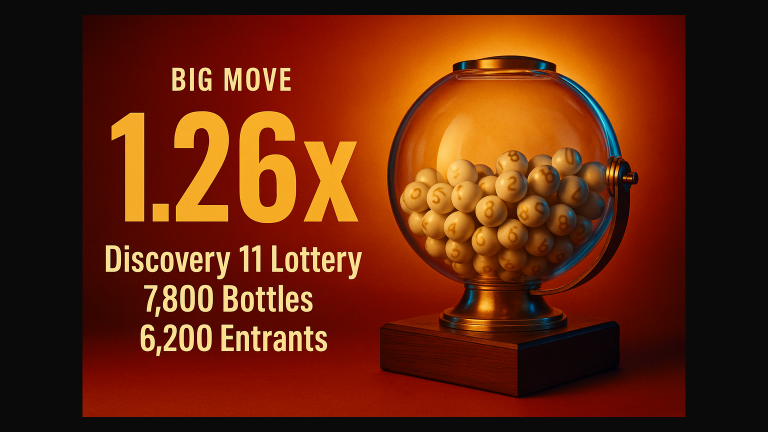
More bottles than entrants. Bardstown Bourbon Company opened the Discovery Series 11 distillery lottery Thursday morning, and the math is the headline — 7,800 bottles available against 6,200 first-day entrants. That’s a 1.26 ratio, meaning roughly four in five entrants will win an allocation if the pool holds through Sunday’s close. The 2024 lottery cleared…
This weekend Brent Elliott is at the Four Roses Lawrenceburg distillery walking through the decision that produced “Reunion” OBSV 2026. Four pours — OBSV at seven years, nine years, and eleven years plus — with the master distiller explaining the V-yeast maturation arc that made him hold the selection four years past the conventional window….
Today’s Sunday Cut opens with a four-day deadline most bourbon buyers will miss. Old Fitzgerald Bottled-in-Bond Fall 2026 is in pre-allocation at $79.99 through June 4 at participating Heaven Hill retail accounts. Eleven years, 100 proof, wheated mash bill, federally certified under all four conditions of the Bottled-in-Bond Act. Last spring’s allocation ran out before…
Wednesday morning, Heaven Hill put every number on paper. Elijah Craig Barrel Proof C926 — the third batch of the 2026 EC Barrel Proof calendar — locks in at $79.99 MSRP, 130.4 proof, fourteen years and two months average age, with a June 8 national ship date across all fifty states. Approximately thirty-two thousand bottles….