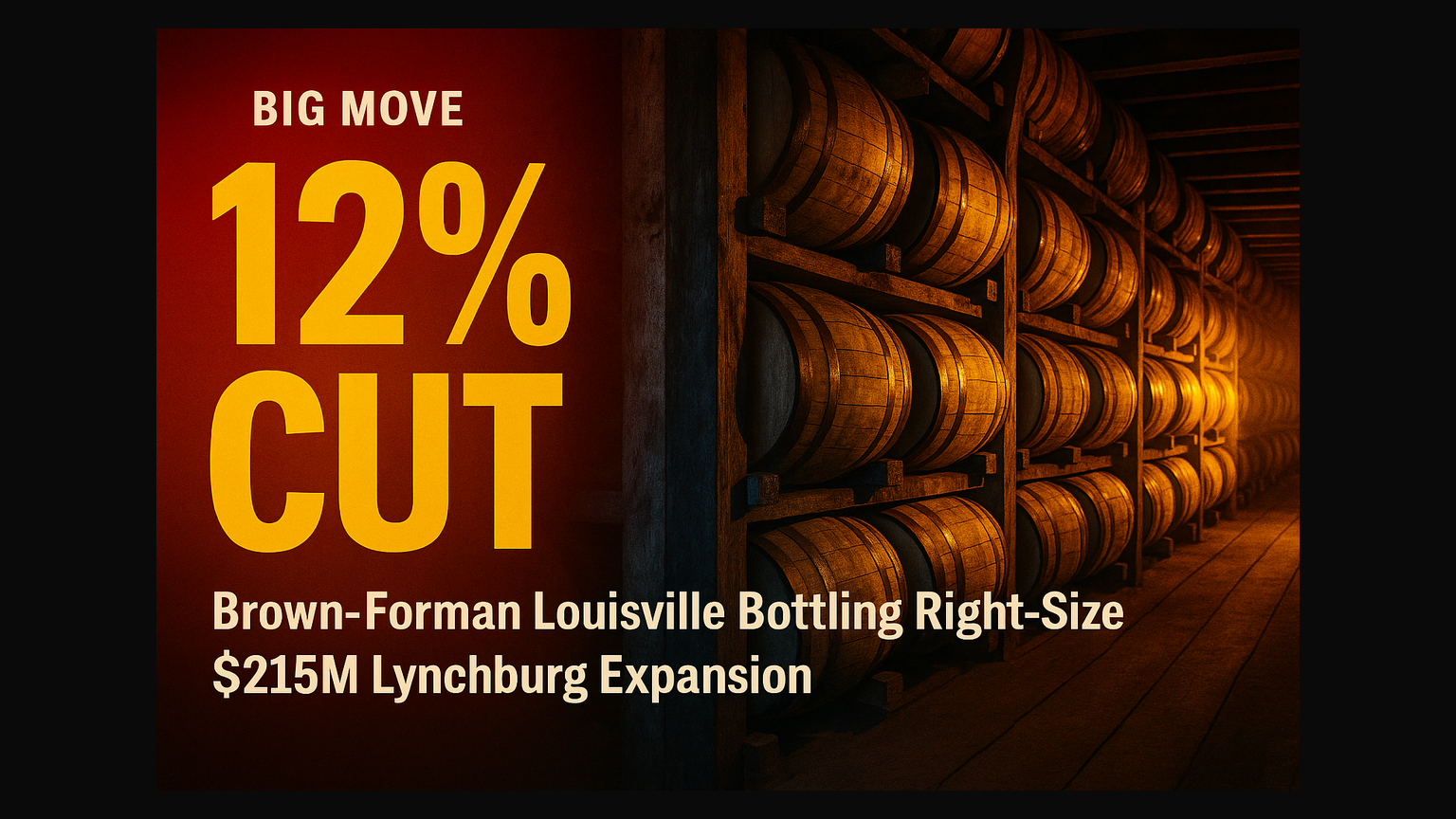
Brown-Forman Cuts Louisville While Expanding Lynchburg — The Cut
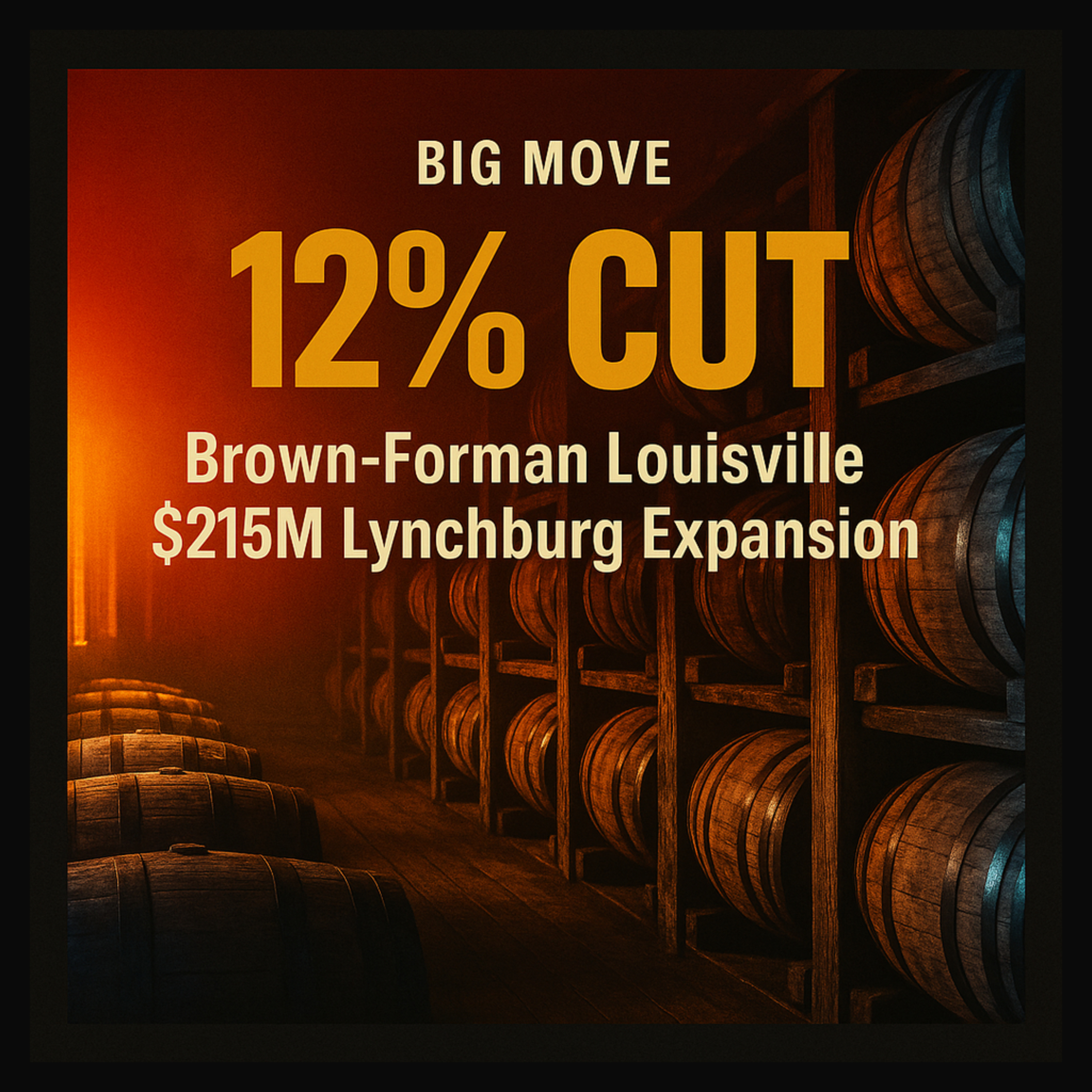
In this episode
▶ Listen to this episode on Spotify You’ve been told premiumization. They’re cutting volume. Brown-Forman published full Q4 fiscal 2026 earnings Friday morning, and three numbers tell the whole story — $215 million expanding the Jack Daniel’s Lynchburg distillery through 2028, a 12 percent right-size of Louisville bottling capacity against the 2024 baseline, and fiscal…
Mentioned in this episode: Buffalo Trace, William Larue Weller, Heaven Hill, Bardstown, Old Forester, Woodford Reserve, Stagg
Read the full transcript
Target runtime: 7:48 Word count: 1,198 Estimated runtime: 7:59 Source: The Cut Daily 2026-04-17
—
This is The Cut. American whiskey, daily.
You’ve been told premiumization. They’re cutting volume. Brown-Forman dropped Q4 fiscal 2026 earnings Friday — $215 million expanding Lynchburg through 2028, a 12 percent right-size of Louisville bottling, and a fiscal 2027 hold-the-line on bourbon volume. That’s the playbook now.
I’m John from Chasing the Unicorn Podcast. Here’s what moved today. April 17, 2026.
Today’s Big Move — Brown-Forman just made the new playbook explicit. Grow the premium tier, shrink the bottling tier, hold the bourbon line. Here’s what happened.
Brown-Forman published full Q4 fiscal 2026 earnings Friday morning. Three numbers do the work.
The first is $215 million. That’s the budget — through fiscal 2028 — for expanding the Jack Daniel’s distillery in Lynchburg, Tennessee. New fermentation capacity. Two new mash cookers. A third Lincoln County Process maple-charcoal vat. The expansion targets premium Jack Daniel’s expressions through the 2030s, not bulk volume.
The second is 12 percent. That’s how much Louisville bottling capacity is being right-sized against the 2024 baseline — roughly 90 affected positions absorbed through attrition and internal moves.
The third is the one most readers won’t see. Fiscal 2027 guidance holds bourbon-segment volume flat at fiscal 2026 levels. No expansion at the Old Forester or Woodford Reserve cooperage tiers. Continued investment behind the September 2026 Birthday Bourbon cycle.
Here’s what makes this matter beyond Brown-Forman’s own balance sheet. CEO Lawson Whiting called it structural production discipline calibrated to the post-overproduction reset. That’s plain English for — we made too much bourbon during the boom, the market has corrected, and we’re not adding to the glut. Beam Suntory idled Clermont this year. MGP right-sized Lawrenceburg. Heaven Hill is putting $200 million into aged-tier expansion. Brown-Forman just made the framework — grow the premium tier, shrink the bulk tier, hold the line in the middle — fully explicit and fully monetary.
For your shelf, nothing changes this month. What just got confirmed is that Old Forester and Woodford Reserve premium-tier supply is stable through 2027. Store picks at MSRP remain a buy. And the broader bourbon glut is being managed down, not added to. Which lines up with where today’s First Sip lands — because two of today’s biggest releases are leaning on the same technique.
Today’s First Sip — finishing. You’ll see it on the label of Lux Row’s Blood Oath Pact 12 with its Cognac-cask portion, and Buffalo Trace’s XC-28 with a toasted-stave finish at 16 years. Worth understanding what the term actually means.
So here’s what it is.
After primary aging is done, some bourbons get a second life in a different barrel — rum, port, sherry, cognac, Madeira, French oak. A few months, sometimes a few years, in the second vessel. That’s finishing.
What it’s not — it’s not just slapping a fancy cask on a tired bourbon. Done right, a finish layers something new on top of a bourbon that’s already good. The port adds berry and dark fruit. The rum adds tropical sweetness. The sherry adds dried fruit and a whiff of oxidation. The good ones integrate. You taste bourbon first, then the finish arrives as an echo.
Done wrong, the finish covers up a mediocre base. If all you taste is the cask, the distiller was hiding something.
Think of it like seasoning a steak. Good seasoning makes a good steak better. Heavy seasoning hides a bad cut. Same logic in the glass.
What this changes — taste through the finish. If you can still taste the bourbon, the cask earned its place. If all you get is port and grape, something’s being hidden. Speaking of — today’s Chase has the cleanest active allocation of the spring.
Today’s Chase — three bottles across three tiers. Let’s start with the one that matters most.
Lux Row Blood Oath Pact 12. The $80 to $200 tier. $129.99 standard ticket, $179.99 premium “Master Blender” ticket. 99.6 proof. Four-bourbon blend, Cognac-cask finished portion. The ticket-allocation cycle opened Friday at 9 a.m. Eastern. Entries close 11:59 p.m. Eastern Wednesday, April 22. Winners notified April 24. Distillery-direct event April 25 on the Lux Row campus in Bardstown.
Flavor direction — signature Pact profile. Caramel, baking spice, dried orchard fruit. The Cognac-cask finished portion adds dark fruit and confectionery sweetness on top of a high-rye-and-wheated four-bourbon blend. At 99.6 proof, it’s approachable. Water optional.
Here’s why it’s the spotlight. The Pact 12 ticket-allocation cycle is the highest-leverage active allocation event in the next eight days. The 3.9 standard-tier ratio means roughly one in four entrants wins. And the premium “Master Blender” ticket runs at 13.8 entrants per spot — but what it buys is a closed-door producer presentation that’s genuinely category-rare access. You don’t see this format from this tier of producer.
This is worth the chase. The action is simple. Register through the Lux Row distillery-direct portal by Wednesday night. If you win, pick up at the campus April 25.
Also on today’s Chase — Asheville Distilling Troy and Sons Heirloom Bourbon 8-Year at $79.99, an 8-year heritage-corn bourbon at mountain elevation, buy at MSRP through your North Carolina specialty retailer this week. And Buffalo Trace XC-28 toasted-stave 16-year at $250 for a 375 milliliter, distillery-direct walk-in only — worth watching, but secondary above $650 isn’t where the XC program historically settles. Full detail in today’s Cut Daily. If you want more, head to The Brief at chasingtheunicornpodcast.
Which brings us to today’s Bar Talk — and it’s the question Brown-Forman’s earnings just put on the table.
Today’s Bar Talk — Brown-Forman just expanded Lynchburg while cutting Louisville. Is the industry idle cycle over, or did it just get more specific? Community’s split on whether you can call this an idle cycle when half the headline numbers are expansion. Here’s what’s actually going on.
Quick vocabulary anchor. Tier-bifurcated capacity allocation. Sounds heavier than it is. A major distillery actually runs three tiers of production — premium expressions at long aging and low volume, mid-tier core line at steady volume, and bulk bottling for the brand’s biggest sellers. Each tier has its own capacity needs.
Here’s the math. Brown-Forman’s $215 million Lynchburg expansion targets premium Tennessee whiskey through the 2030s. The 12 percent Louisville cut is bulk bottling. Fiscal 2027 guidance holds bourbon-segment volume flat. Compare that to peers. Beam Suntory’s Clermont is a full-cessation idle. MGP right-sized Lawrenceburg in January. Heaven Hill is putting $200 million into 6-to-10-year aging tier expansion. The pattern is selective-tier expansion paired with bulk-tier discipline. Not pure capacity reduction.
Here’s what it means for the rest of us — Brown-Forman just made the playbook explicit. Grow the premium tier, shrink the bulk tier, hold the line in the middle.
One more for today — today’s full American Whiskey Industry Brief grades the William Larue Weller 2024 secondary print at $1,275. That’s 54.5 percent erosion from a $2,800 peak — and the deeper story is Stagg and Handy compressing within a single percentage point of it. The barrel-strength tier is moving as one unit now. It’s waiting at chasingtheunicornpodcast.com.
That’s The Cut. The full American Whiskey Industry Brief is waiting at chasingtheunicornpodcast.com/the-brief/. I’m John F. Schuster II. Thanks for joining me. Your unicorn is out there.
The Cut Daily
▶ Listen to this episode on Spotify
You’ve been told premiumization. They’re cutting volume. Brown-Forman published full Q4 fiscal 2026 earnings Friday morning, and three numbers tell the whole story — $215 million expanding the Jack Daniel’s Lynchburg distillery through 2028, a 12 percent right-size of Louisville bottling capacity against the 2024 baseline, and fiscal 2027 guidance that holds bourbon-segment volume flat. CEO Lawson Whiting called it structural production discipline calibrated to the post-overproduction reset. Beam Suntory idled Clermont. MGP right-sized Lawrenceburg. Heaven Hill is putting $200 million into aged-tier expansion. Brown-Forman just made the framework — grow the premium tier, shrink the bulk tier, hold the line in the middle — fully explicit and fully monetary. Today’s Cut also covers the Lux Row Blood Oath Pact 12 ticket-allocation cycle and the William Larue Weller 2024 secondary print at $1,275 (54.5% floor erosion). Listen to the full episode.Listen to this episode on Spotify, or find us wherever you get your podcasts.

Informational and entertainment purposes only. Nothing here is investment advice. Verify before buying, trading, or bidding. We are not liable for errors or financial losses.
You’ve been told premiumization. They’re cutting volume. Brown-Forman dropped Q4 fiscal 2026 earnings Friday — $215 million expanding Lynchburg through 2028, a 12 percent right-size of Louisville bottling, and a fiscal 2027 hold-the-line on bourbon volume. That’s the playbook now.
The biggest move in American whiskey this window is a single earnings release that makes the industry’s new playbook explicit. Brown-Forman published full Q4 fiscal 2026 results Friday morning, and three numbers tell the whole story — $215 million expanding the Jack Daniel’s Lynchburg distillery through 2028, a 12 percent right-sizing of Louisville bottling capacity against the 2024 baseline, and fiscal 2027 guidance that holds bourbon-segment volume flat. Today’s Cut also covers the Lux Row Blood Oath Pact 12 ticket-allocation cycle opening at 3.9 times entrants-per-bottle, the Bardstown Discovery Series 11 lottery compressing to 1.21x at the 36-hour mark, the TTB confirmation of Buffalo Trace XC-28 toasted-stave 16-year, and three Southeast craft releases landing the same day across Tennessee, Virginia, and North Carolina.
Brown-Forman published full Q4 fiscal 2026 earnings Friday morning. Three numbers do the work. The first is $215 million. That’s the budget — through fiscal 2028 — for expanding the Jack Daniel’s distillery in Lynchburg, Tennessee. New fermentation capacity. Two new mash cookers. A third Lincoln County Process maple-charcoal vat. The expansion targets premium Jack Daniel’s expressions through the 2030s, not bulk volume. The second number is 12 percent. That’s how much Louisville bottling capacity is being right-sized against the 2024 baseline — roughly 90 affected positions absorbed through attrition and internal moves. The third number is the one most readers won’t see. Fiscal 2027 guidance holds bourbon-segment volume flat at fiscal 2026 levels. No expansion at the Old Forester or Woodford Reserve cooperage tiers. Continued investment behind the September 2026 Birthday Bourbon cycle. Here’s what makes this disclosure matter beyond Brown-Forman’s own balance sheet. CEO Lawson Whiting called it “structural production discipline calibrated to the post-overproduction reset.” That’s plain English for: we made too much bourbon during the boom, the market has corrected, and we’re not adding to the glut. Beam Suntory idled Clermont this year. MGP right-sized Lawrenceburg. Heaven Hill is putting $200 million into aged-tier expansion. Brown-Forman just made the framework — grow the premium tier, shrink the bulk tier, hold the line in the middle — fully explicit and fully monetary.
Two of today’s biggest releases — Lux Row’s Blood Oath Pact 12 with a Cognac-cask finished portion, and Buffalo Trace’s XC-28 with a toasted-stave finish at 16 years — both lean on the same technique. It’s worth understanding what “finishing” actually means. After primary aging is done, some bourbons get a second life in a different barrel — rum, port, sherry, cognac, Madeira, French oak, Caribbean rum casks, Italian wine casks. A few months, sometimes a few years, in the second vessel. This is “finishing.” Done right, a finish layers something new on top of a bourbon that’s already good. The port adds berry and dark fruit. The rum adds tropical sweetness. The sherry adds dried fruit, nuts, and a whiff of oxidation. The good ones integrate — you taste bourbon first, then the finish arrives as an echo. Done wrong, a finish covers up a mediocre base whiskey. If the finish is the only thing you taste and the bourbon underneath is thin, the distiller was using the cask to hide something. Garrison Brothers Lady Bird is the current textbook case of finishing done right — the base bourbon is legitimate on its own, and the Cognac cask finish arrives as depth, not disguise. That’s the model. What this changes: Taste through the finish. If you can still taste the bourbon, the finish earned its place. If all you get is port and grape, something’s being hidden.
Floor erosion is how much a bottle’s market value has dropped from its all-time high. A 54.5 percent erosion reading means William Larue Weller 2024 is trading at about 46 cents on the dollar compared to what it went for at peak — and the bigger story is the company it’s keeping. WLW is the Buffalo Trace Antique Collection’s barrel-strength wheated bourbon, and Wednesday’s $1,275 hammer at Bonhams sits within $35 of the April 13 hammer at $1,310. That tight corridor matters because the same April 16 cycle priced George T. Stagg at 53.9 percent erosion and Thomas H. Handy Sazerac at 54.6 percent. Three different mashbills — wheated bourbon, low-rye bourbon, straight rye — all compressing within a single percentage point of each other. The BTAC barrel-strength tier is now moving as one unit, not as three separate stories.
The Hunt: 5 active drops · Bar Talk: 2 debates · The Secondary: 3 graded bottles
◆ The Brief (free): https://chasingtheunicornpodcast.com/the-brief/
◆ Listen on Spotify: https://open.spotify.com/show/56Lt67gvTPjifCyeqFW3IT
◆ YouTube: https://www.youtube.com/@chasingtheunicornpodcast
Want the full picture? The complete American Whiskey Industry Brief — every section, every source, every story — is published free every morning at chasingtheunicornpodcast.com. Read it at chasingtheunicornpodcast.com/the-brief/.