New Riff Just Turned Eight Years Old — The Cut — S02E86

In this episode
{“@context”:”https://schema.org”,”@type”:”PodcastEpisode”,”name”:”New Riff Just Turned Eight Years Old — The Cut — S02E86″,”description”:”The biggest bourbon news this window is a federal approval, not a corporate deal. New Riff Distilling just cleared TTB approval for its
Mentioned in this episode: Buffalo Trace, William Larue Weller, Wild Turkey, Heaven Hill, Four Roses, New Riff
Read the full transcript
Feature: The Label Room Word count: 885
This is The Cut. American whiskey, daily.
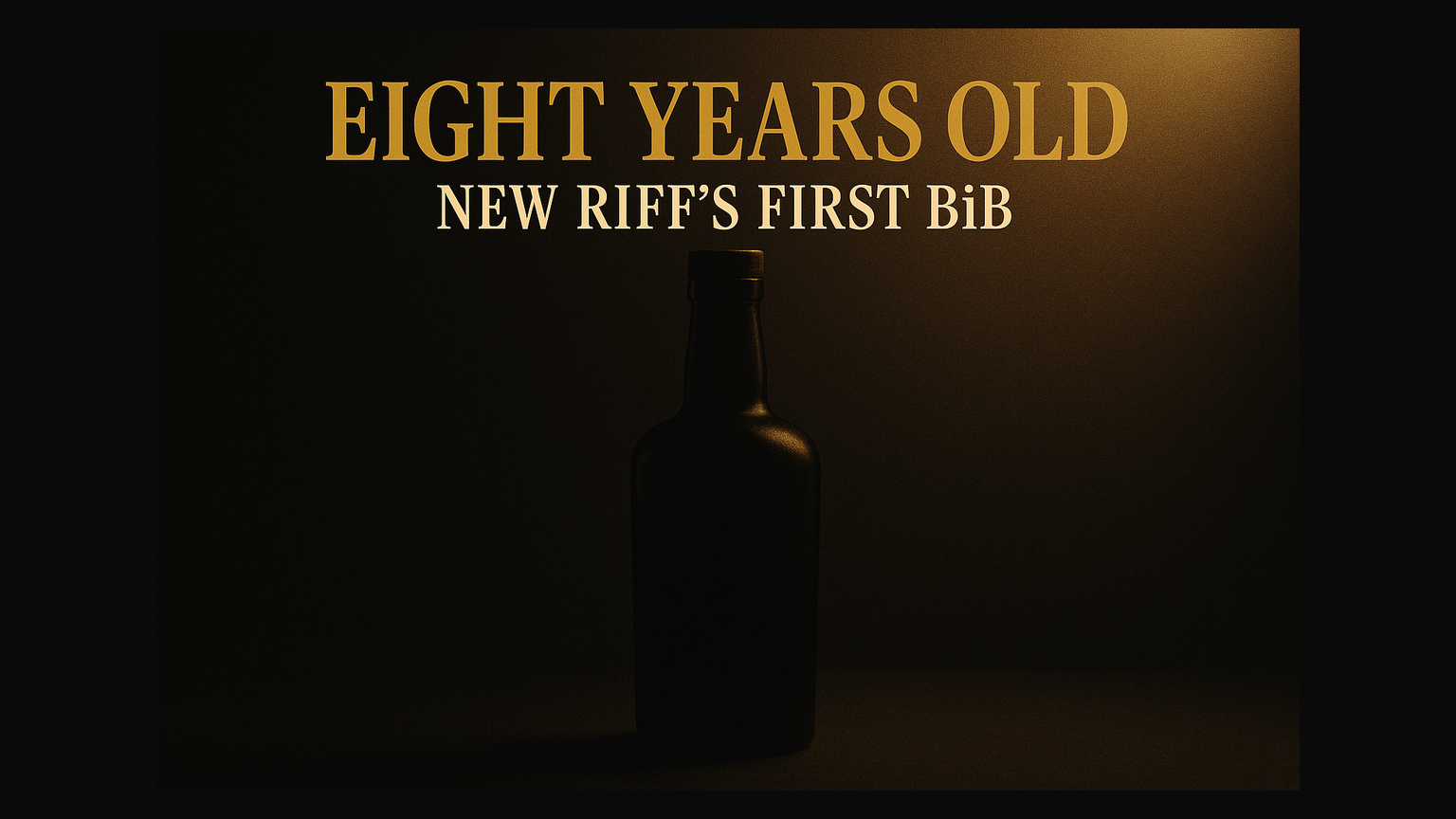
New Riff just cleared federal paperwork for an eight-year Bottled-in-Bond — the first age statement in the brand’s history that can stand next to the legacy houses instead of arguing it shouldn’t have to. It ships to Kentucky and Ohio shelves by Friday. But that’s not the only label that moved paper this week, and one of the others is worth your attention too.
I’m John from Chasing the Unicorn Podcast. Here’s what moved today. July 21, 2026.
Let’s start with New Riff, because it’s the biggest single piece of news in the window. The distillery cleared TTB approval on July 17 for its first Bottled-in-Bond carrying a full eight-year age statement — a jump from the four-to-five-year range that’s defined the line since 2020. Co-founder Ken Lewis put it plainly: this is the first bottle where New Riff’s age can go head to head with Heaven Hill and Four Roses instead of leaning on transparency alone.
And that’s the part I want you to sit with. New Riff built its whole reputation on disclosure — published mash bills, published state of distillation, no mystery. For a decade, “young but honest” was the pitch. Now the distillate from 2014 has finally caught up in years, and the pitch changes. It’s bottled at the mandatory hundred proof, drawn from a single rickhouse floor, and the distillery says it’s limited but not allocated — no lottery, no per-account cap. If you’re in Kentucky or Ohio, this is a real bottle by Friday. Just a trip to the store.
Now, today’s Label Room. This is where a bottle gets its federal paperwork before it ever reaches a shelf — and this week, one filing stood out for a reason that has nothing to do with age.
Wild Turkey’s next Rare Breed Barrel Proof batch cleared approval at 118.6 proof. That’s nearly two full points above the last batch’s 116.8, and it’s the sharpest single-batch proof jump this label has seen in three years. Rare Breed doesn’t carry a fixed age statement — it’s blended to hit a flavor target, not a number — so a proof swing like this is really the only signal you get about what changed behind the scenes.
Here’s what changed. Wild Turkey just finished a capacity expansion at its Lawrenceburg facility, and master distiller Eddie Russell has said that expansion frees up barrel selection that used to be pinched by tighter production. Translation: they had more barrels to choose from, so they picked stronger ones. And the price didn’t move. Sixty dollars, same as it’s always been, for noticeably more whiskey in the glass.
That’s the kind of reveal I like — not a new label with a marketing story attached, but hard evidence that a company’s production decisions are already paying off for the person buying the bottle. Watch the next batch. If the proof keeps climbing, that confirms the expansion is durably changing how Wild Turkey selects barrels, not just a one-time pull from deeper in the warehouse.
So here’s what it is. Most bourbon gets chill filtered before bottling — cooled down and run through a filter that strips out oils and esters that would otherwise cloud the whiskey when it’s cold or on ice. It makes the bottle look clean on a shelf. The tradeoff is those oils carry some of the richest aromatic compounds in the whiskey. Skip that step, and you get haze in a cold pour — that’s not a flaw, that’s the whiskey working the way it’s supposed to.
The TTB just closed a loophole on this. As of this week, a bourbon can’t call itself non-chill filtered if any part of the batch was filtered at any stage — including partial filtration some brands were apparently blending in and labeling around. What this changes — cloudiness in your glass isn’t a problem anymore. After this ruling, it’s proof the label’s telling the truth.
While we’re talking about what’s worth chasing — North Carolina’s ABC just opened its William Larue Weller lottery today, and it’s a clean entry window running through July 27. This is one of the five annual Buffalo Trace Antique Collection releases, and it’s historically the strongest of the five on secondary — recent vintages have traded between fourteen hundred and sixteen fifty against a MSRP of $119.99. Free to enter, no purchase required until you win. If you’ve been sitting out lottery season because the odds usually feel hopeless, this is the one where the math actually favors showing up. Put your name in before Monday and forget about it.
So here’s the one thing to take from all of this. A distillery’s paperwork this week told you more than its marketing ever could — New Riff’s age statement, Wild Turkey’s proof jump, the non-chill-filtered ruling. None of that was a press release dressed up as news. It was documentation catching up to what these companies were already doing quietly. That’s usually the more reliable signal. Watch the filings, not the announcements, and you’ll see the next good bottle coming before anyone puts a bow on it.
That’s The Cut. The full American Whiskey Industry Brief is free every morning at chasingtheunicornpodcast.com. I’m John Schuster. Thanks for joining me. Your unicorn is out there.
The Cut Daily
Listen to today’s episode and find us on Spotify and everywhere you listen at chasingtheunicornpodcast.com/podcast.

Informational and entertainment purposes only. Nothing here is investment advice. Verify before buying, trading, or bidding. We are not liable for errors or financial losses.
New Riff just turned eight years old. The Newport, Kentucky distillery cleared federal approval for its first 8-year Bottled-in-Bond, shipping to Kentucky and Ohio retailers by Friday — the first time its age statement can go toe-to-toe with the legacy houses.
The biggest bourbon news this window is a federal approval, not a corporate deal. New Riff just cleared TTB paperwork for its first 8-year Bottled-in-Bond, and it’s hitting shelves this week — unallocated, first-come, no lottery. That matters because it’s the first time this transparency-first distillery has had the age to match brands that have been doing this since before New Riff existed. Today’s edition also covers a Texas direct-shipping win for craft distilleries, a tightened federal rule on “non-chill filtered” labeling, and a fresh Buffalo Trace-family single barrel pick — plus the Chase, a Bar Talk debate on Texas’s new law, and a First Sip lesson on what “non-chill filtered” actually means.
New Riff just hit a milestone it couldn’t have hit at launch. The Newport, Kentucky distillery cleared federal approval on July 17 for its first Bottled-in-Bond carrying a full eight-year age statement — a jump from the four-to-five-year range that’s defined the line since 2020. Co-founder Ken Lewis called it the first bottle where the age statement is actually competitive with the legacy Kentucky houses. That’s a real shift. New Riff built its reputation on transparency — published mash bills, published state of distillation — not on age. Now it has both. The release is bottled at the mandatory 100 proof, drawn from a single rickhouse floor, and the distillery says it’s limited but not allocated — no lottery, no per-account cap. It ships to Kentucky and Ohio retailers by Friday. Industry watchers are calling this the moment the 2014-15 wave of craft distilleries proves it’s old enough to compete on age, not just honesty. For a decade, “young but transparent” was the pitch. Now there’s an age statement to back it up.
Today’s TTB news is about a phrase you’ve probably seen on a label without knowing what it actually promises. Most bourbon goes through chill filtration before bottling — the whiskey is cooled to near-freezing and filtered to strip out certain oils and esters that can make it look cloudy when it’s cold or on ice. That makes the bottle look clean on a shelf. The trade-off is flavor: those oils carry some of the richest aromatic compounds in the whiskey. “Non-chill filtered” means the distillery skipped that step. You might see haze in a cold pour — that’s not a flaw, that’s the whiskey working. The TTB just ruled that a bourbon can’t call itself non-chill filtered if any part of the batch was filtered at any stage, closing a loophole some brands were reportedly using. New Riff, whose 8-year BiB is today’s Big Move, has built its whole reputation on exactly this kind of production transparency. What this changes: Cloudiness in your cold-pour bourbon isn’t a problem — it’s information. And after today’s ruling, the words “non-chill filtered” on a label mean more than they used to.
Floor erosion is how far a bottle’s resale value has dropped from its all-time high. This 2024 release peaked at $210 back in November 2024 and now trades around $145 — a 31% drop. The timing lines up with today’s news: Heaven Hill just confirmed its fall 2026 batch carries the same clean, unblended 18-year age statement, which tells collectors supply confidence is intact and the scarcity premium on the older batch isn’t holding.
Rickhouse Report: 5 stories · Regional Report: 3 stories
◆ The Brief (free): https://chasingtheunicornpodcast.com/the-brief/
◆ Listen on Spotify: https://open.spotify.com/show/1IZS2wXY7nAUcL9akukblE
◆ YouTube: https://www.youtube.com/@chasingtheunicornpodcast
Want the full picture? The complete American Whiskey Industry Brief — every section, every source, every story — is published free every morning at chasingtheunicornpodcast.com. Read it at chasingtheunicornpodcast.com/the-brief/.
Chasing a specific bottle? The Bourbon Release Calendar lists every lottery deadline, walk-up window and MSRP we’re tracking — updated every morning.