August 20, 2026
Is This $100 Pappy Van Winkle Raffle Actually Legit?
Or subscribe where you already listen
New episode every weekday morning. The Cut Weekend lands Saturday and Sunday.
Read the full transcript
This is The Cut. American whiskey, daily.
A charity in Lexington is giving away six bottles of Pappy Van Winkle for a hundred bucks a ticket — and less than ten percent of the field has sold. That's not a typo. That's just math nobody's taken advantage of yet.
I'm John from Chasing the Unicorn Podcast. Here's what moved today. August 20, 2026.
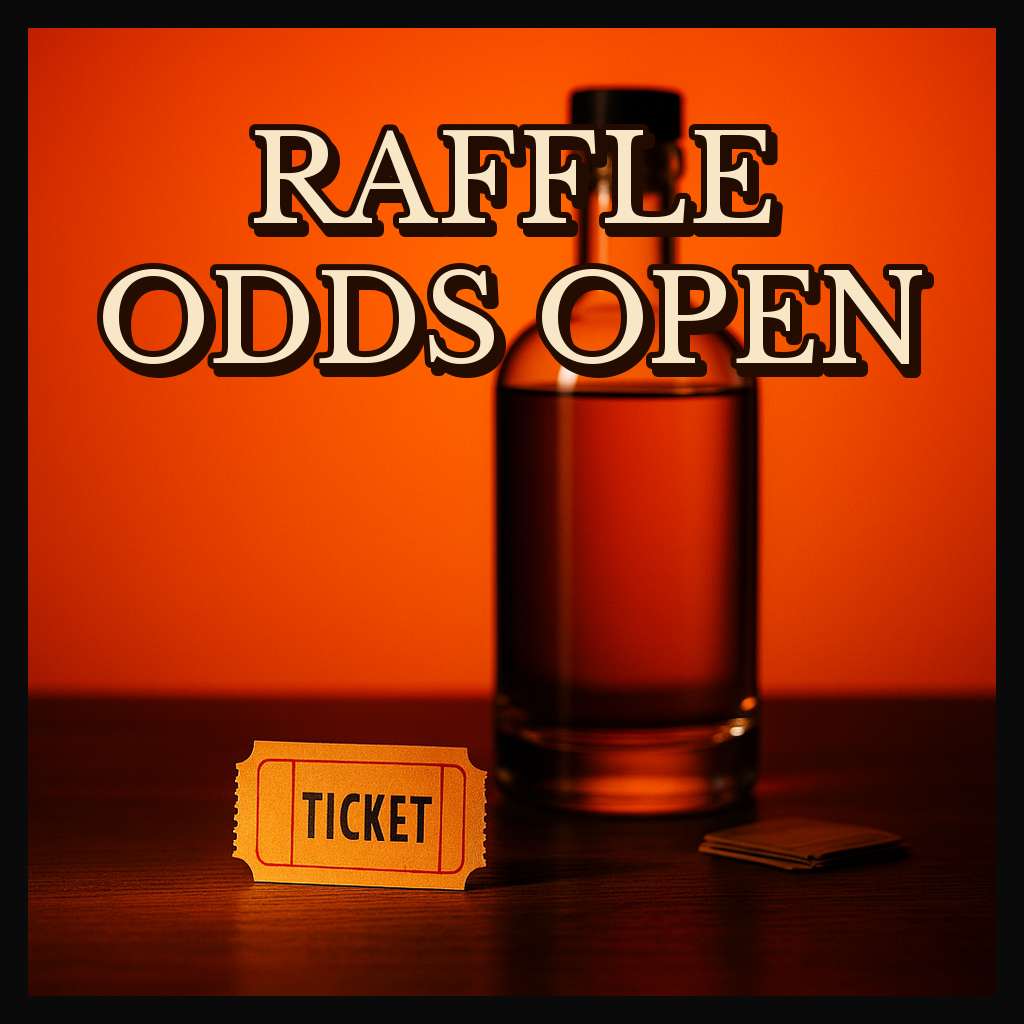
Today's Big Move is that raffle, and it's worth slowing down on, because most allocated-bottle access runs through odds nobody can calculate. Commonwealth Causes, a Kentucky nonprofit, capped its Ultimate Bourbon Collection Raffle at fifteen hundred tickets, a hundred dollars each. As of this week, a hundred and thirty had sold. Under ten percent, this close to the finish line, with the drawing set for August 27.
The grand prize is a full six-bottle Pappy Van Winkle set. But that's not the whole ticket. Four more prize packages ride along with it — a Buffalo Trace Double Eagle Very Rare, a six-bottle William Larue Weller vertical, an eight-bottle Blanton's letter set, and a single Elmer T. Lee. One ticket, five separate shots at bourbon most drinkers will never see on a shelf at any price.
Compare that to a typical distributor lottery, where the odds are a black box and the prize is usually one bottle. Here the ticket count is public, the cap is fixed, and the field genuinely hasn't filled up. Proceeds go to youth and community programs through the Lexington Sporting Club Foundation, so even the ticket you don't win does something. Nothing on your shelf changes this week. But a hundred dollars buys real odds at bourbon you can't buy at any price at retail.
Now — today's stop On the Road. It isn't just Kentucky doing something worth watching this week. Three very different corners of the country moved, and none of them look like each other.
Start in Iowa. Cedar Ridge Distillery just became the official bourbon of Hawkeye Athletics — the first spirits partnership the University of Iowa has ever signed. They launched a line called 1847, named for the year the university was founded, and it's already pouring in the premium club areas at Kinnick Stadium. Cedar Ridge isn't some outside brand buying its way onto a scoreboard, either — it's Iowa's own, the state's first licensed distillery since Prohibition, and its Original 86 has been the top-selling bourbon in Iowa for a while now. What this really is: a state's best-selling bourbon getting put in front of a stadium full of people who'd never otherwise walk into its tasting room. That's a distribution win most craft distilleries spend a decade chasing and never get.
Then there's the Hudson Valley, in New York. A husband-and-wife team bought a two-hundred-twenty-acre former sheep farm back in 2020 and turned it into a rye distillery — but the twist is, they grow most of their own grain. About seventy percent of what goes into the still is raised right there, on the same dirt, under regenerative farming practices. Their flagship rye runs three years old, eighty-eight dollars a bottle. That's an honest farm-to-bottle claim, not a label with a nice illustration on it. Vertical integration like that is rare even among craft producers who build their whole pitch around provenance.
And out in Los Angeles — of all places — a brand called Filmland Spirits is dropping a horror-movie-themed American Single Malt called The Malted Mummy. Five years old, finished in beer barrels sourced from an Iowa brewery, then aged out in Kentucky. It debuts next week at a festival before landing in nineteen states. The category it's chasing is the fastest-growing corner of the whiskey shelf right now — American Single Malt was worth over eight hundred million dollars last year and is on pace to nearly double by the mid-2030s. A novelty label riding a real growth curve, built on a genuinely odd supply chain. That's the bet.
Three regions, three completely different playbooks — a sports sponsorship, a working farm, and a beer-barrel horror bottle. None of them needed a lottery or an allocation list to matter. That's the story On the Road is actually telling this week: growth in this category isn't only happening behind a velvet rope in Kentucky.
Now, quick First Sip. So here's what it is. "Allocated" describes how a bottle gets distributed — not how good it is. Allocated bourbons are made in limited quantities where demand outpaces supply, so distributors ration them out to retailers in small numbers. Pappy, Buffalo Trace Antique Collection, Weller, Blanton's — allocated because production is genuinely constrained, not because a marketing team decided to call them rare. You can tell a bottle is really allocated when it moves through a lottery or a wait list, when the price varies wildly by state, and when the secondary market pays multiples of the sticker. Today's raffle is a clean example from the outside — five genuinely hard-to-find prize tiers, moved through a public, fixed ticket count instead of a black box. What this changes — next time you hear "allocated," don't assume it means better. It just means scarcer, and scarcer is only worth chasing when the bottle underneath actually earns it. And if you're logging pours in the Perfect Pour app, put an allocated bottle next to a regular release in your Logbook sometime — it's available now at theperfectpourapp.com, and it's a good way to see how differently the two actually show up on your Pour Print.
One to grab this week. Bardstown Bourbon Company's 2026 Discovery hits shelves nationwide starting tomorrow, at a hundred thirty-nine ninety-nine. It's a blend of seven, ten, and eleven-year-old bourbons, finished four months in custom Garryana oak out of Oregon, bottled hot at a hundred twelve point eight proof. What makes it worth flagging is the timing — Bardstown released it the same day, at the exact same price, as its Scotch-cask sibling, Lochs of Jura. That's a genuine same-week comparison, not a marketing pair dressed up to look like one. If you're the kind of drinker who likes to taste two decisions side by side instead of guessing, this is the week to do it. Grab a bottle, and if you can find its sibling too, do the flight yourself.
So here's the one thing to take with you today. The bottles worth chasing this week didn't all come from a warehouse in Kentucky — they came from a stadium sponsorship in Iowa, a sheep farm in New York, and a beer barrel in Iowa that ended up in Kentucky anyway. The map is wider than the allocation list. Keep your eyes on all of it.
That's The Cut. The full American Whiskey Industry Brief is free every morning at chasingtheunicornpodcast.com. I'm John Schuster. Thanks for joining me. Your unicorn is out there.
Listen to today's episode and find us on Spotify and everywhere you listen at chasingtheunicornpodcast.com/episodes.
Informational and entertainment purposes only. Nothing here is investment advice. Verify before buying, trading, or bidding. We are not liable for errors or financial losses.
Six bottles of Pappy. One hundred bucks. A $100 raffle ticket for six bottles of Pappy Van Winkle just opened — and with only 130 of 1,500 entries sold, the odds are still genuinely good.
A Kentucky charity raffle is offering a six-bottle Pappy Van Winkle set, a Buffalo Trace Double Eagle Very Rare, a Weller vertical, and a Blanton's letter set — all for a $100 ticket, with less than 10% of the field sold so far. That matters because most allocated-bottle access runs through odds nobody can calculate; this one you can actually do the math on. Today's edition also covers Maker's Mark's oldest cask-strength cellar release yet, a paused tariff that leaves the real export problem untouched, and a rare same-price Bardstown Bourbon comparison.
A Kentucky nonprofit is running a bourbon raffle where the math actually favors you. Commonwealth Causes capped its Ultimate Bourbon Collection Raffle at 1,500 tickets, $100 each. As of this week, only 130 had sold. That's under 10% of the field, this close to the finish line. The grand prize is a full six-bottle Pappy Van Winkle set. Four more prize packages ride on the same $100 ticket: a Buffalo Trace Double Eagle Very Rare bottle, a six-bottle William Larue Weller vertical, an eight-bottle Blanton's letter set, and a single Elmer T. Lee. That's five separate shots at bourbon most drinkers will never see on a shelf, from one ticket. The drawing lands August 27 at 8 p.m. Eastern. The raffle runs under Kentucky Charitable Gaming License #ORG0002761, and proceeds go to the Lexington Sporting Club Foundation's education, youth development, and community programs. Compare that to a typical distributor lottery, where the odds are a black box and the prize is usually one bottle, not five. Here, the ticket count is public, the cap is fixed, and the field genuinely hasn't filled up. That's rare.
"Allocated" describes how a bottle gets distributed — not how good it is. Allocated bourbons are made in limited quantities where demand outpaces supply, so distributors ration them out to retailers in small numbers. Pappy Van Winkle, Buffalo Trace Antique Collection, Weller, Blanton's — these are allocated because their production is genuinely constrained, not because a marketing team decided to call them "rare." You can tell a bottle is really allocated when it shows up through a lottery or wait list, when the retail price varies wildly by state, and when the secondary market pays multiples of the sticker price. Today's raffle is a useful example of what allocation actually looks like from the outside: five prize tiers, all genuinely hard to find at retail, distributed through a mechanism with a public, fixed ticket count instead of a black-box lottery. What this changes: next time you hear "allocated," don't assume it means better. It just means scarcer — and scarcer is worth chasing only when the bottle underneath earns it.
Floor erosion is how much a bottle's market value has dropped from its all-time high. A 36.9% erosion means this Eagle Rare 17 is now trading for well under two-thirds of what it commanded in 2023. It's still selling far above its roughly $99 MSRP, but the gap has been shrinking steadily, tracking a broader correction across the mid-tier of Buffalo Trace's Antique Collection.
Rickhouse Report: 5 stories · Regional Report: 3 stories
◆ The Brief (free): https://chasingtheunicornpodcast.com/the-brief/
◆ Listen on Apple Podcasts: https://podcasts.apple.com/us/podcast/chasing-the-unicorn-bourbon-american-whiskey/id6788592653
◆ Listen on Spotify: https://open.spotify.com/show/1IZS2wXY7nAUcL9akukblE
◆ YouTube: https://www.youtube.com/@chasingtheunicornpodcast
Want the full picture? The complete American Whiskey Industry Brief — every section, every source, every story — is published free every morning at chasingtheunicornpodcast.com. Read it at chasingtheunicornpodcast.com/the-brief/.
Chasing a specific bottle? The Bourbon Release Calendar lists every lottery deadline, walk-up window and MSRP we're tracking — updated every morning.
Mentioned in this episode: Buffalo Trace, Eagle Rare, William Larue Weller, Pappy Van Winkle, Bardstown, Maker's Mark, Blanton's, Old Grand-Dad, Sazerac, BTAC