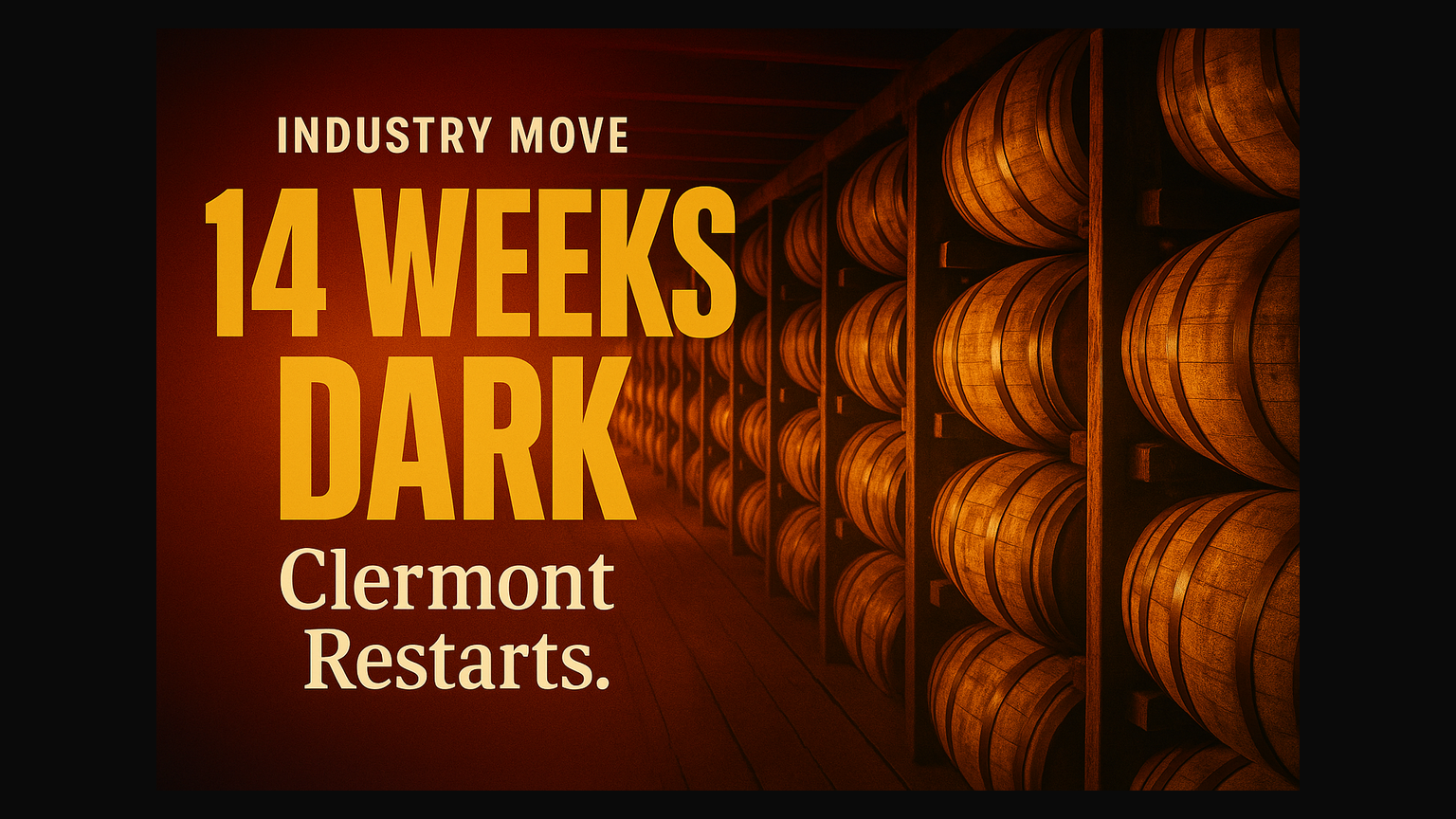
The Cut — June 1, 2026 — Beam’s Clermont Distillery Restarts: 14 Weeks Dark and What It Means for Bourbon Through 2035
In this episode
Monday’s Cut opens with the most consequential production decision in American bourbon this year. Beam Suntory’s Clermont, Kentucky distillery — source of Knob Creek, Booker’s, Baker’s, and Jim Beam — resumed full distillation this morning after a 14-week production pause. The barrels entering the rickhouse today won’t reach your shelf for nine years. Knob Creek’s…
Mentioned in this episode: Wild Turkey, Heaven Hill, Old Fitzgerald, Parker’s Heritage, Jim Beam, Booker’s, Knob Creek, Woodford Reserve
Read the full transcript
This is The Cut.
Warm caramel on the nose, soft stone fruit and almond cream on the palate, a finish that rounds out slow past the thirty-second mark. That’s eleven years of wheated bourbon aging — and a bottle of it sits at $79.99 with a pre-allocation window that closes in four days.
I’m John from Chasing the Unicorn Podcast. Here’s what we’re going after today. June 1, 2026.
Here’s where we want to end up. Old Fitzgerald Bottled-in-Bond Fall 2026 at MSRP — wheated Heaven Hill, eleven years, 100 proof — before the pre-allocation queue closes June 4 and walk-in pricing takes over.
Here’s what makes it tricky. Pre-allocation isn’t a lottery. It’s a queue — first in, bottle at MSRP. But accounts don’t advertise it loud, the window is short, and most buyers find out after it closes. Last cycle, Old Fitzgerald BiB came out of pre-allocation and hit walk-in retail at $95 to $110. The window is the only thing that changed.
Here’s the move. Go to Seelbach’s, Liquor Barn, or Total Wine — whichever ships to your state — search Old Fitzgerald BiB Fall 2026, and get in the pre-allocation queue before June 4.
Today’s lead industry story: Beam Suntory’s Clermont distillery restarted full operations this morning after fourteen weeks down. Clermont makes Knob Creek, Booker’s, Baker’s, and Jim Beam. The barrels going in today become 2035 shelf bottles — Knob Creek’s nine-year age statement means today’s new-make won’t hit retail until 2034. This is the supply-side math bourbon runs on. What gets made now, you buy a decade from now.
That’s the context behind Old Fitzgerald BiB at $79.99 this week. Heaven Hill’s been running its own version of supply discipline. Eleven-year-old wheated bourbon at this price is getting harder to source — not because production stopped, but because mature inventory is aging out of the rickhouses faster than the newer distillate can replace it. Two things you’re paying for here: grain and time. Wheat instead of rye gives you that soft, rounded finish from the hook — the sweetness without the rye spike. Eleven years deepens the caramel layer and extends the warmth on the back end. At $79.99, that’s a decade of warehouse work without a lottery.
Old Fitzgerald Bottled-in-Bond Fall 2026 is the Chase Spotlight this week. Eleven years, 100 proof, wheated Heaven Hill. Pre-allocation closes June 4. This is worth the chase.
Also on the list: Parker’s Heritage Collection 2026 Bottled-in-Bond at $99.99 — high-rye, ten-year minimum age, ships June 7 to pre-order accounts, inside the Father’s Day window for buyers who reserve before that date. No true two-hundred-dollar-plus release worth chasing this week — sometimes the high end is quiet, and that’s fine. Full read is in today’s Cut Daily on our website. Free.
A word of caution on pre-allocation windows. They’re real, but they’re not guarantees. Some accounts sell through before the stated close date. Some allocations run smaller than the queue. The downside of missing this one is $15 to $30 more for the same bottle in August — that’s the full cost of being wrong. Get in the queue, move on, and decide later whether the markup is worth paying. The price of being wrong matters as much as the odds of being right. Here, the downside is modest. Plan accordingly.
Today’s full American Whiskey Industry Brief on Patreon has the complete Flight — Garrison Brothers Cowboy Bourbon 2026 at $149.99 against Wild Turkey Master’s Keep Triumph 2026 at $199.99. Same gifting occasion, opposite production philosophies: Texas Hill Country climate-accelerated aging at six to seven years versus seventeen years of Kentucky season cycling. Which one earns the $50 premium for the recipient who will actually open it? The Father’s Day gifting verdict is in the Flight. Also in the Brief: Brown-Forman’s FY2026 annual results — Jack Daniel’s family volume down 4.7%, Woodford Reserve flat for the first time since 2017, and what their confirmed production restraint means for the 2029 to 2031 age-statement pipeline.
That’s The Cut. The full American Whiskey Industry Brief is at patreon.com/ChasingTheUnicornPodcast. I’m John Schuster. Thanks for joining me. Your unicorn is out there.
The Cut Daily
Listen to today’s episode and find us on Spotify and everywhere you listen at chasingtheunicornpodcast.com/podcast.

Informational and entertainment purposes only. Nothing here is investment advice. Verify before buying, trading, or bidding. We are not liable for errors or financial losses.
Fourteen weeks dark. One decision. Beam Suntory’s Clermont distillery — the largest bourbon campus in the world — resumed full operations this morning after a deliberate 14-week production pause. Every barrel going in today becomes Knob Creek in 2035.
The biggest production decision in American bourbon this year just resolved — Beam Suntory’s Clermont, Kentucky distillery restarted full operations this morning, closing the supply-discipline chapter that opened in February and locking the forward production calendar for Knob Creek, Booker’s, and Jim Beam through 2035. In the same 72-hour window, two live Father’s Day reserve access windows opened — Garrison Brothers Cowboy Bourbon 2026 at $149.99 and Old Forester Birthday Bourbon 2026 with a confirmed September ship date — and a Knob Creek 15-Year Single Barrel COLA at 120 proof landed in the TTB pipeline. Today’s Cut Daily covers the restart, the Father’s Day access windows worth acting on this week, and a First Sip on why production pauses and restarts follow patterns bourbon drinkers can learn to read before the consequences hit their shelf.
Beam Suntory’s Jim Beam Distillery in Clermont, Kentucky resumed full distillation this morning after 14 weeks down. That’s the most consequential production decision in American whiskey in the first half of 2026 — and almost none of it affects what’s on your shelf this week.
Here’s what actually matters: the bourbon entering barrels today won’t reach your shelf for nine years. Knob Creek’s 9-Year age statement means June 2026 new-make becomes a 2035 shelf bottle. The Knob Creek 15-Year single barrel COLA filed last week draws from barrels distilled in 2011 or earlier — the last of the pre-demand-boom lean-production era at this maturity level. The restart doesn’t change this week’s buying options. It sets the production calendar for 2034 and 2035.
Clermont is the source for Jim Beam White Label, Knob Creek, Booker’s, and Baker’s. When this distillery runs, Beam’s full premium tier is being built. When it’s down, that pipeline runs leaner by exactly as long as the pause lasted.
Beam framed the 14-week pause as deliberate supply discipline — not a demand problem, not a facility issue. Inventory levels were running above their forward-demand model threshold. They were also optimizing under Kentucky’s new barrel inventory tax phase-out, which started in January and reduces the cost of barrels already aging without requiring new production. A financially rational, well-timed pause.
One consequence is immediate: a confirmed restart closes the scarcity argument that had been supporting secondary floors on current Knob Creek and Booker’s positions since February.
Bourbon runs on roughly seven-year boom-and-bust cycles. Knowing where we are in the current one explains today’s news — and tells you when to buy.
The shorthand: high demand drives distilleries to overproduce. That overproduction creates a glut. Prices soften. Distilleries idle or cut back. Supply tightens again. Prices firm. Demand builds. Repeat.
We are in the correction phase right now. The 2020–2023 pandemic era drove a demand boom that pushed distilleries to produce more whiskey than the market could absorb. That overproduction is working through the system — mid-tier secondary prices have compressed 30–50% from their 2022 peaks. Meanwhile, the largest producers have deliberately reduced output. The Kentucky Distillers’ Association confirmed an 11.3% year-over-year proof-gallon decline through April 2026 across its membership. That is not a market crisis. That is supply discipline working.
Today’s Clermont restart is a pivot point inside that cycle. Beam held production back for 14 weeks. Now the facility is back on. The barrels filling Clermont’s rickhouses this morning won’t clear Knob Creek’s nine-year age statement until 2035. The production gap that just closed will show up as relative tightness in the 9-year tier starting in 2034.
What this changes: the supply situation you face buying bourbon in 2034 is partly determined by production decisions being made right now. Today’s restart is one of those decisions. You just watched it happen in real time.
Floor erosion is how far a bottle’s auction price has dropped from its all-time high. George T. Stagg’s 2025 release closed Saturday’s Unicorn Auctions session at $720 — the lowest realized price for a current-release Stagg at a major American auction since Spring 2021. At 56.4% below its 2023 peak, the bottle is now selling for less than half what it fetched at maximum. Two forces are compressing the floor simultaneously: BTAC 2025 allocation counts increased modestly versus 2024, adding supply; and collectors are exiting mid-tier secondary positions ahead of fall re-allocation windows as the broader correction migrates upward into blue-chip expressions. Today’s Clermont restart adds a third pressure: a confirmed production restart at the industry’s largest distillery closes the near-term scarcity narrative that had been supporting secondary floors on allocated expressions across the category. When the supply-discipline argument closes, the secondary positions built on that argument soften.
Rickhouse Report: 5 stories · Regional Report: 3 stories
◆ Full AWIB (Paid Patreon Subscriber): https://www.patreon.com/c/ChasingTheUnicornPodcast
◆ Listen on Spotify: https://open.spotify.com/show/56Lt67gvTPjifCyeqFW3IT
◆ YouTube: https://www.youtube.com/@chasingtheunicornpodcast
Want the full picture? The complete American Whiskey Industry Brief — every section, every source, every story — is published daily for subscribers on Patreon. Join us at patreon.com/ChasingTheUnicornPodcast.