August 26, 2026
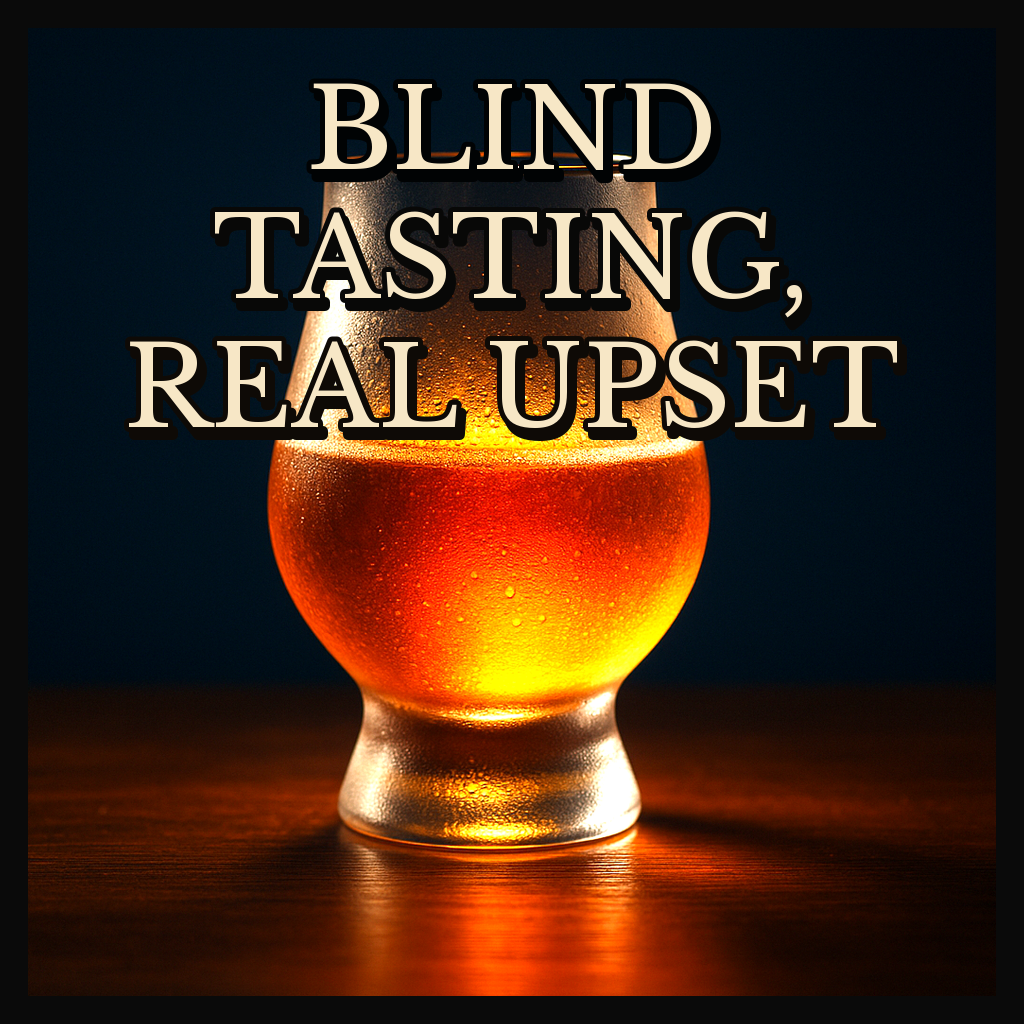
Can a Cheap Bourbon Really Beat an Expensive One Blind?
Or subscribe where you already listen
New episode every weekday morning. The Cut Weekend lands Saturday and Sunday.
Read the full transcript
This is The Cut. American whiskey, daily.
A $75 bottle just beat a $1,880 one. Blind. Judges lined up nine bourbons with the labels stripped off and picked the cheapest one in the room over two of Buffalo Trace's most expensive names. The scoreboard didn't care what anything cost.
I'm John from Chasing the Unicorn Podcast. Here's what moved today. August 26, 2026.
Here's the setup. American Whiskey Masters 2026 took nine bourbons that had already won Master medals and put them in one blind panel. No labels, no prices, just liquid in glasses. When the scores landed, the overall winner wasn't George T. Stagg, which runs about $1,300 a bottle. It wasn't Eagle Rare 17, which runs $1,880. It was Ampersand Aureus — a five-year-old sourced bourbon finished in orange wine casks, retailing at $75. And the field wasn't small. Early Times Bottled-in-Bond at $16 and standard Buffalo Trace at $20 were sitting in that same lineup. Judges tasted across an enormous price spread and still ranked the cheap end ahead of some of the most collectible names in the category.
Here's what's worth sitting with. Aureus isn't a decades-old cult classic. It's been on shelves a few months, made by Foley Family Wines and Spirits, bottled at 121.8 proof. It just outscored bourbon nearly twenty-five times its price, blind, in front of trained judges. That doesn't make Eagle Rare and Stagg bad — long aging and barrel-proof intensity do real things a five-year-old can't. But it's hard evidence that price and quality don't move together at the top of the shelf. Nothing you already own got worse this week. What changed is the evidence for what a $75 bottle can actually do.
Now — today's Chase. This is the one I'd actually act on this week, and it isn't the Aureus, because that one's already on shelves. It's a rye that's been gone a while and is about to come back with a hard date attached.
New Riff Sherry Finish Malted Rye goes on sale Friday, August 28, at 11 a.m., through the distillery's Newport, Kentucky gift shop, online, and select national retailers. It's a six-year-old, 100 percent malted rye — an unusual mash bill even for New Riff, since most American rye uses malted rye as a minority grain, not the whole bill — finished in Oloroso and Pedro Ximénez sherry casks after its initial aging in New Riff's own barrels. It comes in at 117.3 proof and $69.99. This isn't a blind bet on a first release. This exact whiskey already won a double gold medal and was a Best in Class finalist at the 2025 San Francisco World Spirits Competition before it disappeared from rotation. The sherry finish should push dried fruit and nut character over the rye spice — more layered than New Riff's standard bottled rye.
The move is simple. Set an alarm for 11 a.m. Friday. Distillery drops like this, with a published proof and a real competition record, tend to move fast once the word gets out — and this one already has a fan base from its first run. If you're near Newport, the gift shop is your best shot at walking out with a bottle same-day.
Worth a quick mention too — there's a charity raffle closing tomorrow, Thursday, at 8 p.m., a hundred dollars a ticket for a shot at a Pappy Van Winkle six-bottle set. Only a fraction of the tickets are sold. Long odds, but real ones, if that's your kind of chase.
Now let's talk about how to actually taste any of this once it's in your glass. So here's what it is. The judges who picked Aureus over two four-figure bourbons weren't guessing — they used the same basic technique anyone with a glass can use. Start with your nose, not your mouth. Swirl once, hold the glass an inch below your nose, mouth slightly open, and breathe normally. Don't jam your nose in and inhale hard — that burns out your palate before the first sip. Take a small sip, hold it a beat, swallow, and then pay attention to what happens ten to thirty seconds later. That lingering finish is where a genuinely good bourbon — cheap or expensive — separates itself from one riding on reputation.
You don't need fancy vocabulary to do this right. "Tastes good" and "tastes like dessert" are legitimate tasting notes. The judges who ranked a $75 bottle above a $1,880 one weren't swayed by a label, because in a blind tasting there wasn't one — just attention, paid carefully.
What this changes — next time you pour something, try it blind. Have someone else hand you the glass without the bottle in sight. If you've got the Perfect Pour app, log that pour in your Rickhouse with no label visible, and let your Pour Print tell you what you actually taste versus what you think you're supposed to taste. It's available now, and it's the fastest way to find out if your palate agrees with the judges.
So here's the takeaway from today. The bottle that wins blind and the bottle that costs the most aren't always the same bottle — and the only way to find out which one you actually prefer is to taste it without knowing the price first. That's true of the $75 sourced bourbon that just beat a $1,880 one, and it's true of whatever's in your cabinet right now.
That's The Cut. The full American Whiskey Industry Brief is free every morning at chasingtheunicornpodcast.com. I'm John Schuster. Thanks for joining me. Your unicorn is out there.
Listen to today's episode and find us on Spotify and everywhere you listen at chasingtheunicornpodcast.com/episodes.
Informational and entertainment purposes only. Nothing here is investment advice. Verify before buying, trading, or bidding. We are not liable for errors or financial losses.
A $75 bottle just beat a $1,880 one. Judges at American Whiskey Masters 2026 tasted nine bourbons blind — and picked Ampersand Aureus, a five-year-old sourced bourbon, over Eagle Rare 17 and George T. Stagg. The scoreboard didn't care about the price tag.
A blind tasting panel just handed the biggest upset of the week to a $75 bottle, ranking it above two of Buffalo Trace's most expensive annual releases. That matters because it's real evidence — not opinion — that price and quality don't always move together at the top of the bourbon shelf. Today's edition also covers a record-setting Willett auction sale, a returning sherry-cask rye with a Friday drop date, and a closing raffle with real odds at allocated bourbon.
Here's the setup. American Whiskey Masters 2026 put nine bourbons that had already won Master medals into one blind panel. No labels. No prices. Just liquid in glasses. When the scores came in, the overall winner wasn't George T. Stagg at roughly $1,300 a bottle. It wasn't Eagle Rare 17 Year at $1,880. It was Ampersand Aureus — a five-year-old sourced bourbon finished in orange wine casks, retailing at $75. The field wasn't small, either. Early Times Bottled-in-Bond at $16 and standard Buffalo Trace at $20 were in the same blind lineup. Judges tasted across an enormous price spread and still ranked the cheap end ahead of some of the most collectible names in the category. Aureus is made by Foley Family Wines & Spirits, bottled at 121.8 proof, and it's been on shelves only a few months. That's the part worth sitting with — this isn't a decades-old cult classic. It's a new release that just outscored bourbon nearly twenty-five times its price, blind, in front of trained judges. It doesn't mean Eagle Rare and Stagg are bad bourbon. Long aging and barrel-proof intensity do things a five-year-old genuinely can't. But it's a real data point against the idea that price tracks quality at the top of the shelf.
The judges who picked Ampersand Aureus over two four-figure bourbons weren't guessing — they were using the same basic technique available to anyone with a glass. Start with your nose, not your mouth. Swirl once, hold the glass an inch below your nose, mouth slightly open, and breathe normally — don't jam your nose in and inhale hard, that just burns out your palate before the first sip. Take a small sip, hold it a beat, swallow, then pay attention to what happens 10 to 30 seconds later. That lingering finish is where a genuinely good bourbon — cheap or expensive — separates itself from one riding on reputation. You don't need fancy vocabulary to do this right. "Tastes good" and "tastes like dessert" are legitimate tasting notes. The judges who ranked a $75 bottle above a $1,880 one weren't swayed by the label, because in a blind tasting there wasn't one — just attention, paid carefully.
Floor erosion usually measures how far a bottle's price has fallen from its all-time high. This bottle did the reverse — it just set a new all-time high. That distinction matters because it shows the secondary market isn't moving as one block right now. While plenty of allocated bottles are still worth less than they were in 2022, genuinely rare single-barrel selections with a real story behind them — this one is named for a legendary Stitzel-Weller and Bernheim master distiller — are holding, and in this case climbing.
Rickhouse Report: 5 stories · Regional Report: 3 stories
◆ The Brief (free): https://chasingtheunicornpodcast.com/the-brief/
◆ Listen on Apple Podcasts: https://podcasts.apple.com/us/podcast/chasing-the-unicorn-bourbon-american-whiskey/id6788592653
◆ Listen on Spotify: https://open.spotify.com/show/1IZS2wXY7nAUcL9akukblE
◆ YouTube: https://www.youtube.com/@chasingtheunicornpodcast
Want the full picture? The complete American Whiskey Industry Brief — every section, every source, every story — is published free every morning at chasingtheunicornpodcast.com. Read it at chasingtheunicornpodcast.com/the-brief/.
Chasing a specific bottle? The Bourbon Release Calendar lists every lottery deadline, walk-up window and MSRP we're tracking — updated every morning.
Mentioned in this episode: Buffalo Trace, Eagle Rare, Weller, George T. Stagg, Pappy Van Winkle, Blanton's, New Riff, Sazerac, BTAC