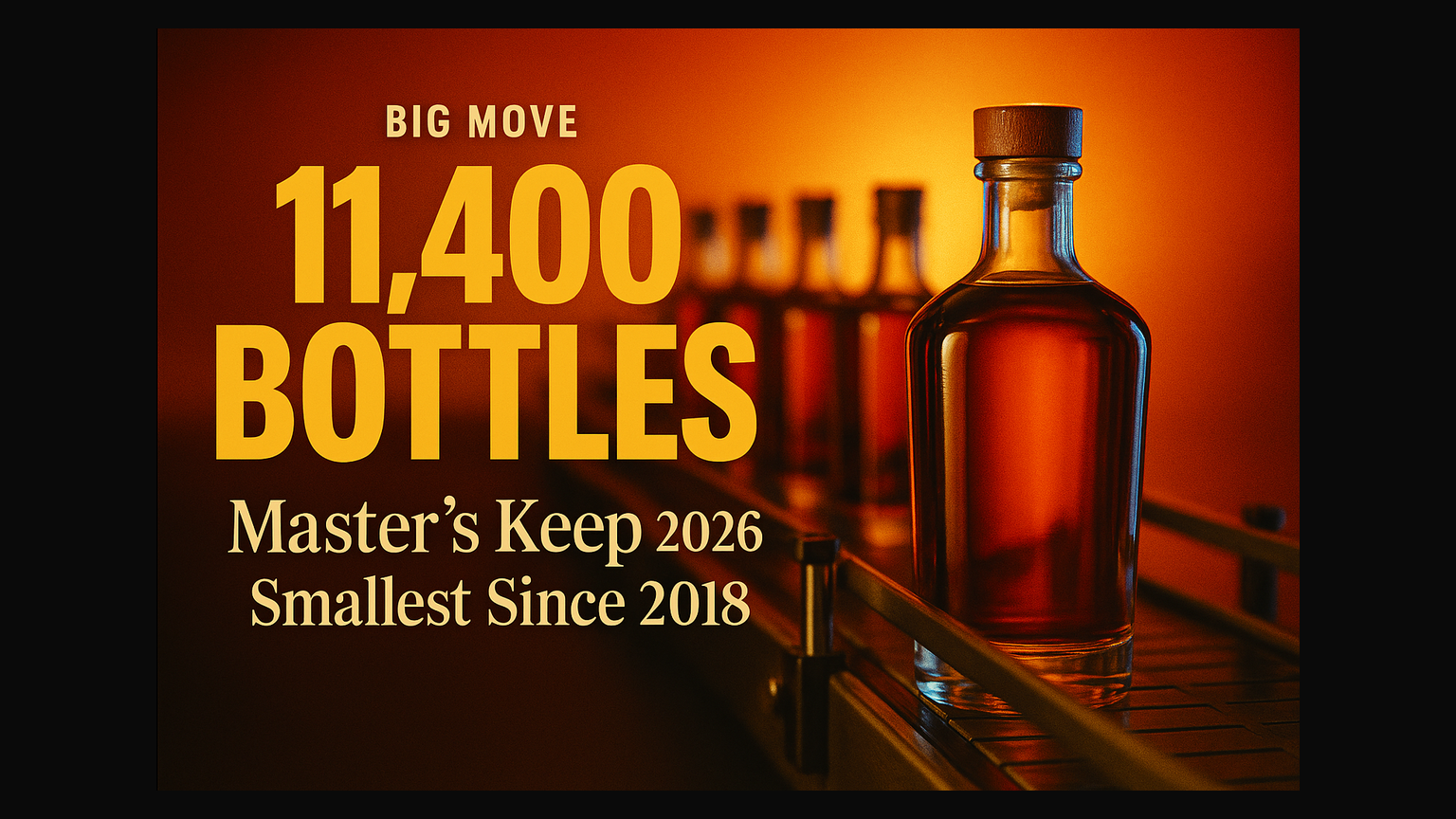
The Cut — April 15, 2026 — Master’s Keep 2026 — Smallest Run Since 2018 Revival
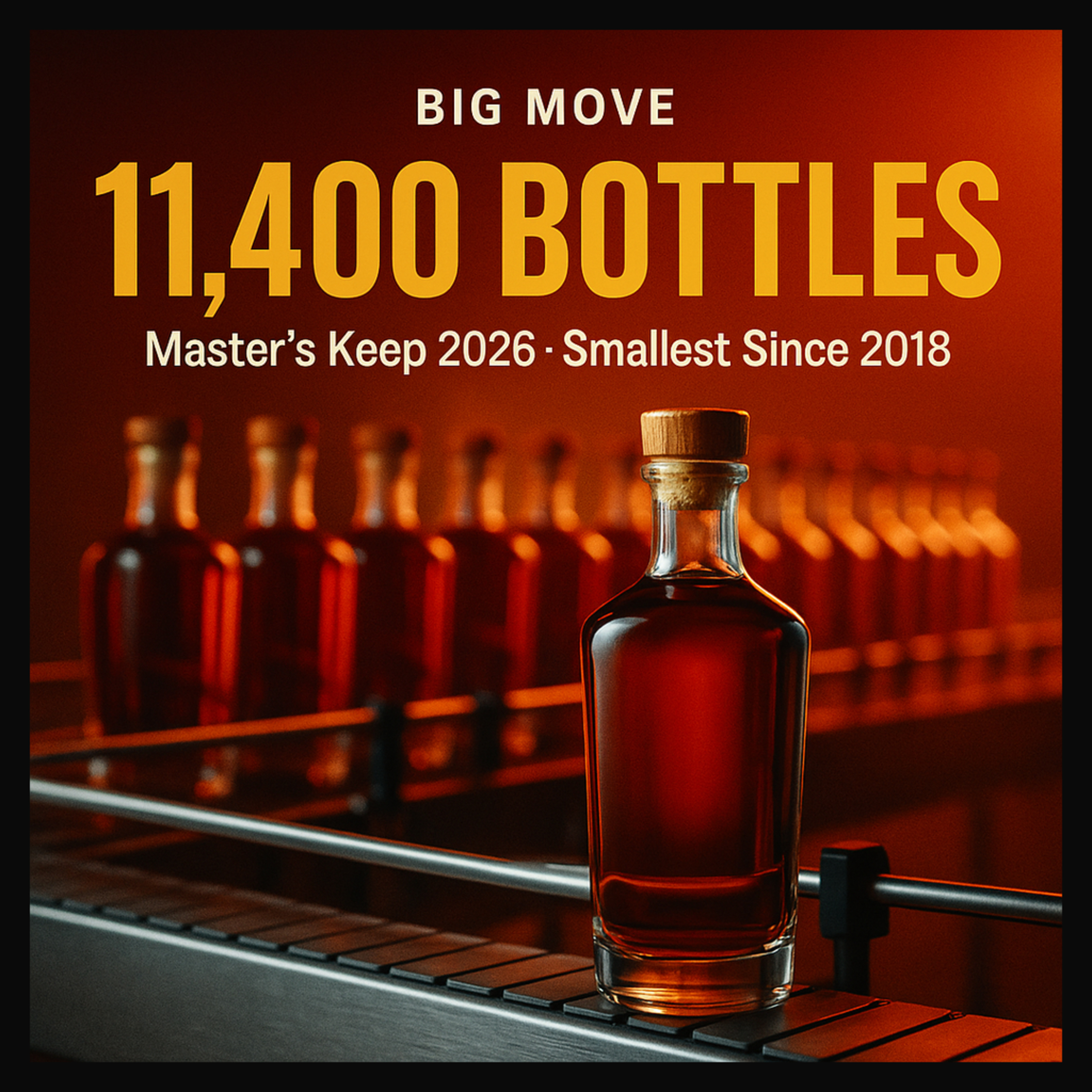
In this episode
▶ Listen to this episode on Spotify Master’s Keep just got smaller. Wild Turkey published the 2026 Master’s Keep specs Tuesday morning, and the volume is the headline — 11,400 bottles, the smallest Master’s Keep release since the 2018 Revival edition. Every release since 2018 has been larger. The 2026 edition reverses that trend. The…
Mentioned in this episode: Buffalo Trace, George T. Stagg, Wild Turkey, Heaven Hill, Bardstown, Maker’s Mark, BTAC
Read the full transcript
Target runtime: 7:48 Word count: 1,194 Estimated runtime: 7:58 Source: The Cut Daily 2026-04-15
—
This is The Cut. American whiskey, daily.
Master’s Keep just got smaller. Wild Turkey published the 2026 specs on Tuesday — 17 years old, 110.4 proof, finished in re-toasted original barrels at 11,400 bottles. That’s the smallest Master’s Keep since 2018 Revival, and 249 dollars retail.
I’m John from Chasing the Unicorn Podcast. Here’s what moved today. April 15, 2026.
Today’s Big Move — Wild Turkey just shrank Master’s Keep, and the methodology is the news. Here’s what happened.
Wild Turkey published the 2026 Master’s Keep specs Tuesday morning. Two facts to track. The first is the volume. 11,400 bottles. That’s the smallest Master’s Keep release since the 2018 Revival edition, which ran 10,200. Every release since 2018 has been larger. The 2026 edition reverses that trend.
The second is the methodology. Master’s Keep 2026 is a 17-year Wild Turkey bourbon — Wild Turkey’s standard high-rye mashbill, 75 percent corn, 13 percent rye, 12 percent malted barley. After the primary 17-year aging cycle finished, the cooperage emptied each barrel, re-toasted the inside of the wood at a Medium-Plus profile, then refilled the barrel with the same liquid for another 11 months. That’s the finish. No new vessel. No port pipe, no rum cask, no wine barrel. Same wood, deeper toast, more time. Eddie Russell calls it the cleanest way to deepen the oak signature without trading away Wild Turkey’s house profile.
Bottling is 110.4 proof. Retail is $249.99. Single-day national rollout April 30 — no distillery allocation. Here’s why this release is worth tracking. The re-toasted-original-barrel approach is the program’s first secondary-finish protocol since 2023’s Master’s Keep One. The 2024 and 2025 editions ran straight-aged formats. Wild Turkey is willing to run finish experiments at the Master’s Keep tier again — and they’re doing it inside the barrel they already had, not by chasing somebody else’s wine cask.
For your shelf, $249.99 for 17-year, 110.4 proof, finished bourbon at 11,400 bottles is a buy at retail if you can get to a specialty shop on April 30. Above $475 secondary, you’re paying for scarcity, not for the bottle. And while we’re talking mashbills — that high-rye recipe is exactly what’s anchoring today’s First Sip.
Today’s First Sip — the mash bill. You’ll see the word “wheated” on Bardstown’s Discovery Series 11 fact sheet, and the word is doing real work.
So here’s what it is.
The mash bill is the recipe of grains that goes into the still before distillation. Every bourbon has to be at least 51 percent corn. The other 49 percent is where distilleries differ — and where flavor direction is set before the barrel ever enters the picture. Corn is the sweetness. Rye is the spice — black pepper, cinnamon, a sharper finish. Wheat is the softness — rounder, mellower, easier on the palate. Malted barley, usually a small percentage, helps fermentation along and adds a biscuit-like note.
Two bottles tell the story cleanly. Buffalo Trace is a high-rye bourbon — around 10 percent rye, punchier, spicier. Maker’s Mark is a wheated bourbon — wheat replaces the rye, and the result is softer, warmer, easier to drink neat. Same legal category. Very different experiences.
Think of the mash bill the way you read a recipe — same oven, same time, different ingredients, different result.
What this changes — if you love Maker’s Mark, you probably prefer wheated bourbons. If you love Bulleit, you probably prefer high-rye. That’s a useful thing to know when you’re staring at a shelf — and it’s the lens for today’s Chase.
Today’s Chase — three bottles across three tiers. Let’s start with the one that matters most.
Bardstown Bourbon Company Discovery Series 11. The $80 to $200 tier. $169.99 distillery, $179.99 specialty retail. 14 years, 118.6 proof, cask strength. April 22 distillery allocation event in Bardstown, then rolling national specialty retail through Q2.
Flavor direction — MGP wheated bourbon. Caramel, vanilla, soft baking spice, dried orchard fruit, integrated oak. 14 years gives you tannin depth without the wood taking over, and at 118.6 proof, the full profile comes through. Add a few drops of water and it opens up.
Here’s why it’s the spotlight. The fact sheet names the source distillery, the primary aging facility, the aging duration there, and the secondary warehousing — single-source MGP Indiana, 14 years at Lawrenceburg, 18 months of finishing in Kentucky. That level of attribution is the cleanest disclosure the sourced-bourbon segment has delivered at scale. And $169.99 for a 14-year, cask-strength, single-source wheated bourbon is below where the Buffalo Trace wheated lineup lives. With MGP’s order book contracting and aged wheated stocks tightening, this is category-rare at the price.
This is worth the chase. April 22 at the distillery is the cleanest buy at MSRP. Specialty retail is the backup window through Q2.
Also on today’s Chase — Heaven Hill Bottled-in-Bond 12-Year specialty stragglers at $79.99, residual allocation in lower-volume markets through April 30. And Wild Turkey Master’s Keep 2026 at $249.99 — the bottle we just spent two minutes on. Full detail in today’s Cut Daily. If you want more, head to our Patreon at chasingtheunicornpodcast.
Which brings us to today’s Bar Talk — and it’s the question that landed with that Discovery Series fact sheet.
Today’s Bar Talk — sourced bourbon just got more honest, and the question is whether the rest of the segment follows. Community’s split on whether Bardstown’s disclosure raises the floor or just decorates one bottle. Here’s what’s actually going on.
Quick vocabulary anchor. NDP — non-distilling producer — is the category term for any brand that bottles bourbon it didn’t distill itself. MGP Ingredients in Lawrenceburg, Indiana is the largest contract distiller in American whiskey. A meaningful share of the bourbon at the $50 to $200 tier was distilled at MGP and bottled by somebody else.
Here’s the math. Bardstown’s fact sheet specifies single-source MGP Indiana distillation, 14-year primary aging at Lawrenceburg, and 18 months at Bardstown’s Kentucky warehousing. Compare the recent NDP baselines. Smoke Wagon discloses mashbill and approximate age, not source. Old Carter discloses batch and cask count. Penelope discloses MGP Indiana sourcing across the line. None of them name the specific aging warehouse and break out the duration by location. Discovery Series 11 does. The April 14 MGP order-book contraction — 22 percent year-over-year — adds urgency. If aged stocks are tightening, source-specific disclosure becomes a defensible necessity, not a marketing flourish. The next 60 days are the test — whether Smoke Wagon, Old Carter, and the smaller MGP-sourced bottlers respond with matching depth.
Here’s what it means for the rest of us — Bardstown raised the floor. Now we watch whether the rest of the segment matches it or hopes we don’t notice.
One more for today — today’s full American Whiskey Industry Brief grades the George T. Stagg 2024 secondary print at $1,425, that’s 54 percent erosion from a $3,100 peak. The full BTAC lineup is now compressing inside a four-point band across bourbon and rye mashbills. It’s waiting on Patreon.
That’s The Cut. The full American Whiskey Industry Brief is waiting at patreon.com/ChasingTheUnicornPodcast. I’m John Schuster. Thanks for joining me. Your unicorn is out there.
The Cut Daily
▶ Listen to this episode on Spotify
Master’s Keep just got smaller. Wild Turkey published the 2026 Master’s Keep specs Tuesday morning, and the volume is the headline — 11,400 bottles, the smallest Master’s Keep release since the 2018 Revival edition. Every release since 2018 has been larger. The 2026 edition reverses that trend. The methodology is also the news — a 17-year Wild Turkey bourbon, dumped from its original barrel, finished for 11 more months in that same barrel after the cooperage re-toasted the staves at a Medium-Plus profile. Same wood, deeper toast, more time. Bottling is 110.4 proof, retail is $249.99, single-day national rollout April 30 with no distillery allocation. Today’s Cut also covers Bardstown Bourbon Company Discovery Series 11 at $169.99 with single-source MGP attribution, the Brown-Forman Q4 preliminary update, and the George T. Stagg 2024 hammer at $1,425 (54.0% floor erosion). Listen to the full episode.Listen to this episode on Spotify, or find us wherever you get your podcasts.

Informational and entertainment purposes only. Nothing here is investment advice. Verify before buying, trading, or bidding. We are not liable for errors or financial losses.
Master’s Keep just got smaller. Wild Turkey published the 2026 specs on Tuesday — 17 years old, 110.4 proof, finished in re-toasted original barrels at 11,400 bottles. That’s the smallest Master’s Keep since 2018 Revival, and 249 dollars retail.
The biggest move in American whiskey this window is a release announcement that doesn’t follow the usual playbook. Wild Turkey’s Master’s Keep program has run as the brand’s annual allocated flagship since 2015 — and the 2026 edition just landed at 11,400 bottles, the smallest run since the 2018 Revival edition. The methodology is also the news: a 17-year bourbon, dumped from its original barrel, finished for 11 more months in that same barrel after the cooperage re-toasted the staves. Today’s Cut also covers Bardstown Bourbon Company’s Discovery Series 11 specs landing at $169.99 cask strength, Brown-Forman’s preliminary Q4 update with Jack Daniel’s volume off 11 percent, and three Pacific Northwest releases hitting retail on the same day.
Wild Turkey published the 2026 Master’s Keep specs Tuesday morning. Two facts to track. The first is the volume — 11,400 bottles. That’s the smallest Master’s Keep release since the 2018 Revival edition, which ran 10,200. Every release since 2018 has been larger. The 2026 edition reverses that trend. The second is the methodology. Master’s Keep 2026 is a 17-year-old Wild Turkey bourbon — Wild Turkey’s standard high-rye mashbill, 75 percent corn, 13 percent rye, 12 percent malted barley. After the primary 17-year aging cycle finished, the cooperage emptied each barrel, re-toasted the inside of the wood at a Medium-Plus profile, then refilled the barrel with the same liquid for another 11 months. That’s the finish. No new vessel. No port pipe, no rum cask, no wine barrel. Same wood, deeper toast, more time. Eddie Russell calls it “the cleanest way to deepen the oak signature without trading away Wild Turkey’s house profile.” Bottling is 110.4 proof. Retail is $249.99. Single-day national rollout April 30 — no distillery allocation. Here’s what makes this release worth tracking. The re-toasted-original-barrel methodology is the program’s first secondary-finish protocol since 2023’s Master’s Keep One. The 2024 and 2025 editions ran straight-aged formats. Wild Turkey is willing to run finish experiments at the Master’s Keep tier again — and they’re doing it inside the barrel they already had, not by chasing somebody else’s wine cask.
Bardstown’s Discovery Series 11 hits the distillery on April 22 as a 14-year wheated bourbon — and the word “wheated” is doing real work on that label. Here’s why. The mash bill is the recipe of grains that goes into the still before distillation. Every bourbon must be at least 51% corn. The other 49% is where distilleries differ — and where flavor direction is set before the barrel ever enters the picture. Corn is the sweetness. Rye is the spice — black pepper, cinnamon, a sharper finish. Wheat is the softness — rounder, mellower, easier on the palate. Malted barley (usually a small percentage) helps fermentation along and adds a biscuit-like note. Two bottles that tell the story cleanly: Buffalo Trace is a “high-rye” bourbon — around 10% rye, punchier and spicier. Maker’s Mark is a “wheated” bourbon — wheat replaces the rye, and the result is softer, warmer, easier to drink neat. Same legal category. Very different experiences. What this changes: Read the mash bill the way you read a recipe. If you love Maker’s Mark, you probably prefer wheated bourbons. If you love Bulleit, you probably prefer high-rye. That’s a useful thing to know when you’re staring at a shelf — and Discovery Series 11’s 51-corn / 45-wheat / 4-malt mash bill puts it firmly in the wheated camp.
Floor erosion is how much a bottle’s market value has dropped from its all-time high. A 54 percent erosion reading means George T. Stagg 2024 is trading at about 46 cents on the dollar compared to what it went for at peak — and it’s a bigger story than one bottle. Stagg is the Buffalo Trace Antique Collection’s barrel-strength bourbon expression, and Tuesday’s $1,425 hammer extends a pattern across the full BTAC lineup. William Larue Weller compressed 60 percent. Stagg compressed 54 percent. Sazerac 18 compressed 52 percent. Thomas H. Handy compressed 50 percent. Bourbon-mashbill expressions and rye-mashbill expressions are now tracking within four percentage points on compression depth. The wheated tier still holds the deepest erosion — but the spread is meaningfully tighter than 2022-2023 peak-era divergence.
The Hunt: 5 active drops · Bar Talk: 2 debates · The Secondary: 3 graded bottles
◆ Full AWIB (Paid Patreon Subscriber): https://www.patreon.com/c/ChasingTheUnicornPodcast
◆ Listen on Spotify: https://open.spotify.com/show/56Lt67gvTPjifCyeqFW3IT
◆ YouTube: https://www.youtube.com/@chasingtheunicornpodcast
Want the full picture? The complete American Whiskey Industry Brief — every section, every source, every story — is published daily for subscribers on Patreon. Join us at patreon.com/ChasingTheUnicornPodcast.