Four Lobbyists Indicted Over an $8,500 Pappy Van Winkle — The Cut
In this episode
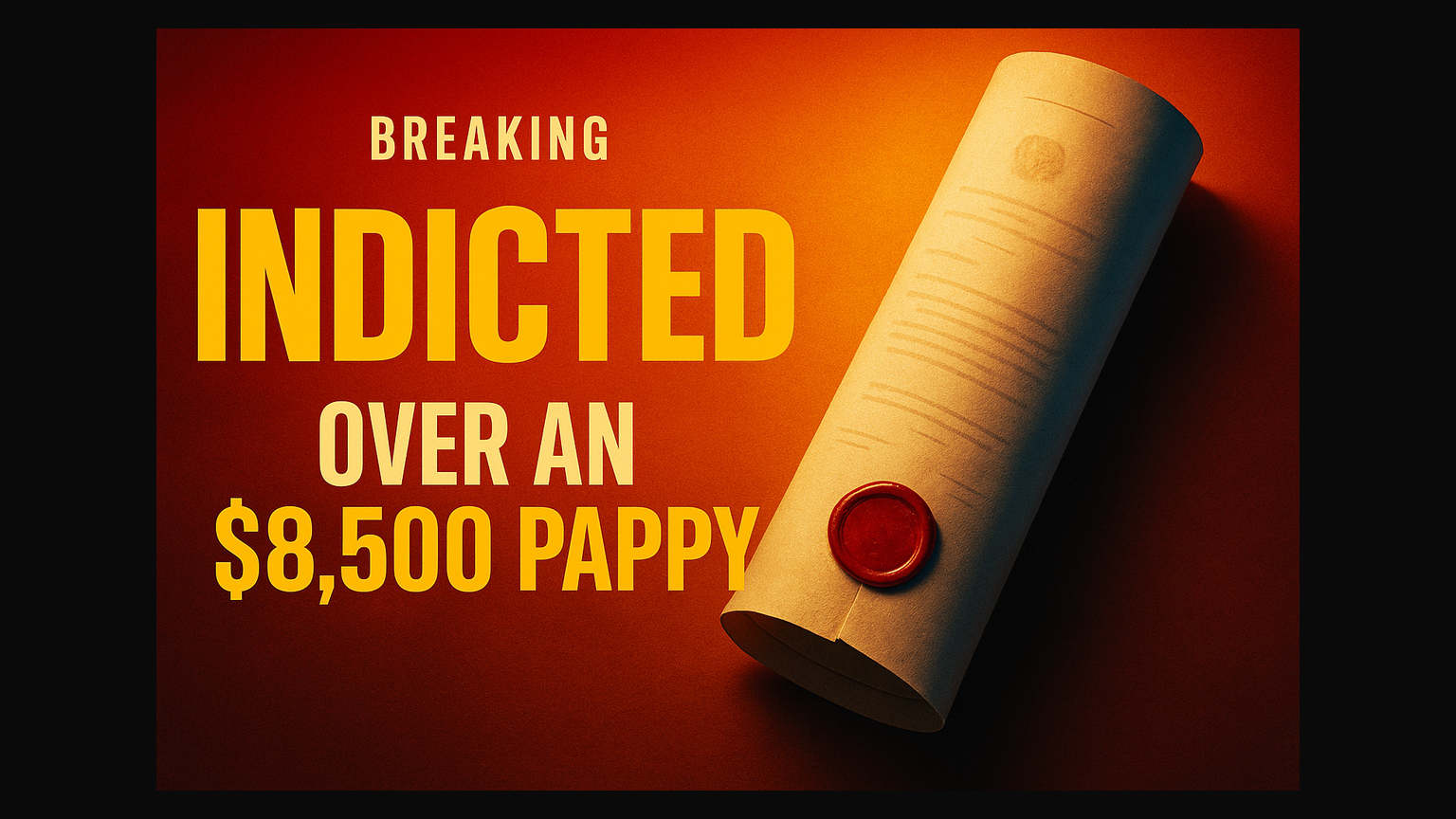
Today’s biggest move in American whiskey landed in a North Carolina courtroom. A Wake County grand jury indicted four lobbyists over a 2024 Kentucky Bourbon Trail trip they organized for Republican state lawmakers, charging that funding the trip through a political nonprofit called Greater Carolina still counts as an indirect gift under North Carolina’s lobbying-gift…
Mentioned in this episode: Pappy Van Winkle, Bardstown, Maker’s Mark, Angel’s Envy
Read the full transcript
Target runtime: 7:48 Word count: 1,198 Estimated runtime: 7:59 Source: The Cut Daily 2026-04-23
—
This is The Cut. American whiskey, daily.
Four lobbyists just got indicted over bourbon. A Wake County grand jury charged them over a Kentucky Bourbon Trail trip they arranged for North Carolina lawmakers — and the evidence includes an $8,500 bottle of Pappy Van Winkle. Here’s what actually got them.
I’m John from Chasing the Unicorn Podcast. Here’s what moved today. April 23, 2026.
Today’s Big Move — four lobbyists criminally charged over a bourbon-industry hospitality trip. Here’s what happened.
A Wake County grand jury in North Carolina indicted four lobbyists over a 2024 Kentucky Bourbon Trail trip they organized for Republican state lawmakers. Not a fine. Not a civil complaint. A criminal indictment.
The mechanics matter. The lobbyists didn’t hand cash to legislators directly. They routed money through a political nonprofit called Greater Carolina, which paid for travel, hotel, and meals across the multi-day distillery tour. North Carolina’s lobbying-gift statute bans lobbyists from giving gifts to elected officials either directly or indirectly. The prosecutors’ theory is that funding the trip through a nonprofit still counts as an indirect gift — and that argument is now in criminal court.
What makes this bourbon-specific: evidence in the case includes an $8,500 Pappy Van Winkle bottle purchased by undercover officers. That purchase documented exactly what kind of access the tour could provide — and gave it a market value the statute can measure. An $8,500 bottle isn’t a tasting sample. It’s the kind of access that flows through distillery reserve programs and allocation relationships.
This is the first criminal case of its kind involving the Kentucky Bourbon Trail. The Trail handles roughly two-and-a-half million visitors a year through standard programming — tours, tasting rooms, passport stamps. What the North Carolina case tests is a different arrangement: lobbyist-raised funds providing public officials access to rare allocated bottles outside normal retail channels.
The Kentucky Distillers’ Association has not issued a statement. Major Kentucky distillers named in the evidentiary record haven’t publicly responded either.
Nothing changes at your store this week. But reserve programs and allocation lists now exist inside a legal question they’ve never faced before.
That case puts finishing center stage — because the Pappy bottle at the heart of it is exactly the kind of rare, allocation-only pour that distilleries protect carefully. Which brings us to today’s First Sip — finishing. What it is, when it works, and when it doesn’t.
Today’s First Sip — finishing. You’ll see it on Blood Oath Pact 12 on Saturday and on a lot of shelves around it — and most drinkers don’t know what it’s actually doing.
So here’s what it is.
After a bourbon finishes its primary aging — years in a new charred oak barrel — some distilleries move it into a second vessel for a stretch. Rum casks, port pipes, sherry barrels, cognac casks, and increasingly wine casks from international varietals like Montepulciano and Sangiovese. A few months in the second container, sometimes a few years. That’s finishing.
Done right, a finish layers something new on top of a bourbon that was already worth drinking. The port adds berry and dark fruit. The rum adds tropical sweetness. The Montepulciano adds ripe black cherry, leather, and spiced cocoa. The ones that work integrate — you taste the bourbon first, and the finish arrives as an echo rather than a replacement.
Done wrong, a finish buries a mediocre base whiskey. If the second cask is all you taste and the bourbon underneath doesn’t come through, the distiller was using that barrel to cover something up.
Think of it like a sauce on a steak. A good sauce complements the meat — you still know what you’re eating. A bad sauce is hiding a cheap cut.
What this changes — taste through the finish. If the bourbon shows up first and the cask follows, the finish earned its place. If all you get is the second barrel, something’s being covered up. Speaking of which — today’s Chase has a finished bourbon where the base holds up exactly the way it should.
Today’s Chase — three bottles across three tiers. One is a collector’s decanter, one is closing its window, and one drops Saturday. Let’s start with the one that matters most.
Blood Oath Pact 12 Italian Wine Cask Finish. Mid-tier. $129.99. 98.6 proof. 51,000-bottle national allocation.
Flavor direction first. Sequential Italian wine-cask finishing on a ryed bourbon base — Montepulciano goes in first, Sangiovese second. What you get is black cherry, leather, spiced cocoa, dried fruit, and baking spice across a long finish. It’s complex without being loud about it.
Here’s why it’s the spotlight. Italian wine-cask finishing on Kentucky bourbon is almost unheard of — this combination doesn’t exist anywhere else in the category right now. The base blend is 9-year and 12-year ryed bourbons, and that base holds up through both casks. The bourbon is present. The finish is the addition, not the replacement. TTB verification confirmed all specs this week. And pre-allocation requests at Seelbach’s, Reservebar, Total Wine, and Binny’s are already running four-to-one over what’s available for the June national rollout.
This is worth the chase. Saturday’s walk-up at Lux Row in Bardstown is the cleanest path — no lottery, no waitlist, just show up. If you’re not within driving distance of Bardstown, get your name in with Seelbach’s or Reservebar now before the June window narrows further.
Also on today’s Chase — WhistlePig Rye, White & Blue PiggyBank at $80, a 110-proof collectible decanter version of the 10 Year with campaign display value through July 4 — buy it at the low end of the range when you find it. And Angel’s Envy 2026 Cask Strength Bourbon at $249.99, Day 7 of a 14-day window — Pacific Northwest and Mid-Atlantic markets are tightening fastest, primary price is the right price before this moves to secondary. Full detail in today’s Cut Daily. If you want more, head to The Brief at chasingtheunicornpodcast.
Alright — today’s Bar Talk. While that Pappy bottle is sitting in a North Carolina evidence file, WhistlePig launched a campaign this week to make rye America’s official whiskey. And the community is split on whether that’s a legitimate historical argument or just a marketing stunt.
Today’s Bar Talk — did rye earn the right to be America’s official whiskey before bourbon did? Community’s split on whether WhistlePig’s petition is real history or a label campaign. Here’s what’s actually going on.
WhistlePig launched a Congressional petition this week — 1,776 signatures by July 4, 2026, the country’s 250th anniversary, and the petition gets formally delivered to Congress. Bourbon loyalists read it as marketing dressed in founding-era clothing. Rye advocates read it as a legitimate heritage argument.
Here’s where the history lands. At the grain level, bourbon requires at least 51% corn — corn delivers the sweetness, the body, the caramel. Straight rye requires at least 51% rye grain — rye delivers spice, black pepper, sharper finish. Both follow the same federal production rules. Both are American whiskeys. The flavor difference between a Rittenhouse Rye and a Maker’s Mark is real, and it comes directly from the grain.
The historical record genuinely leans rye. George Washington operated one of the largest rye distilleries in the early republic at Mount Vernon — roughly 11,000 gallons a year at peak in the 1790s. Pennsylvania and Maryland rye dominated American distilled-spirits consumption through the early 19th century before bourbon’s rise accelerated during Prohibition and the post-WWII era. Bourbon’s current “America’s Native Spirit” status comes from a 1964 Senate Concurrent Resolution — symbolic, non-binding, no legal exclusivity. A rye designation wouldn’t displace it. Both would coexist.
Here’s what it means for the rest of us — the petition is marketing. The history is real — rye came first, and that’s worth knowing before you choose your bottle.
One more for today — today’s full American Whiskey Industry Brief covers the Uncle Nearest Q2 2026 asset-sale deadline in full, including the 30-day shutdown risk and the stalking-horse bidder announcement expected before end of April. It’s waiting at chasingtheunicornpodcast.com.
That’s The Cut. The full American Whiskey Industry Brief is waiting at chasingtheunicornpodcast.com/the-brief/. I’m John F. Schuster II. Thanks for joining me. Your unicorn is out there.
The Cut Daily
Listen to today’s episode and find us on Spotify and everywhere you listen at chasingtheunicornpodcast.com/podcast.

Informational and entertainment purposes only. Nothing here is investment advice. Verify before buying, trading, or bidding. We are not liable for errors or financial losses.
Four lobbyists just got indicted over bourbon. A Wake County grand jury charged them over a Kentucky Bourbon Trail trip they arranged for North Carolina lawmakers — and the evidence includes an $8,500 bottle of Pappy Van Winkle. Here’s what actually got them.
The biggest move in American whiskey Thursday is a criminal indictment that landed in Raleigh with a Pappy Van Winkle receipt attached. A North Carolina grand jury charged four lobbyists over a multi-day Kentucky distillery trip they organized for state lawmakers — the first criminal case to place bourbon-industry hospitality inside a lobbying-gift-statute frame. Also today: WhistlePig launched a Congressional petition to name rye America’s official whiskey ahead of the July 4 250th anniversary, Michter’s confirmed the first-ever barrel-strength version of its flagship sour mash for a May launch at $120, and the Blood Oath Pact 12 Italian wine-cask finish drops Saturday at the distillery in Bardstown.
Here’s what moved Wednesday. A Wake County grand jury in North Carolina indicted four lobbyists over a 2024 Kentucky Bourbon Trail trip they organized for Republican state lawmakers. Not a fine, not a civil complaint — a criminal indictment.
The mechanics matter. The lobbyists didn’t hand cash to the legislators directly. They routed money through a political nonprofit called Greater Carolina, which paid for travel, hotel, and meals on the multi-day distillery tour. North Carolina’s lobbying-gift statute bans lobbyists from providing gifts to elected officials either directly or indirectly. The prosecutors’ theory is that funding the trip through a nonprofit is still an indirect gift, and that argument is now in criminal court.
What makes this bourbon-specific: evidence in the case includes an $8,500 Pappy Van Winkle bottle purchased by undercover officers. That purchase documented exactly what kind of access the tour could arrange — and gave it a market value the statute can measure. An $8,500 bottle isn’t a tasting sample. It’s the kind of access that flows through distillery reserve programs and allocation relationships.
This is the first criminal case of its kind involving the Kentucky Bourbon Trail. The Trail itself handles roughly two-and-a-half million visitors a year through standard-admission programming — distillery tours, tasting rooms, passport stamps. What the NC case tests is a specific arrangement: lobbyist-raised funds providing public officials access to rare allocated bottles outside normal retail channels.
The Kentucky Distillers’ Association has not issued a statement. Major Kentucky distillers named in the evidentiary record have not publicly responded.
After a bourbon finishes its primary aging — years in a new charred oak barrel — some distilleries move it into a second vessel for a stretch. Rum, port, sherry, cognac, Madeira, French oak, and, increasingly, wine casks from Montepulciano, Sangiovese, or other international varietals. A few months, sometimes a few years, in the second container. This is finishing.
Done right, a finish layers something new on top of bourbon that was already worth drinking. The port adds berry and dark fruit. The rum adds tropical sweetness. The Montepulciano adds ripe black cherry, leather, and spiced cocoa. The ones that work integrate — you taste the bourbon first, and the finish arrives as an echo rather than a replacement.
Done wrong, a finish buries a mediocre base whiskey. If the finish is all you taste and the bourbon underneath doesn’t come through, the distiller was using the second cask to hide something.
Blood Oath Pact 12 runs through two Italian wine casks sequentially — Montepulciano first, Sangiovese second — over a base blend of 9-year and 12-year ryed bourbon. The right question when you taste it is the same one worth asking with any finished whiskey: does the bourbon show up first, or does the cask do all the talking?
What this changes: Taste through the finish. If the bourbon is still present, the cask earned its place. If all you get is the second barrel, something’s being covered up.
Floor erosion is how much a bottle’s market value has dropped from its all-time high. At 12.7%, the Binny’s 18 is bidding at roughly 87 cents on the dollar against its 2024 peak. The daily trajectory matters as much as the number: Wednesday’s session showed a $79,200 live bid implying 7.9% erosion; Thursday’s reporting window shows $75,100 at 12.7%, meaning the live bid moved backward overnight. That mid-auction softening is common for very high-value lots — sophisticated bidders hold their positions until the final 24 to 48 hours, when bid increments tend to be largest. The auction closes April 26. The Binny’s 18 is one of approximately six Van Winkle 18 Year private barrel selections produced from Stitzel-Weller stocks — a source that closed in 1992 and cannot be replicated. That bounded supply is why this bottle’s floor erosion runs at single digits even in a soft collector environment.
The Hunt: 6 active drops · Bar Talk: 2 debates · The Secondary: 3 graded bottles
◆ The Brief (free): https://chasingtheunicornpodcast.com/the-brief/
◆ Listen on Spotify: https://open.spotify.com/show/56Lt67gvTPjifCyeqFW3IT
◆ YouTube: https://www.youtube.com/@chasingtheunicornpodcast
Want the full picture? The complete American Whiskey Industry Brief — every section, every source, every story — is published free every morning at chasingtheunicornpodcast.com. Read it at chasingtheunicornpodcast.com/the-brief/.