The Cut — April 20, 2026 — Brown-Forman Stock Pops 14.2% On Sazerac Bid
In this episode
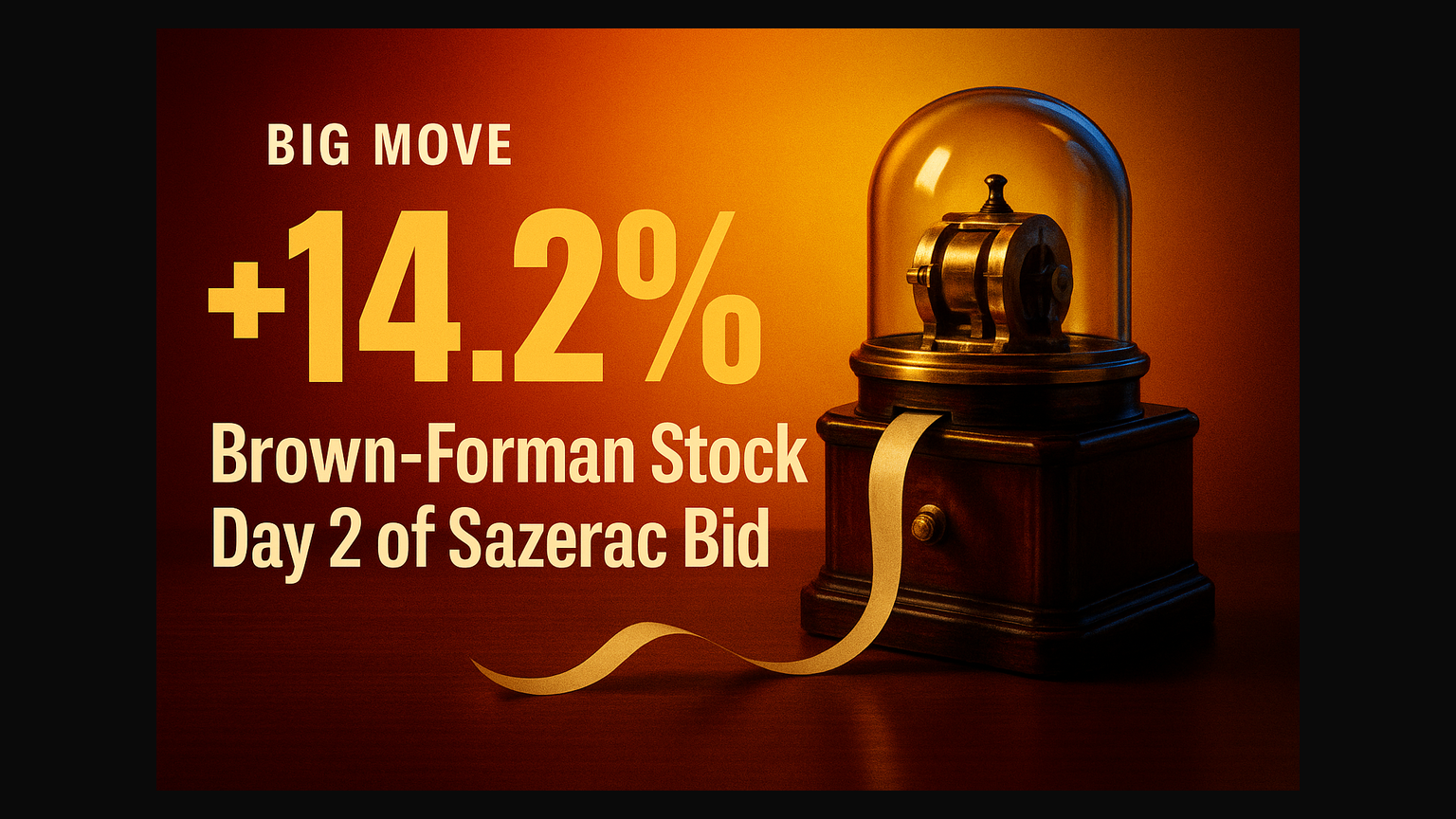
Brown-Forman didn’t crash. It opened up fourteen. The stock that makes Jack Daniel’s, Woodford Reserve, and Old Forester closed Friday at $41.02 and opened Monday at $46.85 — a 14.2% jump on more than four times normal volume. Pernod Ricard issued its first formal statement Monday morning confirming preliminary merger talks. Goldman, JPMorgan, Morgan Stanley,…
Mentioned in this episode: Buffalo Trace, Eagle Rare, Weller, Heaven Hill, Old Forester, Blanton’s, Angel’s Envy, Sazerac, BTAC
Read the full transcript
Target runtime: 7:48 Word count: 1,176 Estimated runtime: 7:50 Source: The Cut Daily 2026-04-20
—
This is The Cut. American whiskey, daily.
Brown-Forman didn’t crash. It opened up fourteen. The stock that makes Jack Daniel’s, Woodford, and Old Forester gained 14.2% Monday morning on more than four times its normal volume — Wall Street saying the Sazerac bid is real, and the Pernod talks are real too.
I’m John from Chasing the Unicorn Podcast. Here’s what moved today. April 20, 2026.
Today’s Big Move — Brown-Forman stock just popped 14 percent, and Pernod is real. Here’s what happened.
The opening bell rang at the New York Stock Exchange. Brown-Forman shares — that’s the Jack Daniel’s parent — opened at $46.85. They closed Friday at $41.02. That’s a 14.2% jump in one session, on more than four times the stock’s normal trading volume. Translation: a lot of people decided over the weekend that this Sazerac bid was real, and they bought.
Two more things happened the same morning. Pernod Ricard, the French company in the other deal, issued its first formal statement. They confirmed they’re in preliminary talks with Brown-Forman. They didn’t disclose pricing. They didn’t disclose structure. But they confirmed the talks exist. That removes the only argument that this might just be Sazerac noise. Two real bidders are in the room.
Goldman Sachs, JPMorgan, Morgan Stanley, and Wells Fargo each initiated formal analyst coverage before the bell. The investor framing is now structural — the Brown family controls the voting shares; the economic shareholders hold the regular stock. Those two groups can rationally want different deals. Sazerac’s all-cash $32 fully exits the family. Pernod’s likely structure keeps them in.
Then DISCUS — the industry’s main trade association — issued an antitrust statement Monday afternoon. They flagged that a Sazerac-Brown-Forman combination would put Pappy, Buffalo Trace, BTAC, Eagle Rare, Blanton’s, Weller, Jack Daniel’s, Woodford, and Old Forester under one roof. That’s regulator-bait, and DISCUS said so out loud. Hart-Scott-Rodino review is the realistic ceiling.
Nothing on your shelf changes this week. Jack Daniel’s, Woodford, and Old Forester ship as normal. What changed Monday is that the market priced two real deals — and a regulator-watch flag just went up. Which lines up with today’s First Sip — because the question underneath the price action is the same question underneath every bottle.
Today’s First Sip — why the price went up, or down. Here’s what it actually means when you see it.
So here’s what it is.
Bourbon prices don’t move randomly. The same bottle at $45 in Kentucky can run $85 in Utah because of the three-tier system and state liquor rules. A bottle that was $60 last year and $80 this year reflects decisions made years upstream.
What it’s not — it’s not greed-of-the-week. The shelf price is the last step in a long chain. Glass shortages, because a bourbon bottle is specialty glass. Barrel costs, because white oak supply has been under pressure for a decade. Tariffs, because European and Canadian retaliatory duties pushed export-oriented bourbon back onto U.S. shelves. Distillery idles, because when a major producer pauses production — like Heaven Hill just confirmed for 2026 — existing inventory becomes more valuable.
Why it matters — what hits the news today hits your shelf eighteen months from now. The lag is the point. By the time the price moves on you, the cause is already in the rearview.
Think of it like a freight train. By the time you see it pass, the engineer made the call hours ago.
What this changes — today’s Heaven Hill production cut is next year’s release calendar. Today’s tariff dispute is next year’s price tag. Speaking of — today’s Chase has the bottle that proves the point.
Today’s Chase — three bottles across three tiers. Let’s start with the one that matters most.
Hudson Whiskey Bright Lights Empire Rye 2026. Mid-tier. $189.99. 92.4 proof. 10-year age statement. 4,200 bottles allocated.
Flavor direction — New York rye character. Lighter than Kentucky high-rye, more grain-forward and citrus-leaning. Ten years in oak adds depth and dried-fruit notes. More integrated and oak-deep than the Coppersea and Black Button six-to-eight-year Empire Rye expressions you might already know.
Here’s why it’s the spotlight. This is the first 10-year age-stated Empire Rye from any of the six founding-cohort distilleries. Longest age statement the New York rye sub-category has ever produced. Mash bill is 80% New York rye, 15% New York corn, 5% malted barley — distilled, aged, and bottled in New York under the Empire Rye certification. Twelve-plus years of capital commitment from Tuthilltown reaching the bottle now. Allocation is meaningful at 4,200 bottles, but it’s not aggressively constrained.
This is worth the chase. New York State retail is the primary lane — Astor Wines, Park Avenue Liquor Shop, Sherry-Lehmann. Secondary distribution into New Jersey, Connecticut, Pennsylvania, and Massachusetts runs through Q2. If you’re in the New York metro area, this is a Monday-night phone call.
Also on today’s Chase — Buffalo Trace Single Oak Rye Bourbon at $74.99 per 375 milliliter, the first permanent release from the Single Oak Project, buy at MSRP. And Angel’s Envy 10-Year Cask Strength Rye at $269.99, Day 4 of the national window, mid-Atlantic specialty still has bottles. Full detail in today’s Cut Daily. If you want more, head to our Patreon at chasingtheunicornpodcast.
Which brings us to today’s Bar Talk — and it lands right back on Brown-Forman.
Today’s Bar Talk — does Sazerac’s all-cash $32 actually beat Pernod’s share-swap for ordinary BF.B holders? Community’s split on whether the family’s vote will follow the higher cash number. Here’s what’s actually going on.
Brown-Forman has two classes of stock. The Brown family controls the voting shares — Class A. Everybody else owns the economic shares — Class B, the ones traded on the exchange. Both classes get the same dividends. Only Class A votes on a sale. That structure was built in 1933 to keep the Browns in control of any deal.
The math. Sazerac put $32 a share in cash on the table April 15. Friday close was $41.02. Monday open was $46.85 — 11.7% above Sazerac’s cash floor. Translation: the market is pricing meaningful odds the final deal lands above $32. Pernod confirmed talks at 8:30 AM Paris time but didn’t disclose price or structure. JPMorgan flagged the Class A versus Class B fiduciary tension explicitly. DISCUS framed the antitrust risk — if Sazerac has to divest Eagle Rare or Pappy to close, the realized cash drops below $32.
Here’s what it means for the rest of us — when the family votes and the rest of us only count, the rest of us learn how the room actually works.
One more for today — today’s full American Whiskey Industry Brief carries the Binny’s 18 Van Winkle auction at Day 2, $76,800 live bid, 10.7% floor erosion off the 2024 peak. The blue-chip floor is firming through the M&A overhang, not softening. It’s waiting on Patreon.
That’s The Cut. The full American Whiskey Industry Brief is waiting at patreon.com/ChasingTheUnicornPodcast. I’m John Schuster. Thanks for joining me. Your unicorn is out there.
The Cut Daily
Listen to today’s episode and find us on Spotify and everywhere you listen at chasingtheunicornpodcast.com/podcast.

Informational and entertainment purposes only. Nothing here is investment advice. Verify before buying, trading, or bidding. We are not liable for errors or financial losses.
Brown-Forman didn’t crash. It opened up fourteen. The stock that makes Jack Daniel’s, Woodford, and Old Forester gained 14.2% Monday morning on more than four times its normal volume — Wall Street saying the Sazerac bid is real, and the Pernod talks are real too.
The biggest move in American whiskey today isn’t a new bottle — it’s a stock chart. Brown-Forman, the company that makes Jack Daniel’s, Woodford Reserve, and Old Forester, opened Monday morning up 14.2% on the Sazerac bid. Pernod Ricard issued its first formal statement confirming the merger talks. Goldman, JPMorgan, and Morgan Stanley all initiated coverage before the bell. Today’s Cut also covers Hudson Whiskey’s first 10-year Empire Rye out of New York, the Angel’s Envy 10-Year Cask Strength Rye sellthrough hitting Day 4, and where the Binny’s 18 Van Winkle auction sits with six days left.
Here’s what happened Monday. The opening bell rang at the New York Stock Exchange. Brown-Forman shares — that’s the Jack Daniel’s parent — opened at $46.85. They closed Friday at $41.02. That’s a 14.2% jump in one session, on more than four times the stock’s normal trading volume. Translation: a lot of people decided over the weekend that this Sazerac bid was real, and they bought. Two more things happened the same morning. Pernod Ricard, the French company in the other deal, issued its first formal statement. They confirmed they’re in preliminary talks with Brown-Forman. They didn’t disclose pricing. They didn’t disclose structure. But they confirmed the talks exist. That removes the only argument that this might just be Sazerac noise. Two real bidders are in the room. Goldman Sachs, JPMorgan, Morgan Stanley, and Wells Fargo each initiated formal analyst coverage before the bell. The investor framing is now structural — the Brown family controls the voting shares, that’s Class A; the economic shareholders hold Class B, the regular ones. Those two groups can rationally want different deals. Sazerac’s all-cash $32 fully exits the family. Pernod’s likely structure keeps them in. Then DISCUS — the industry’s main trade association — issued an antitrust statement Monday afternoon. They flagged that a Sazerac-Brown-Forman combination would put Pappy, Buffalo Trace, BTAC, Eagle Rare, Blanton’s, Weller, Jack Daniel’s, Woodford, and Old Forester under one roof. That’s regulator-bait, and DISCUS said so out loud.
Bourbon prices don’t move randomly. The same bottle at $45 in Kentucky can cost $85 in Utah because of the three-tier system and state liquor control rules. A bottle that was $60 last year at $80 this year reflects decisions made years upstream. Specific things that move bourbon prices at the shelf — glass shortages, because a bourbon bottle is specialty glass, and when global supply tightens, bottling costs spike. Barrel costs, because white oak supply has been under pressure for a decade. Tariffs and trade disputes, because European and Canadian retaliatory tariffs have pushed export-oriented bourbon to compete for U.S. shelf space. Distillery idles, because when a major producer pauses production — as Beam’s Happy Hollow did and as Heaven Hill just confirmed for 2026 — existing inventory becomes relatively more valuable. Kentucky barrel tax changes, because aging inventory taxes are being phased out over 20 years starting in 2026. And overproduction from 2022 to 2023 — too much bourbon was made during the pandemic-era boom, and that oversupply is still working through the system, which is why some allocated bottles are easier to find now than they were three years ago. What this changes: The AWIB tracks industry news because the industry news is eventually at your shelf. Today’s Heaven Hill production cut is next year’s release calendar change. Today’s tariff dispute is next year’s price shift.
Floor erosion is how much a bottle’s market value has dropped from its all-time high. A 10.7% erosion means the Binny’s 18 is now trading at about 89 cents on the dollar against its 2024 peak — and that’s actually firmed up since Sunday’s open at 12.7%. The auction runs through April 26. Six days left. Final-48-hour bidding is where most auction movement happens, so the closing hammer will tell us where Q2’s blue-chip Van Winkle floor actually sits. Above $80,000 means the top-tier private-barrel collector market is holding through the M&A overhang. Below $70,000 would signal real erosion at the trophy tier.
The Hunt: 5 active drops · Bar Talk: 2 debates · The Secondary: 3 graded bottles
◆ Full AWIB (Paid Patreon Subscriber): https://www.patreon.com/c/ChasingTheUnicornPodcast
◆ Listen on Spotify: https://open.spotify.com/show/56Lt67gvTPjifCyeqFW3IT
◆ YouTube: https://www.youtube.com/@chasingtheunicornpodcast
Want the full picture? The complete American Whiskey Industry Brief — every section, every source, every story — is published daily for subscribers on Patreon. Join us at patreon.com/ChasingTheUnicornPodcast.