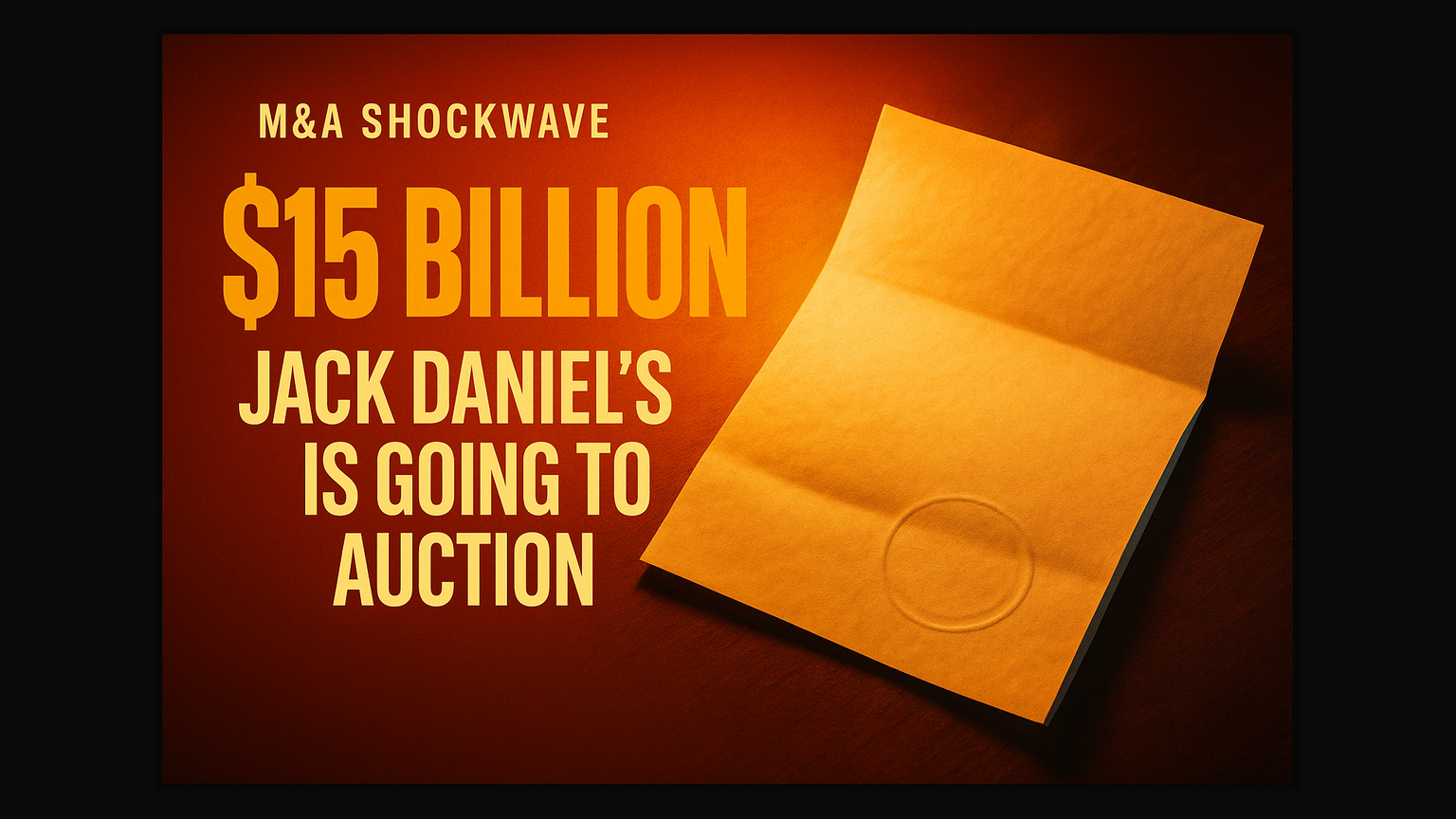
The Cut — April 24, 2026 — Jack Daniel’s Auction Is Now Official — Goldman Sachs Is Advising
In this episode
Today’s biggest move in American whiskey started at 6:02 AM when Brown-Forman filed a Form 8-K with the SEC formally acknowledging two competing acquisition bids — Sazerac at $15 billion all-cash, Pernod Ricard at an undisclosed stock-plus-cash figure. Goldman Sachs is now advising the board. A poison pill is in place. Brown-Forman’s Class B shares…
Mentioned in this episode: Buffalo Trace, Eagle Rare, Weller, Bardstown, Old Forester, Woodford Reserve, Sazerac, BTAC
Read the full transcript
Target runtime: 7:48 Word count: 1,201 Estimated runtime: 8:00 Source: The Cut Daily 2026-04-24
—
This is The Cut. American whiskey, daily.
Jack Daniel’s just hired Goldman Sachs. Brown-Forman filed an SEC disclosure this morning formally putting both the Sazerac and Pernod Ricard bids on record — Goldman Sachs advising means the board is running a real auction, not just managing the news.
I’m John from Chasing the Unicorn Podcast. Here’s what moved today. April 24, 2026.
Today’s Big Move — Brown-Forman files the SEC papers and the auction for Jack Daniel’s is now official. Here’s what happened.
Brown-Forman filed a Form 8-K with the SEC at 6:02 this morning. That’s the required regulatory disclosure when something material happens at a public company. What happened: the board officially acknowledged that both Sazerac and Pernod Ricard have made bids to buy the company.
Sazerac’s offer is $15 billion cash. Full number, no complexity — cash on the table. Pernod Ricard’s proposal is a mix of stock and cash, and the 8-K doesn’t disclose the full amount. But here’s the detail that matters: Pernod has already signed a confidentiality agreement giving them access to Brown-Forman’s private financial information. Sazerac hasn’t. In M&A terms, Pernod is inside the building and Sazerac is still in the lobby.
Brown-Forman also adopted a poison pill — a defensive structure that prevents any single shareholder from quietly accumulating more than 15% of the company without board approval. It doesn’t block a sale. It gives the board control over the timeline and prevents either bidder from going around them directly to shareholders.
The market moved immediately. Brown-Forman’s Class B shares closed Thursday at $47.20 and opened Friday at $54.80 — a 16% gain on roughly 14 million shares before 10 AM. That’s the market pricing in the expectation that a deal gets done.
Goldman Sachs as financial advisor means one specific thing: the board is running a competitive auction, not choosing a preferred buyer quietly. This is how billion-dollar deals actually work — you hire the bank, establish the process, and let the bidders compete.
The Brown family has controlled this company for 156 years through dual-class voting shares. They’re moving deliberately, not quickly.
Nothing on your shelf changes this week. What’s being decided right now is who controls Jack Daniel’s, Woodford Reserve, and Old Forester a year from today. Which makes this a good moment to look at what Brown-Forman actually makes — because today’s First Sip connects directly to one of their bottles on the Chase. The concept is proof and ABV, and if you’ve ever wondered what those numbers actually mean, here’s the foundation.
Today’s First Sip — proof and ABV. You’ll see it on Blood Oath Pact 12 at 98.6 proof and on Old Forester 1920 at 115 proof — and the number on the label is telling you something most drinkers miss.
So here’s what it is.
Proof is twice the alcohol by volume. 80 proof is 40% ABV. 100 proof is 50%. 107 proof is 53.5%. The math never changes.
The reason bourbon uses proof instead of just printing the percentage is historical. In colonial America, if you poured whiskey on gunpowder and lit it, the whiskey was “proven” — above about 50% ABV, the flame held. Below that, the water content put it out. The doubled number is a holdover from that test.
Higher proof isn’t necessarily harsher. Some 120-proof bourbons go down easier than some 90-proof ones — it depends on how well the distillery managed the balance between wood extraction, fermentation, and water chemistry. Higher proof generally means less water was added between the barrel and the bottle. More of the original barrel character stays intact.
The number that matters most isn’t actually the one on the label. It’s the barrel entry proof. Federal rules cap that at 125 proof. Distillers who enter barrels at 110 or 115 instead of the legal maximum tend to get richer, more integrated whiskey — because more water-soluble flavor compounds get pulled from the wood across the full aging run.
What this changes — when you see a 107-proof bottle next to an 80-proof bottle on the same shelf, the higher proof isn’t a warning. It’s telling you how close to the barrel you’re drinking. Speaking of which — today’s Chase has a bottle that earns its 98.6 proof.
Today’s Chase — three bottles across three tiers. Two close their windows this weekend, and one is a Walk-up tomorrow. Let’s start with the one that matters most.
Blood Oath Pact 12 Italian Wine Cask Finish. Mid-tier. $129.99. 98.6 proof. 51,000-bottle national allocation.
Flavor direction first. Sequential Montepulciano and Sangiovese finishing over a ryed bourbon base — what you get is black cherry, leather, spiced cocoa, dried fruit, and baking spice at a finish length that earns the proof. It’s complex without being loud about it.
Here’s why it’s the spotlight. Sequential Italian wine-cask finishing on Kentucky bourbon is genuinely rare territory — this combination doesn’t exist anywhere else in the category right now. The base blend is 9-year and 12-year ryed bourbons, and that base holds up through both casks. The bourbon is present. The finish layers on top of it rather than replacing it. Retail allocation requests are already running well beyond what’s available for the June national rollout.
This is worth the chase. Tomorrow’s walk-up at Lux Row in Bardstown is the cleanest same-day access — no lottery, no waitlist. Show up. If you’re not within driving distance of Bardstown, get your name in at Seelbach’s or ReserveBar before the June pre-allocation window closes on you.
Also on today’s Chase — WhistlePig Rye, White & Blue PiggyBank at $80, a 110-proof collectible decanter running through July 4 — buy it at the entry price on sight, don’t pay secondary. And Blade and Bow 22-Year 2026 at $299.99, pre-order windows are open now and close within 48 hours at most specialty retailers — at that price, it’s the cleanest path to Stitzel-Weller provenance outside the Van Winkle chase. Full detail in today’s Cut Daily. If you want more, head to our Patreon at chasingtheunicornpodcast.
Alright — today’s Bar Talk. The Eagle Rare 30 Bonhams auction opened this morning and the community immediately split on what the opening bids actually mean.
Today’s Bar Talk — Eagle Rare 30 Bonhams Day 1, and whether opening bids at low estimate signal soft demand or just normal auction mechanics. Community’s split on what those numbers are actually telling you. Here’s what’s actually going on.
Lot #1 opened this morning at $9,600 — right at the low end of the pre-sale estimate range. Online reaction split immediately. One camp called it soft demand for Buffalo Trace’s most expensive bottle ever. The other said low-estimate Day 1 bids are exactly what healthy auctions look like.
Here’s how Bonhams-style multi-week online auctions actually work. The window runs 14 days. Most participants register early, place a low placeholder bid to stay visible, and wait. Historical Bonhams data shows approximately 78% of final price action happens in the last 48 hours — when competitive pressure forces escalation and serious bidders stop watching from the sidelines. Day 1 bids are “I’m here” signals, not “this is what I’ll pay” signals. That’s not unique to bourbon. It’s how high-value online auctions have worked for two decades.
The data underneath the debate tells a more specific story. Lot #2 opened at $10,240 — just above the low estimate. Eagle Rare 10-Year six-bottle cases — the drinker tier — had three lots clear their high estimate within the first four hours. Eagle Rare 17 BTAC 2025 lots were tracking at or near their high estimates by midday. The collector-tier lots, Lots #1 and #2, are at the floor. The drinker-tier lots are already above the ceiling. The auction closes May 8 at 11:30 AM EST. That’s when the real number lands.
Here’s what it means for the rest of us — Day 1 bids are placeholders. Three drinker-tier Eagle Rare cases already cleared high estimate. The real number lands May 8.
One more for today — today’s full American Whiskey Industry Brief covers the MGP Lawrenceburg supply transition in full, including which craft and NDP brands built their identity on sourced bourbon and what that tightening means for shelf pricing through 2027. It’s waiting on Patreon.
That’s The Cut. The full American Whiskey Industry Brief is waiting at patreon.com/ChasingTheUnicornPodcast. I’m John Schuster. Thanks for joining me. Your unicorn is out there.
The Cut Daily
Listen to today’s episode and find us on Spotify and everywhere you listen at chasingtheunicornpodcast.com/podcast.

Informational and entertainment purposes only. Nothing here is investment advice. Verify before buying, trading, or bidding. We are not liable for errors or financial losses.
Jack Daniel’s just hired Goldman Sachs. Brown-Forman filed an SEC disclosure this morning formally putting both the Sazerac and Pernod Ricard bids on record — Goldman Sachs advising means the board is running a real auction, not just managing the news.
The biggest move in American whiskey Friday is a formal SEC filing that turns months of industry speculation into a board-level public process. Brown-Forman — the 156-year-old family company that owns Jack Daniel’s, Woodford Reserve, and Old Forester — filed paperwork this morning officially acknowledging that both Sazerac and Pernod Ricard are competing to buy them. Goldman Sachs is now advising. A poison-pill defense is in place. Nothing is decided, but the auction is open. Also today: Blood Oath Pact 12 drops tomorrow at Lux Row in Bardstown with a category-rare Italian wine-cask finish, Blade and Bow 22-Year 2026 specs confirmed at $299.99 with a 48-hour specialty pre-order window, and Eagle Rare 30’s inaugural Bonhams auction opened this morning.
Here’s what changed this morning. Brown-Forman filed a Form 8-K with the SEC at 6:02 AM — the required regulatory disclosure when something material happens at a public company. What happened: the board officially acknowledged that both Sazerac and Pernod Ricard have made bids to buy the company.
Sazerac’s offer is $15 billion cash. That’s the full number — no stock, no complexity, just cash on the table. Pernod Ricard’s proposal is a mix of stock and cash, and the 8-K doesn’t disclose the full amount. But here’s the notable detail: Pernod has already signed a confidentiality agreement giving them access to Brown-Forman’s private financial information. Sazerac hasn’t. In M&A terms, Pernod is inside the building and Sazerac is still in the lobby.
Brown-Forman also adopted a poison pill — a defensive structure that prevents any single shareholder from quietly accumulating more than 15% of the company without board approval. It doesn’t block a sale. It gives the board control over the timeline and prevents either bidder from going around them directly to shareholders.
The market moved immediately. Brown-Forman’s Class B shares closed Thursday at $47.20 and opened Friday at $54.80 — a 16% gain on roughly 14 million shares traded before 10 AM. That’s the market pricing in the expectation that a deal gets done.
Goldman Sachs as financial advisor means one specific thing: the board is running a competitive auction, not choosing a preferred buyer quietly. This is how billion-dollar deals actually work — you hire the bank, establish the process, and let the bidders compete.
The Brown family has controlled this company for 156 years through dual-class voting shares. They’re moving deliberately, not quickly.
Proof is twice the alcohol by volume. 80 proof is 40% ABV. 100 proof is 50%. 107 proof is 53.5%. The math never changes.
The reason bourbon uses “proof” instead of just printing the percentage is historical. In colonial America, if you poured whiskey on gunpowder and lit it, the whiskey was “proven” — above about 50% ABV, the flame held. Below it, the water content put it out. The doubled number is a holdover from that test.
Higher proof isn’t necessarily harsher. Some 120-proof bourbons go down easier than some 90-proof ones — it depends on how well the distillery managed the balance between wood extraction, fermentation, and water chemistry. Higher proof generally means less water was added between the barrel and the bottle. More of the original barrel character stays intact.
The number that matters most isn’t the one on the label — it’s the barrel entry proof. Federal rules cap this at 125 proof. Distillers who enter barrels at 110 or 115 rather than the legal maximum tend to get richer, more integrated whiskey, because more water-soluble flavor compounds get pulled from the wood during the long aging process.
What this changes: When you see a 107-proof bottle next to an 80-proof bottle on the same shelf, the higher proof isn’t a warning. It’s telling you how close to the barrel you’re drinking.
Floor erosion is how much a bottle’s market value has dropped from its all-time high. At 21.6%, the Twisted Spoke 16 is now bidding at roughly 78 cents on the dollar against its 2024 peak. The more instructive number is what’s happening one lot over: the Binny’s 18 Van Winkle — same auction, same closing date, same pre-2005 Stitzel-Weller source — is currently at 8.8% erosion. Both bottles came from the same distillery in the same era. The 13-point gap in floor erosion between them is the market placing a measurable premium on the 18-year age statement over the 16-year. When similar bottles from identical provenance diverge on erosion, the market is pricing age as a durable differentiator, not scarcity or brand name. The Twisted Spoke 16 is softening. The Binny’s 18 is holding.
The Hunt: 6 active drops · Bar Talk: 2 debates · The Secondary: 4 graded bottles
◆ Full AWIB (Paid Patreon Subscriber): https://www.patreon.com/c/ChasingTheUnicornPodcast
◆ Listen on Spotify: https://open.spotify.com/show/56Lt67gvTPjifCyeqFW3IT
◆ YouTube: https://www.youtube.com/@chasingtheunicornpodcast
Want the full picture? The complete American Whiskey Industry Brief — every section, every source, every story — is published daily for subscribers on Patreon. Join us at patreon.com/ChasingTheUnicornPodcast.