Bourbon Backs Rye — 100,000 Signatures Hit Congress — The Cut
In this episode
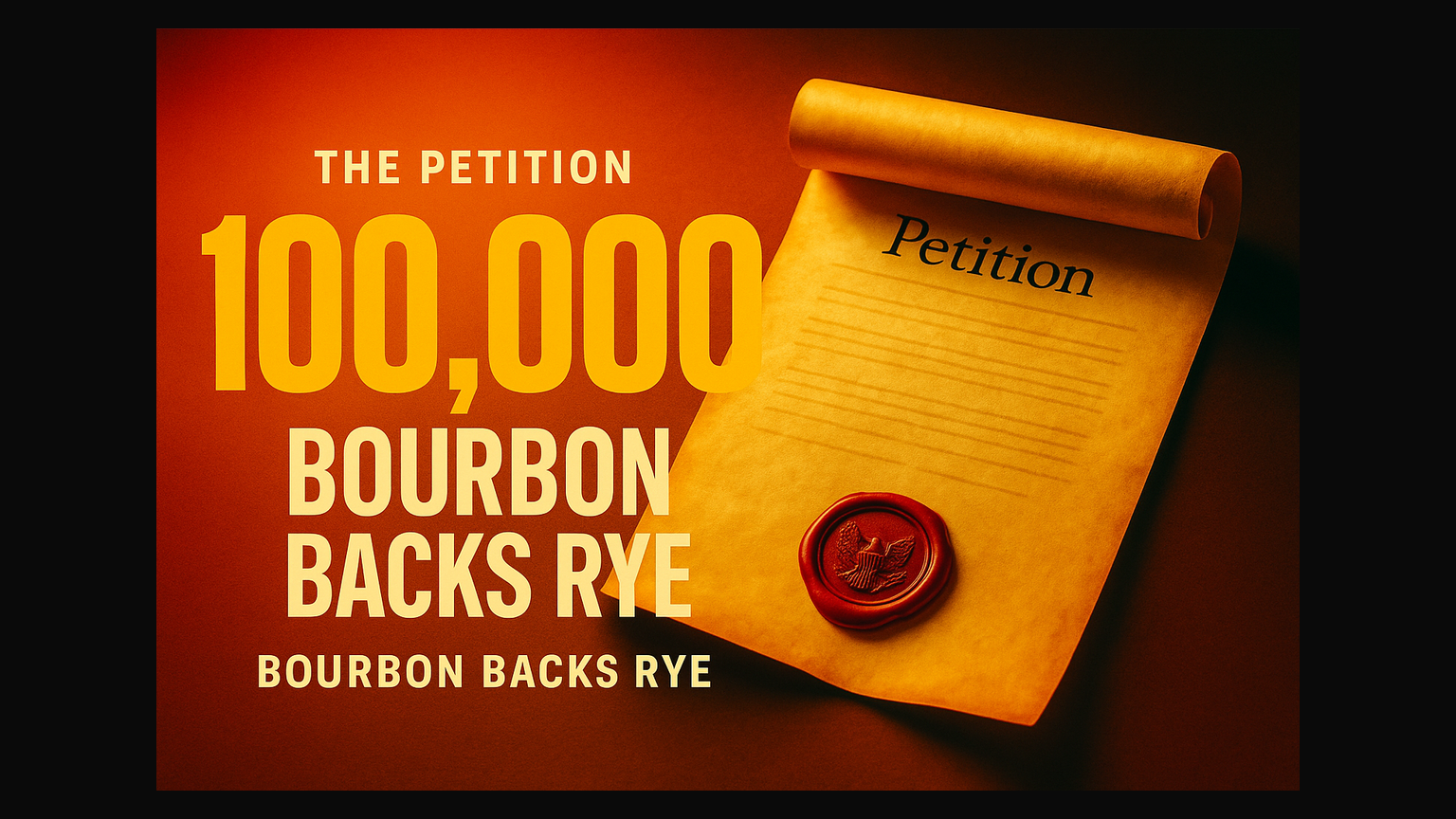
WhistlePig’s campaign for a federal rye whiskey designation hit 100,000 signatures Sunday afternoon — five days ahead of its own schedule — with bipartisan Congressional sponsorship from Senator John Fetterman and Representative Madeleine Dean of Pennsylvania and a July 4 bill introduction now on the calendar. Buffalo Trace followed with its first public statement in…
Mentioned in this episode: Buffalo Trace, Heaven Hill, Angel’s Envy
Read the full transcript
Target runtime: 7:48 Word count: 1,187 Estimated runtime: 7:55 Source: The Cut Daily 2026-04-26
—
This is The Cut. American whiskey, daily.
Buffalo Trace just backed a rye petition. WhistlePig’s campaign for a national rye designation hit 100,000 signatures Sunday — five days early — and Buffalo Trace issued its first category-defense statement the same afternoon. Bourbon and rye are headed to Congress together.
I’m John from Chasing the Unicorn Podcast. Here’s what moved today. April 26, 2026.
Today’s Big Move — rye just got Congress. Here’s what happened.
WhistlePig’s petition to make rye whiskey a federally recognized American heritage category hit 100,000 signatures at 2:47 Sunday afternoon. Five days ahead of the campaign’s own schedule. That’s the kind of number that earns a return call from Congressional staff. And they got more than a call.
Senator John Fetterman has been the campaign’s Senate sponsor since the start. Sunday, he got a House companion: Representative Madeleine Dean of Pennsylvania joined as co-sponsor, putting a July 4 bill introduction on the calendar. The date isn’t accidental. Independence Day. American rye. Pennsylvania origin story. That’s a built narrative with a real target behind it.
But here’s what made Sunday genuinely interesting: Buffalo Trace. America’s most-watched bourbon distillery — whose name is built entirely on bourbon, not rye — issued its first public statement in the whole debate. Not against the petition. A category-defense statement backing broader rye recognition while making clear bourbon’s own identity stays intact.
Before Sunday, this was a WhistlePig marketing campaign that got big. After Sunday, it’s a bipartisan Congressional process with cross-category buy-in from across the shelf. Bourbon just handed rye a credibility upgrade it couldn’t have bought on its own. Nothing on your shelf changes this week. If the bill passes, American rye earns the same federally protected-origin status bourbon carries — and that’s years away. What happened Sunday is that rye got loud enough for Congress to pick up the phone.
That brings us directly to today’s First Sip — because the word you’re going to see on the Blade and Bow 22-Year pre-order confirmations landing in inboxes right now is the concept worth understanding today: allocation.
Today’s First Sip — allocated versus regular release. You’ll see it in real time today with Blade and Bow 22-Year confirmations going out, and most drinkers use the term wrong.
So here’s what it is.
Allocated describes how a bottle is distributed — not how good it is. An allocated bottle is one where the distillery produces fewer bottles than the market wants, so distributors ration them out to retailers in small numbers. It’s a supply constraint working through a three-tier system. It’s not a quality designation.
What it’s not: anything with “limited release” printed on the label. That phrase is marketing. A bottle is actually allocated when retailers run a lottery or wait list, when an MSRP exists but shelf prices vary wildly by region, and when secondary-market prices run multiples of what the bottle used to cost.
Today’s Blade and Bow 22-Year is the cleanest real-world example. 3,600 bottles nationally. Demand running six-to-nine times that at major specialty retailers. Most people who submitted pre-orders won’t be confirmed — not because the system failed, but because the bottle is genuinely short. That’s what allocation is: a real production constraint, not a marketing decision. Think of it like a restaurant with twelve tables. A wait list isn’t a flaw. There are just fewer tables than people who want to eat there.
What this changes — when you see “limited release” on a label, ask whether the bottle runs a lottery. If it does, you’re looking at real allocation. If it’s always on the shelf, you’re looking at marketing. Speaking of real allocation — today’s Chase has one of the cleanest annual cask-strength values in the accessible-premium tier, and its window closes in five days.
Today’s Chase — three bottles across three tiers. All three are finishing-cask expressions available at MSRP right now. Let’s start with the one that matters most.
Angel’s Envy Cask Strength 2026. Mid-tier, at $89.99.
In the glass: ripe cherry, dark plum, and dried fruit from the port-barrel finish, with vanilla, caramel, and baking spice from the straight bourbon base underneath. The batch-strength proof — approximately 121 this cycle — gives you a warming, oily mouthfeel and a long port-sweetened finish. Non-chill-filtered. This is a bottle that earns its proof.
Here’s why it’s the spotlight: Angel’s Envy Cask Strength is the most consistent annual cask-strength value in the accessible-premium category. Port-barrel finishing done correctly over a legitimate bourbon base, at barrel proof, under $90. That combination doesn’t happen often at this price. The allocation window closes around May 1. That’s five days from today.
This is worth the chase. Buy on sight. It’s available at specialty retail across Heaven Hill distribution markets nationally. Use the Angel’s Envy retail locator at angelsenvy.com to find your closest account.
Also on today’s Chase — Hard Truth Barrel Finish Reserve, French Oak Cask, in the under-$80 tier, $79.99 at Indianapolis, Chicago, and Columbus specialty retail through end of month. French oak cask finishing on a craft bourbon under $80 is worth a look if you’re in the Midwest this week. And Blade and Bow 22-Year 2026 in the premium tier at $299.99 — if your pre-order was confirmed, claim it by April 30. If it wasn’t, May 18 retail arrival is your last shot at MSRP; historical shelf clearance at major specialty accounts runs 24 to 72 hours. Full detail in today’s Cut Daily. If you want more, head to The Brief at chasingtheunicornpodcast.
Which brings us to today’s Bar Talk — the question that lit up r/bourbon Sunday morning.
Today’s Bar Talk — pre-order lottery versus state lottery. Community’s split on which system actually works better for buyers chasing allocated bourbon. Here’s what’s actually going on.
Blade and Bow 22-Year confirmation emails started landing Sunday morning, and the debate that followed is genuinely worth understanding. Is the specialty-retailer pre-order model fairer than a state ABC lottery? Both gate access to the same scarce bottle through different mechanisms, and each has real advantages and real blind spots.
Here’s the math. Binny’s received approximately 380 bottles for its pre-order window. About 3,420 customers submitted — a 9-to-1 oversubscription ratio. Seelbach’s ran 6-to-1. Total national allocation: 3,600 bottles across the whole country. At those ratios, most submitters were always going to get non-confirmations. No lottery design changes that. The bottle is short. That part is upstream of any retailer’s decision.
Where the pre-order model does outperform a single state lottery: entry flexibility. Submissions were non-binding. You could enter multiple retailers in multiple states at the same time. A traditional state ABC lottery locks you to one entry, one state, one date. A buyer in Illinois could enter Binny’s, Seelbach’s in Kentucky, and Total Wine in a third state simultaneously — that’s a real structural advantage. The trade-off is transparency. State lottery methodology is typically public. Retailer pre-order weighting is not.
Here’s what it means for the rest of us — the pre-order model gives you more at-bats than a single state lottery. May 18 is your last shot at $299.99 — after that, it’s secondary prices.
One more for today — today’s full American Whiskey Industry Brief has the complete Westland Garryana 7 chase call, with the mailing list timeline and secondary velocity data on the program’s 2026 floor. Only 449 bottles remain after the distillery walk-up cleared Saturday in 90 minutes. It’s waiting at chasingtheunicornpodcast.com.
That’s The Cut. The full American Whiskey Industry Brief is waiting at chasingtheunicornpodcast.com/the-brief/. I’m John F. Schuster II. Thanks for joining me. Your unicorn is out there.
The Cut Daily
Listen to today’s episode and find us on Spotify and everywhere you listen at chasingtheunicornpodcast.com/podcast.

Informational and entertainment purposes only. Nothing here is investment advice. Verify before buying, trading, or bidding. We are not liable for errors or financial losses.
Buffalo Trace just backed a rye petition. WhistlePig’s campaign for a national rye designation hit 100,000 signatures Sunday — five days early — and Buffalo Trace issued its first category-defense statement the same afternoon. Bourbon and rye are headed to Congress together.
In American whiskey’s biggest policy moment in years, WhistlePig’s petition for a federal rye whiskey designation hit six figures Sunday afternoon with bipartisan Congressional sponsorship from Senator Fetterman and Representative Madeleine Dean — and then Buffalo Trace stepped in with a statement nobody saw coming. Today we’re covering what the petition actually asks for and what it means for your shelf, unpacking how the Blade and Bow 22-Year pre-order lottery system worked and what to do if you didn’t get confirmed, and showing you which finishing-cask bottles are still sitting at MSRP in the Midwest this week.
WhistlePig’s petition to make rye whiskey a federally recognized American heritage category hit 100,000 signatures at 2:47 Sunday afternoon — five days ahead of the campaign’s own schedule. That’s the kind of number that earns a return call from Congressional staff. And they got more than a call.
Senator John Fetterman, the campaign’s Senate sponsor since the start, now has a House companion: Representative Madeleine Dean of Pennsylvania joined as co-sponsor Sunday, putting a July 4 bill introduction on the calendar. The date isn’t accidental. Independence Day, American rye, Pennsylvania origin story. That’s a built narrative, and it has a real target.
But here’s what made Sunday genuinely interesting: Buffalo Trace. America’s most-watched bourbon distillery — whose name is built entirely on bourbon, not rye — issued its first public statement in the whole debate. Not against the petition. A category-defense statement backing broader rye recognition while making clear bourbon’s own identity stays intact.
Before Sunday, this was a WhistlePig marketing campaign that got big. After Sunday, it’s a bipartisan Congressional process with cross-category buy-in from across the shelf. Bourbon just handed rye a credibility upgrade it couldn’t have bought on its own.
The WhistlePig Rye, White and Blue commemorative bottle tied to the campaign is available at MSRP in most markets right now if the shelf story matters to you.
“Allocated” describes how a bottle is distributed — not how good it is. Allocated bottles are bottles the distillery produces in limited quantities, where demand exceeds supply, so distributors ration them to retailers in small numbers.
The classic allocated bourbons are Pappy Van Winkle, the Buffalo Trace Antique Collection, Four Roses Limited Edition, Old Forester Birthday, Parker’s Heritage. These are allocated because their production is genuinely constrained — aging cycles are long, the barrels that qualify are limited, and the distillery’s output is fixed.
Not everything called “rare” is actually allocated. Marketing loves the word. Allocation is a distribution reality — you can tell a bottle is actually allocated when retailers announce it through a lottery or wait list, when MSRPs exist but retail prices vary wildly by region, and when secondary-market prices run multiples of what the shelf used to charge.
Today’s Blade and Bow 22-Year pre-order confirmation results are a clean real-world example. Three thousand six hundred bottles nationally. Demand running 6-to-9 times that at major specialty retailers. Most submitters won’t be confirmed — not because the system failed, but because the bottle is genuinely in short supply. That’s what allocation actually is: a real production constraint working its way through a three-tier system that has no obligation to be fair, only to move inventory.
What this changes: When you see “limited release” on a label, ask whether the bottle runs a lottery. If it does, you’re looking at real allocation. If it’s always on the shelf, you’re looking at marketing.
Floor erosion is how much a bottle’s market value has dropped from its all-time high. Ten percent erosion on the Twisted Spoke 16 means the bottle sold Sunday for about ten percent less than the highest price ever recorded for it. That number becomes meaningful when you compare it to the other Van Winkle private barrels in the same auction: the Binny’s 18 came in at 1.7% erosion, and the Pappy 23 Private Barrel at 5.2%. The Twisted Spoke 16 is sitting at a noticeably wider spread from its peak — not because the bottle is lower-quality, but because it occupies an awkward pricing tier. At $52,000 to $58,000, it competes for collector attention with the standard annual Pappy allocation cycle, where Pappy 15 and 20 trade on the secondary each fall. That overlap creates pricing pressure the ultra-long-age, ultra-rare bottles above it don’t face.
The Hunt: 5 active drops · Bar Talk: 2 debates · The Secondary: 3 graded bottles
◆ The Brief (free): https://chasingtheunicornpodcast.com/the-brief/
◆ Listen on Spotify: https://open.spotify.com/show/56Lt67gvTPjifCyeqFW3IT
◆ YouTube: https://www.youtube.com/@chasingtheunicornpodcast
Want the full picture? The complete American Whiskey Industry Brief — every section, every source, every story — is published free every morning at chasingtheunicornpodcast.com. Read it at chasingtheunicornpodcast.com/the-brief/.