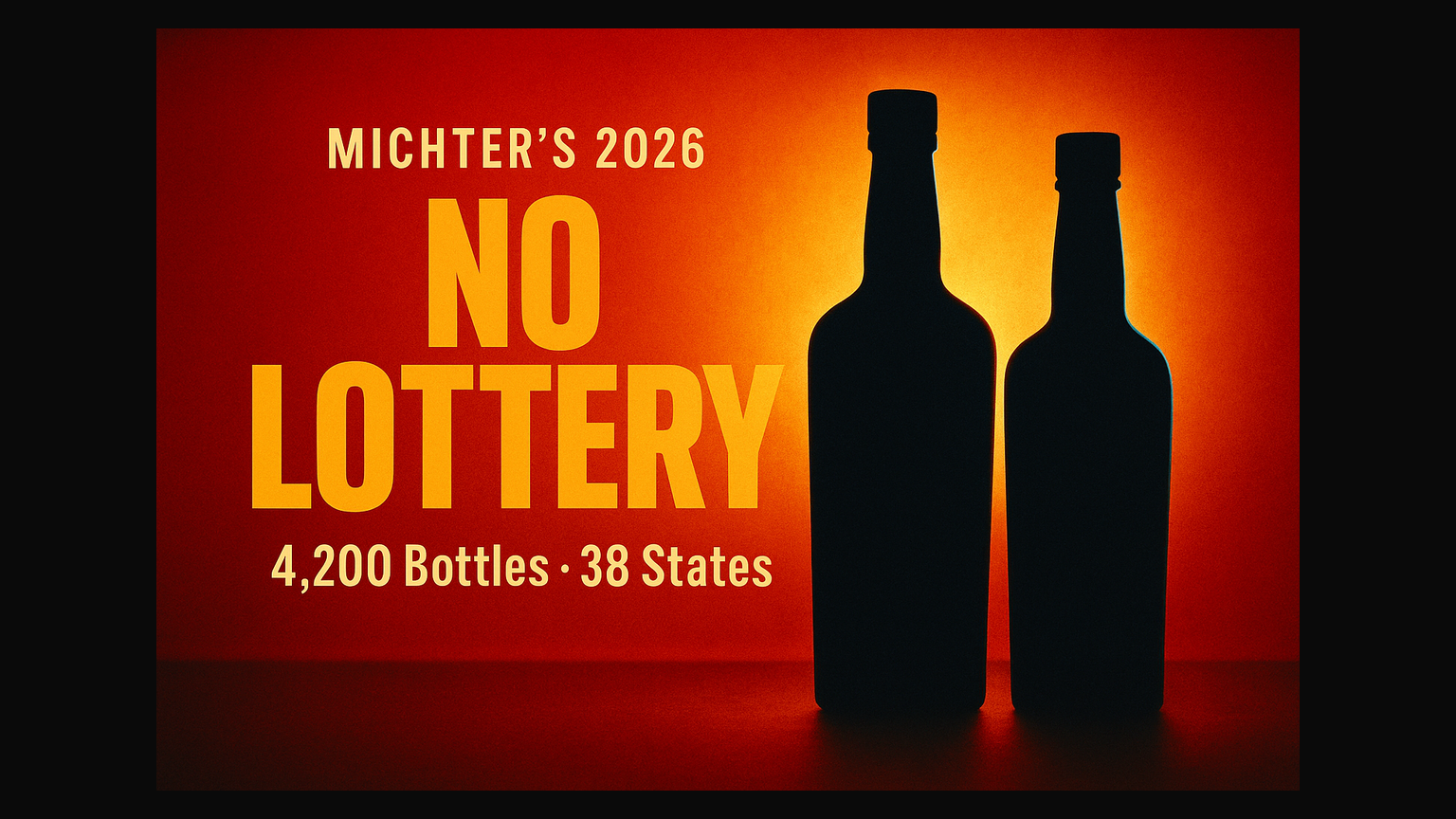
The Cut — April 27, 2026 — Michter’s 2026: 4,200 Bottles, No Lottery
In this episode
Michter’s Distillery confirmed Monday that both 2026 Legacy Series expressions — Shenk’s Homestead Sour Mash Whisky and Bomberger’s Declaration — are locked in at 91.4 proof and $99.99 suggested retail, with a combined 4,200-bottle allocation across 38 states. The 4,200-bottle combined figure is the largest in the Legacy Series’ history, up from 3,600 in 2025,…
Mentioned in this episode: Wild Turkey, Michter’s, Angel’s Envy, Sazerac
Read the full transcript
Target runtime: 7:48 Word count: 1,198 Estimated runtime: 7:59 Source: The Cut Daily 2026-04-27
—
This is The Cut. American whiskey, daily.
Four thousand bottles. No lottery required. Michter’s 2026 Legacy Series — Shenk’s Homestead and Bomberger’s Declaration — lands in 38 states the first week of May at $99.99 each. No lottery gate in most markets. This is the year you actually get one.
I’m John from Chasing the Unicorn Podcast. Here’s what moved today. April 27, 2026.
Today’s Big Move — Michter’s 2026 Legacy Series is confirmed, and the allocation math changed. Here’s what happened.
Michter’s Distillery confirmed Monday that both 2026 Legacy Series expressions — Shenk’s Homestead Sour Mash Whisky and Bomberger’s Declaration — are locked in at 91.4 proof and $99.99 suggested retail. Combined allocation: 4,200 bottles across 38 states. That’s the largest combined Legacy Series allocation in the line’s history. Last year it was 3,600. Six hundred more bottles sounds like a small move. In a line that typically runs lottery gates at most specialty accounts, it’s not.
What the number means practically: more bottles per account across Michter’s specialty distributor footprint. The strategy shifts from lottery submission to showing up. No lottery gate in most markets. It’s on the shelf, you buy it. The Fort Nelson Distillery visitor center in Louisville gets a walk-up allotment starting May 5 — no reservation required.
There’s a production story underneath this worth knowing. Michter’s has been building toward its own grain-to-glass endpoint for years, supplementing with sourced whiskey while its Fort Nelson Distillery inventory matured. The 2026 Legacy Series carries a higher proportion of Fort Nelson own-distilled stock than any prior vintage. That’s a real provenance shift — not a press-release claim.
The names themselves carry history. Shenk’s Homestead honors the Shenk family distilling site in Schaefferstown, Pennsylvania, established in 1753. Bomberger’s honors Michael Bomberger, who operated the same site in the mid-1800s. Contemporary Michter’s produces from Louisville, but the Legacy Series names are the brand’s annual acknowledgment of that lineage. First distribution hits Kentucky and Tennessee specialty accounts in the first week of May, rolling nationally through late May.
That production story connects directly to today’s First Sip — because what you’re seeing on those Legacy Series labels is the concept worth understanding today: age statements, and what it means when one goes missing.
Today’s First Sip — age statements versus no-age-statement bottlings. It connects directly to MGP Ingredients’ first-quarter earnings, and most drinkers treat the difference as marketing noise when it’s actually a commitment.
So here’s what it is.
An age statement — “Aged 10 Years” on the label — means the youngest whiskey in that bottle is 10 years old. If the distillery blended in some 12-year and some 14-year, the label still reads 10. The rule is the age of the youngest drop in the blend, not the average.
No Age Statement, NAS, means the distillery isn’t committing to a minimum. Could be 6-year. Could be 12-year. Could be a range that shifts year to year. You don’t know, because they’re not telling you.
Today’s MGP story makes this concrete. MGP Ingredients in Lawrenceburg, Indiana supplies bulk whiskey to dozens of nationally distributed brands — labels you recognize that don’t say “distilled in Indiana” anywhere on the bottle. Their Q1 earnings confirmed those NDP brands are drawing down existing aging inventory rather than ordering fresh new-make spirit. For those brands, the age of what’s going into the bottle right now is a function of when inventory was laid down during the 2021-to-2023 demand peak. A dropped age statement on a label you’ve been buying is almost always the first consumer-visible signal that the math changed somewhere upstream.
Think of it like a restaurant that used to list the vintage on the wine menu. When the vintage disappears, it’s not because they got shy. It’s because what’s in the glass this year is different from what was in the glass last year, and they’d rather not explain it.
What this changes — age statements are promises. Missing age statements are possibilities. Dropped age statements, especially during a supply correction, are almost always warnings.
Today’s Chase — three bottles across three tiers. Two are port and French oak finishing stories, one is a 22-year age statement that deserves its own segment. Let’s start with the one that matters most.
Hard Truth Barrel Finish Reserve, French Oak Cask. Under-$80 tier, $79.99.
In the glass: toasted almond, brioche, and mild dry spice layered over caramel and corn sweetness. The 100-proof bottling keeps the French oak tannin restrained — food-friendly, not aggressive. This isn’t a cask that’s bulldozing the base whiskey. It’s adding texture.
Here’s why it’s the spotlight: French oak cask finishing on a craft bourbon under $80 is an unusual category move. Most accessible-premium finishing programs default to port or sherry — they’re reliable, they’re popular, and they’re safe. Hard Truth went French oak instead. The toasted almond and dry-spice differentiation is real. It’s not an allocation chase; this is a shelf buy when it shows up at your Midwest specialty account this week. Indianapolis, Chicago, and Columbus specialty retail starting today through end of month. Hard Truth Hills distillery in Nashville, Indiana for anyone making the drive.
Worth watching. If you’re in the Midwest and see it, pick it up. At $79.99 it’s a low-risk trial on a finishing approach that earns the price point.
Also on today’s Chase — Angel’s Envy Cask Strength 2026 in the mid-tier at $89.99, port-barrel finish at approximately 121 proof, allocation window closes around May 1 — buy on sight. And Blade and Bow 22-Year 2026 in the premium tier at $299.99 — confirmed pre-orders claim through April 30, non-confirmed get a May 18 specialty retail window that historically clears in 24 to 72 hours. Full detail in today’s Cut Daily. If you want more, head to our Patreon at chasingtheunicornpodcast.
Alright — today’s Bar Talk. The Uncle Nearest sale debate on r/bourbon this week is better than most community ownership arguments, because it landed on the right question.
Today’s Bar Talk — does it matter who buys Uncle Nearest? Community’s split on whether ownership structure actually changes what’s in the bottle. Here’s what’s actually going on.
The who-cares camp says production decisions survive ownership changes all the time. The independence-matters camp says this brand is different — Fawn Weaver’s founding narrative isn’t marketing layered over a commodity product, it’s the product. Both camps are partially right, and neither is asking the more specific question that resolves it.
Here’s how ownership changes actually work in spirits. The change doesn’t arrive at the barrel on closing day. It arrives at the capital-allocation level, usually 12 to 24 months later. Whoever controls the budget decides how much gets spent aging new inventory, how many SKUs stay on the shelf, and whether the founder stays in the room. A strategic acquirer — Diageo, Beam Suntory, Bacardi, Pernod — folds the brand into an existing portfolio and subjects it to parent-company targets on a fast timeline. A financial acquirer — private equity — typically preserves operating management for a five-to-seven-year hold-and-exit cycle, then sells again. For a founder-identity brand like Uncle Nearest, that’s not philosophical. It’s the difference between Fawn Weaver making production decisions in 2028 or a portfolio manager making them.
The current floor bid is $725 million from L Catterton, a private equity firm. That’s 14 to 16 times Uncle Nearest’s reported 2025 net sales of approximately $46 million — a growth-premium multiple that says the buyer believes the brand’s trajectory justifies paying well above a mature-brand price. A 30-to-45-day competing-offer window is running. Diageo has a structural complication: they currently supply Uncle Nearest’s whiskey through George Dickel in Tullahoma. An acquisition would consolidate supply and brand under one roof, raising distributor-concentration questions that likely removes them from the realistic bidder pool.
Here’s what it means for the rest of us — Uncle Nearest’s fate at the barrel comes down to whoever controls capital at Shelbyville, and that name isn’t public yet.
One more for today — today’s full American Whiskey Industry Brief has the complete Sazerac FTC response analysis: the conditional divestiture framework they submitted Monday through outside counsel, why Wild Turkey is the community’s leading divestiture candidate, and what it means for the Brown family’s next move. It’s waiting on Patreon.
That’s The Cut. The full American Whiskey Industry Brief is waiting at patreon.com/ChasingTheUnicornPodcast. I’m John Schuster. Thanks for joining me. Your unicorn is out there.
The Cut Daily
Listen to today’s episode and find us on Spotify and everywhere you listen at chasingtheunicornpodcast.com/podcast.

Informational and entertainment purposes only. Nothing here is investment advice. Verify before buying, trading, or bidding. We are not liable for errors or financial losses.
Four thousand bottles. No lottery required. Michter’s 2026 Legacy Series — Shenk’s Homestead and Bomberger’s Declaration — lands in 38 states the first week of May at $99.99 each. No lottery gate in most markets. This is the year you actually get one.
Michter’s just confirmed specs on its 2026 Legacy Series — Shenk’s Homestead Sour Mash Whisky and Bomberger’s Declaration — with the biggest combined allocation in the line’s history arriving across 38 states in early May, no lottery required in most markets. That’s today’s lead, and it’s an actionable one. Today’s Cut also explains what MGP Ingredients’ first-quarter earnings mean for every bottle on your shelf that doesn’t say where the whiskey was made — in plain terms, not earnings-call language — and gets into the Uncle Nearest sale debate that r/bourbon is actively running: does it actually matter who buys the brand, or does that change happen three owners later?
Michter’s Distillery confirmed Monday that both 2026 Legacy Series expressions — Shenk’s Homestead Sour Mash Whisky and Bomberger’s Declaration — are locked in at 91.4 proof and $99.99 suggested retail, with a combined 4,200-bottle allocation spread across 38 states. That 4,200-bottle number is the largest combined Legacy Series allocation ever. Last year it was 3,600.
What that difference means practically: more bottles per account across Michter’s specialty distributor footprint, which shifts the strategy away from lottery submission and toward showing up. No lottery gate applies in most markets. It’s on the shelf. You buy it. The Fort Nelson Distillery visitor center in Louisville gets a small walk-up allotment starting May 5 — no reservation required.
There’s a production story worth knowing. Michter’s has been building toward its own grain-to-glass endpoint for years, supplementing with sourced whiskey while its Fort Nelson Distillery inventory matured to usable age. The 2026 Legacy Series editions carry a higher proportion of Fort Nelson own-distilled stock than any prior vintage — a real provenance shift, not a press-release claim. The Legacy Series names reference Michter’s pre-Prohibition Pennsylvania roots: Shenk’s Homestead honors the Shenk family distilling site in Schaefferstown, Pennsylvania, established in 1753. Bomberger’s honors Michael Bomberger, who operated the same site in the mid-1800s. Contemporary Michter’s produces from Louisville, but the names are the brand’s annual acknowledgment of that lineage.
First distribution hits Kentucky and Tennessee specialty accounts in the first week of May, rolling out nationally through Michter’s distributor network into late May. At $99.99 with the largest allocation in line history, both expressions deliver more provenance and age complexity per dollar than nearly anything else in the specialty-premium tier.
“Aged 10 years” on a label means something specific. It means the youngest whiskey in that bottle is 10 years old. If there’s older whiskey blended in — some 12-year, some 14-year — the label still reads 10, because the rule is the age of the youngest drop in the blend, not the average.
“No Age Statement” (NAS) means the distillery isn’t committing to a minimum. They might be using 6-year whiskey. They might be using 12-year. They might be blending across a range that shifts year to year.
Today’s MGP story makes this concrete. MGP Ingredients in Lawrenceburg, Indiana supplies bulk whiskey to dozens of nationally distributed brands — labels you know that don’t say “distilled in Indiana” on the side. Their Q1 earnings confirmed that those NDP brands are drawing down existing aging inventory rather than ordering fresh new-make spirit. For those brands, the age of what’s going into the bottle right now is a function of when the inventory was laid down during the 2021-to-2023 demand peak — not a fresh production decision this year. A dropped age statement on a label you’ve been buying is almost always the first consumer-visible signal that the math changed somewhere upstream.
What this changes: Age statements are promises. Missing age statements are possibilities. Dropped age statements — especially during a supply correction — are almost always warnings.
Floor erosion is how much a bottle’s realized sale price has dropped from its all-time high. Blade and Bow 22-Year 2025 peaked at $650 in June 2025 — roughly 45 days after the 2025 vintage hit specialty retail. It sold at auction this week at $560, which is 13.8% below that peak. The compression pattern is typical of annually-recurring allocated releases: as the next vintage approaches retail, holders who paid peak secondary start discounting to move inventory before the new bottle lands at MSRP. With the 2026 Blade and Bow confirmed at $299.99 and arriving on specialty retail May 18, the 2025’s secondary floor will continue to erode toward that date. The more useful data point is the implied 2026 trajectory: if the 2026 reaches secondary at or above $575 within 60 days of retail — which prior Blade and Bow secondary behavior and the 9-to-1 pre-order oversubscription both suggest it will — the 2025 peak-secondary holders are looking at a net-negative position relative to buying the 2026 at shelf.
The Hunt: 5 active drops · Bar Talk: 2 debates · The Secondary: 3 graded bottles
◆ Full AWIB (Paid Patreon Subscriber): https://www.patreon.com/c/ChasingTheUnicornPodcast
◆ Listen on Spotify: https://open.spotify.com/show/56Lt67gvTPjifCyeqFW3IT
◆ YouTube: https://www.youtube.com/@chasingtheunicornpodcast
Want the full picture? The complete American Whiskey Industry Brief — every section, every source, every story — is published daily for subscribers on Patreon. Join us at patreon.com/ChasingTheUnicornPodcast.