
August 25, 2026
Who Actually Pays When a Tariff Hits a Liquor Shelf?
Or subscribe where you already listen
New episode every weekday morning. The Cut Weekend lands Saturday and Sunday.
Read the full transcript
This is The Cut.
Talks between Washington and Ottawa fell apart over the weekend, and a fifty percent tariff on Canadian wine and spirits took effect Saturday morning. Crown Royal. Fireball. Two bottles that sit in nearly every bar in this country. Who actually pays for a tariff — the country it's aimed at, or you?
I'm John from Chasing the Unicorn Podcast. Everything you're about to hear came out of this morning's brief — these are the arguments in it worth having.
One side says this is overdue. For a year and a half American producers have been shut out up north — most Canadian provinces pulled American bottles entirely, exports fell seventy percent from March through December, and only Alberta and Saskatchewan have let them back. The Distilled Spirits Council calls that discriminatory treatment that has run for eighteen months, and their argument is straightforward: you cannot have a one-way border. Pressure is the only thing that reopens it.
The other side does the arithmetic on who holds the bottle when the bill arrives. Crown Royal moves roughly two point four billion dollars a year at American retail. Fireball, about one point four five. Those aren't Canadian bars — they're American bars, American back-bars, American shot glasses. The importer pays the tariff, the distributor carries it, the bar passes it along, and the person who ends up covering it is whoever orders a Fireball on a Friday night in Ohio.
Both of those are true, and they're true on different clocks. In the short run this is a domestic cost shock — the money comes out of American pockets months or years before any province changes a policy. In the long run the retaliation case has real substance, because eighteen months of a closed border isn't a negotiating position, it's a status quo. I think we eat it first, and we ought to say so plainly rather than pretend a tariff is something that happens to somebody else.
Who actually pays for a tariff — the country it's aimed at, or you?
Tell me where you land on that. Comments, name on it, and I'd genuinely like to hear from anybody working behind a bar right now.
Second question. Redwood Empire just put out a whiskey called The Hyperion — and it isn't a bourbon. It isn't a rye either. It's thirty-two percent bourbon, thirty percent rye, twenty-five percent wheat whiskey and thirteen percent American single malt, pulled from about seventy-nine barrels aged between seven and fourteen years, across Indiana, Kentucky and Tennessee, bottled unfiltered at a hundred and ten proof. Four different whiskeys in one bottle. Innovation, or a way to use up barrels?
The people who call it innovation point at how rare it is. American whiskey almost always stays inside its own lane — a bourbon is a bourbon, a rye is a rye, and the categories exist because the government defines them by grain. Deliberately crossing four of them is a blender's exercise, not a distiller's, and blending is the discipline that built Scotch and Irish whiskey into what they are. It's also honest about being sourced: the company is telling you it bought whiskey from three states and did the assembly itself.
The people who call it a gimmick point at the barrel count. Seventy-nine barrels, four categories, ages spread from seven all the way to fourteen. That is not a recipe, they'd say — that's an inventory. And no future batch will repeat the blend, which is either a charming admission that every year is different or a very convenient way of guaranteeing nobody can ever compare Batch Two to Batch One.
Either way, the word on that label is doing far less work than you think — and it runs straight into the cooperages we went through yesterday. On an American label, "blended" is a legal word, not a compliment. It means whiskeys combined — nothing about quality, nothing about where, nothing about who distilled any of it. And that's the part nobody says out loud: a blend is also what you do with barrels that didn't turn into anything else on their own. Both things are true at the same time, which is exactly why the word tells you so little.
I land on innovation, narrowly, and the ages are what decide it. A fourteen-year barrel is not something you have lying around by accident, and nobody puts one into a dump job. Somebody chose it.
Now, I could be wrong, and I'll make the case against myself. If four categories genuinely made a better whiskey, the people with the deepest stocks in Kentucky would have been doing it for eighty years, and they haven't. Maybe the reason blending across categories is rare in America is not regulation or tradition. Maybe it's that it usually doesn't improve anything, and this is one company with more whiskey types than shelf space finding a story that fits.
Four different whiskeys in one bottle. Innovation, or a way to use up barrels?
Comments below, and be blunt about it. I'd rather have thirty people calling it a gimmick than nobody saying anything.
Third question, and it's the one you'll hear about all week. Two members of the Brown family — the family behind Brown-Forman, which is Jack Daniel's, Woodford Reserve and Old Forester — sent the board a letter calling the company's decline stark and undeniable. It went public days after the chief executive announced his retirement. When the people complaining can't outvote the people they're complaining about, does the complaint do anything?
The case for no is arithmetic. The branch of the family that holds the controlling votes — about sixty percent of them — did not sign this letter. Until that bloc moves, a letter is a letter. Public family disputes at controlled companies are often less about strategy than about leverage inside the family, and the board is under no obligation to answer any of it.
The case for yes is timing. The company's stock has fallen from the mid-seventies to the mid-twenties in three years. Sales were flat at three point nine billion. They shipped more cases than the year before and made less money doing it. And the letter landed during a live search for a new chief executive. Nobody takes that job now without knowing that a section of the founding family is already on record, in public, saying the last few years were unacceptable.
The letter changes nothing about the vote and everything about the job. Whoever gets hired has no honeymoon. That's not nothing — it's the difference between three quiet years to turn something around and about three quarters.
When the people complaining can't outvote the people they're complaining about, does the complaint do anything?
One line in the comments is all I need on this one. Does it matter, or is it noise?
There are five new label filings sitting in the brief that I didn't touch — including the full blend architecture on that Hyperion, every percentage, every state, every age. Everything I argued this morning is sourced in there, next to what's worth chasing and what the secondary market did to any of it. If you think I got one of these wrong, that's where you'd go to prove it.
That's The Cut. Follow the show wherever you listen, so the next one finds you first. The full American Whiskey Industry Brief is free every morning at chasingtheunicornpodcast.com. I'm John Schuster. Thanks for joining me. Your unicorn is out there.
Listen to today's episode and find us on Spotify and everywhere you listen at chasingtheunicornpodcast.com/episodes.

Informational and entertainment purposes only. Nothing here is investment advice. Verify before buying, trading, or bidding. We are not liable for errors or financial losses.
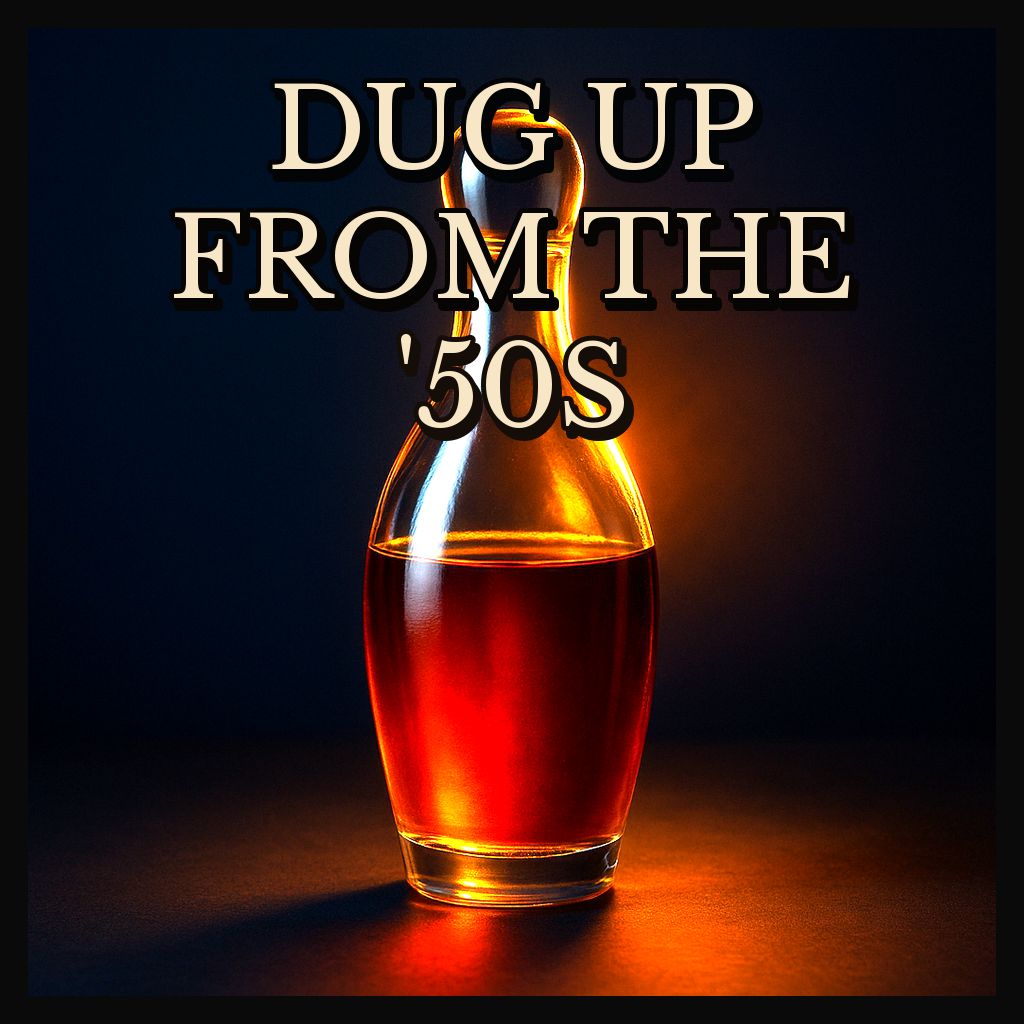
Jim Beam just dug up a bowling pin. A 1950s decanter shaped like one — once handed out as a gift to distillery workers — is back, filled with real 10-year, 100-proof bourbon, and sold only at one address in Clermont.
Jim Beam brought back a bottle shape nobody expected to see again — and put a genuine 10-year bourbon inside it, not a display piece. That matters because most heritage-decanter revivals skip the age statement entirely; this one didn't. Today's edition also unpacks a federal tariff that just hit Crown Royal and Fireball overnight, a new four-whiskey blend from California, and a raffle closing tomorrow with ten shots at allocated Buffalo Trace bottles.
Back in the 1950s, Jim Beam gave its distillery workers a strange gift: bourbon in a bottle shaped like a bowling pin. It was a novelty, a keepsake, nothing more. This week, Beam brought the shape back — but not as a throwaway. The new Ten-Pin decanter holds a real 10-year-old Kentucky Straight Bourbon, bottled at a full 100 proof. That's a meaningful commitment. Most heritage-shaped revivals skip the age statement and just use whatever's on hand, because the bottle is the point, not what's inside it. Beam did the opposite here. You can only get it one place: The American Outpost, the retail shop at the Beam distillery in Clermont, Kentucky. It's $124.99, quantities are limited, and it's tied to Jim Beam Day, marking more than 230 years of the family's bourbon-making history. Eighth-generation master distiller Freddie Noe said it plainly: this is "one of those pieces of Beam history that people remember." No online sales. No shipping. You have to show up. That's unusual in 2026, when most limited releases run through a website or a lottery. This one runs through a parking lot in Clermont.
The mash bill is the grain recipe that goes into the still before anything is distilled — every bourbon is at least 51% corn, and the rest of the recipe is where the flavor direction gets decided. Rye adds spice and a sharper finish. Wheat softens things, rounder and mellower. Malted barley helps fermentation along and adds a biscuit-like note. Today's news gives you an unusual case study: Redwood Empire's new Hyperion blend doesn't stick to one mash bill at all — it combines bourbon, rye, wheat whiskey, and single malt into one bottle, at 32%, 30%, 25%, and 13% respectively. Most American whiskey stays inside one category. This one deliberately doesn't. You don't need to buy a $99 blend to learn the lesson, though. Grab a wheated bottle like Maker's Mark and a high-rye bottle like Bulleit, taste them side by side, and you'll feel the mash bill difference immediately — one softer, one spicier, same legal category.
"Floor erosion" usually describes how far a bottle's resale price has fallen from its peak. This one's different — there's no fresh number to report, because the story right now is uncertainty, not a price move. A public letter from Brown-Forman family members calling the company's decline "stark and undeniable" has collectors watching the brand's annual allocated release more closely than usual heading into September.
Rickhouse Report: 5 stories · Regional Report: 3 stories
◆ The Brief (free): https://chasingtheunicornpodcast.com/the-brief/
◆ Listen on Apple Podcasts: https://podcasts.apple.com/us/podcast/chasing-the-unicorn-bourbon-american-whiskey/id6788592653
◆ Listen on Spotify: https://open.spotify.com/show/1IZS2wXY7nAUcL9akukblE
◆ YouTube: https://www.youtube.com/@chasingtheunicornpodcast
Want the full picture? The complete American Whiskey Industry Brief — every section, every source, every story — is published free every morning at chasingtheunicornpodcast.com. Read it at chasingtheunicornpodcast.com/the-brief/.
Chasing a specific bottle? The Bourbon Release Calendar lists every lottery deadline, walk-up window and MSRP we're tracking — updated every morning.
Mentioned in this episode: E.H. Taylor, Buffalo Trace, Eagle Rare, Weller, Wild Turkey, Maker's Mark, Jim Beam, Old Forester, Woodford Reserve, Blanton's, Sazerac, BTAC