June 6, 2026
Wild Turkey Rickhouse K: $125, Three Floors, Last Sessions Today
Or subscribe where you already listen
New episode every weekday morning. The Cut Weekend lands Saturday and Sunday.
Read the full transcript
This is The Cut.
Three pours from the same warehouse — upper floor, middle floor, ground floor — and by the third glass you can taste exactly what a temperature differential does to a barrel. That's what Wild Turkey is running today at Rickhouse K. Two sessions at $125 a seat, and tonight the door closes until fall.
I'm John from Chasing the Unicorn Podcast. Here's what we're going after today. June 6, 2026.
Here's where we want to end up. You walk away from today knowing what "warehouse floor aging" actually delivers in the glass — and whether the bottles that claim it are earning the label.
Here's what makes it tricky. The phrase "upper floor barrel" shows up on specialty labels and in distillery marketing all the time. Most buyers take it on faith. There's no way to evaluate that claim from a tasting note alone, and the secondary market doesn't discount bottles that use it loosely. The only way to verify it is a side-by-side — which almost nobody has done.
Here's the move. Wild Turkey's Rickhouse K runs morning and afternoon sessions today in Lawrenceburg. Call ahead and confirm seat availability before you make the drive. If you can't get there in person, Parker's Heritage Collection 2026 Bottled-in-Bond ships this weekend at $99.99 — same distillery family, different lens on the same conversation about what transparent production actually looks like.
Two things worth knowing about Parker's Heritage before you decide. First, what's in the bottle. This is a 10-year wheated bourbon from Heaven Hill — same wheat-forward grain bill as Old Fitzgerald — aged six years beyond the federal minimum and bottled at exactly 100 proof. The wheat softens the structure relative to a rye-forward bourbon, which is why a decade in the warehouse integrates cleanly instead of tipping into over-extraction. That's not an accident. That's a distillery making a decision about when the bourbon is ready.
Second, the credential on the label. "Bottled-in-Bond" is not a marketing phrase. It's a federal production audit written into law in 1897 — one distillery, one distilling season, four years minimum in a federally bonded warehouse, bottled at exactly 100 proof. Every one of those four conditions was verified before that label was printed. The BiB stamp means no one can round up the age statement or blend across seasons. What's in the bottle is exactly what the statute describes. At $99.99, that combination of long aging and production transparency buys more honest provenance than most bottles twice the price.
Parker's Heritage Collection 2026 Bottled-in-Bond is the bottle to focus on today. Ten years, 100 proof, wheated mash bill, $99.99 MSRP. Honey and soft wheat bread on the nose, integrated wood spice with a honey-and-wheat center through the finish, clean medium-length fade with soft oak drying. The order window closed last night, but bottles shipped this morning — if your account confirmed a pre-order before June 5, delivery lands June 11 through 14, squarely inside the Father's Day frame. Whisky Advocate had it at 91 points. This is worth the chase.
Also on today's Chase: Wilderness Trail Bottled-in-Bond at $54.99 — a craft wheated-recipe BiB at 100 proof, walk-in at specialty accounts with no list required. Nothing new above two hundred dollars this Father's Day weekend — the top shelf is quiet, and we'll call out a real one the day it shows. Full read is in today's Cut Daily on our website. Free.
A word of caution on the event calculus. The Rickhouse K sessions are worth the drive if you're close to Lawrenceburg. Past that radius, the $125 plus travel needs to buy you something a bottle can't. For most listeners, Parker's Heritage answers the same question without a reservation. The rule of thumb: education is worth paying for when it changes how you read labels going forward. The BiB credential does that every time you pick up a bottle — the price of that lesson is lower than most people expect.
Today's full American Whiskey Industry Brief on Patreon has the Flight — Parker's Heritage 2026 BiB against Old Fitzgerald BiB Fall 2026, the full side-by-side, and the verdict on which $20 gap is worth it for which drinker. And the Label Room has Eagle Rare 17 Year 2026 clearing the TTB registry this morning — completing the 2026 BTAC five-of-five and what that means for state lottery calendars opening in the next two weeks.
That's The Cut. The full American Whiskey Industry Brief is at patreon.com/ChasingTheUnicornPodcast. I'm John Schuster. Thanks for joining me. Your unicorn is out there.
The Cut podcast runs Monday through Friday — catch the next episode Monday morning on Spotify and everywhere you listen at chasingtheunicornpodcast.com/episodes.
Informational and entertainment purposes only. Nothing here is investment advice. Verify before buying, trading, or bidding. We are not liable for errors or financial losses.
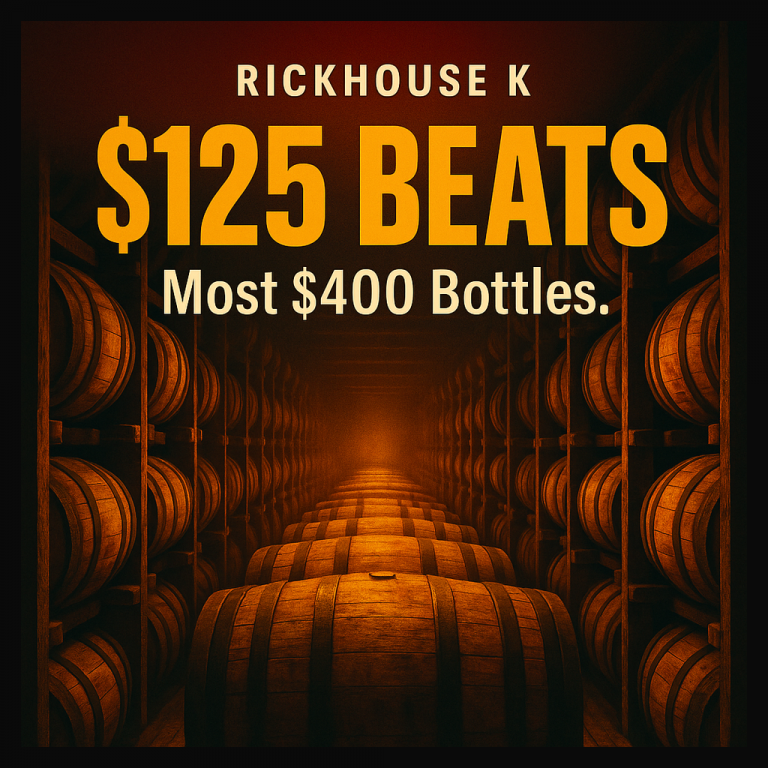
A $125 event beats most $400 bottles. Wild Turkey's Rickhouse K Flavor Map runs its last two scheduled June sessions today — three pours from documented upper, middle, and ground-floor barrel positions in the same warehouse that convert "rickhouse location changes the bourbon" from theory to your own direct observation. Today is the last session until fall.
The biggest bourbon story of this Father's Day weekend isn't a bottle — it's a door that closes tonight. Wild Turkey is running the final two scheduled June sessions of Rickhouse K, the three-pour warehouse demonstration that takes Eddie Russell's barrel-position thesis and turns it into something you can taste for yourself. That's the Saturday lead. Also in today's edition: Parker's Heritage 2026 Bottled-in-Bond shipped this morning at $99.99, the first wheated BiB from Heaven Hill in the premium tier in years — and the federal credential on the label is doing more honest work than any marketing claim it sits next to. Plus the community debate on whether George T. Stagg 2026's series-record 134.4 proof is the best vintage in a decade or the point where more proof starts producing less bourbon.
Wild Turkey is running the last two scheduled June sessions of Rickhouse K today. Two windows — morning and afternoon. $125 per seat. Three pours from documented barrel positions in a single warehouse: upper floor, middle floor, ground floor. These are not different expressions. They're the same bourbon program, same warehouse, same mash bill going in — aged in different positions inside Rickhouse K on Wild Turkey's Lawrenceburg campus.
Here's why that matters. A rickhouse can run nine stories tall. The top floor hits 110-plus degrees in a Kentucky summer and drops hard in winter. The bottom floor stays cool and stable year-round. That temperature swing is not a minor variable — it's the driver of how aggressively whiskey moves in and out of the wood. More heat means more expansion into the barrel. More expansion means faster, bolder extraction. The top-floor barrel and the ground-floor barrel produce different whiskey because they lived through different thermal histories. Same building. Different outcomes.
The Rickhouse K Flavor Map gives you three pours with Eddie Russell's production notes on temperature differentials, evaporation rates, and the specific flavor architecture each floor position tends to produce. The three-pour structure lets you run the comparison yourself. Upper floor against middle floor against ground floor — tasted in sequence, in the same session, in the same room where the barrels age.
At $125, the question the bourbon community has been asking all week is whether that price is defensible. The answer is specific to this program. Most premium distillery experiences at this price tier are charging for atmosphere and heritage narration. Rickhouse K is charging for a controlled comparison that converts a production argument into sensory evidence. That is categorically different, and the distinction holds up to scrutiny.
Call ahead to confirm remaining Saturday seats — Wild Turkey's website shows limited capacity for both sessions.
In 1897, adulterated whiskey was a genuine public health problem. Unscrupulous producers were cutting real bourbon with industrial alcohol, tobacco juice, and prune extract for color. Colonel Edmund Haynes Taylor, Jr. pushed Congress to pass the Bottled-in-Bond Act — the first consumer protection law in American history. It required any whiskey labeled "Bottled-in-Bond" to meet four specific rules.
One distillery. One distilling season (January through June, or July through December). Aged at least four years in a federally bonded warehouse under government supervision. Bottled at exactly 100 proof.
That's it. No bureaucracy beyond those four lines. No marketing flexibility. A guarantee of provenance, age, and proof that a consumer can verify independently of any brand claim.
Here's why it still matters in 2026. Parker's Heritage Collection 2026 carries that credential at $99.99 — a 10-year wheated bourbon from Heaven Hill that exceeds the four-year minimum by six years and bottles at exactly the 100 proof the statute requires. Old Fitzgerald BiB Fall 2026 does the same at $79.99. Wilderness Trail BiB does it at $54.99. None of these labels are using "Bottled-in-Bond" as heritage language. They're using it as a production fact that predates modern label-transparency movements by 130 years.
What this changes: Next time you see "Bottled-in-Bond" on a label, you know what the federal government verified and when that standard was written. It is not decoration. It is the oldest consumer protection in American alcohol law.
Floor erosion is how far a bottle's secondary market price has dropped from its all-time high. William Larue Weller 2025 peaked at $2,850 in October 2022 — when collectors were paying roughly 28 times the $100 MSRP. As of June 4, the same bottle realized $1,220 at Whisky Auctioneer, a 57.2% decline from that peak. Two forces are converging on the Weller floor simultaneously. The broader post-pandemic allocated-bourbon correction has removed $1,630 per bottle from the 2022 high across four years of secondary re-anchoring. And William Larue Weller 2026 is now the sole outstanding BTAC label — the one COLA confirmation that, once it arrives, sets the 2026 vintage's proof and establishes the reference point buyers will use to evaluate whether the 2025 floor represents a recovery entry or a continuation of the correction. Until that proof is public, the 2025 vintage trades at a discount to its incoming replacement rather than at the premium a genuinely scarce prior vintage would command in a stable market.
Rickhouse Report: 5 stories · Regional Report: 3 stories
◆ Full AWIB (Paid Patreon Subscriber): https://www.patreon.com/c/ChasingTheUnicornPodcast
◆ Listen on Apple Podcasts: https://podcasts.apple.com/us/podcast/chasing-the-unicorn-bourbon-american-whiskey/id6788592653
◆ Listen on Spotify: https://open.spotify.com/show/1IZS2wXY7nAUcL9akukblE
◆ YouTube: https://www.youtube.com/@chasingtheunicornpodcast
Want the full picture? The complete American Whiskey Industry Brief — every section, every source, every story — is published free every morning at chasingtheunicornpodcast.com. Read it at chasingtheunicornpodcast.com/the-brief/.
Chasing a specific bottle? The Bourbon Release Calendar lists every lottery deadline, walk-up window and MSRP we're tracking — updated every morning.
Mentioned in this episode: Buffalo Trace, Eagle Rare, William Larue Weller, George T. Stagg, Wild Turkey, Master's Keep, Heaven Hill, Old Fitzgerald, Parker's Heritage, Evan Williams, Wilderness Trail, Bardstown, BTAC