2026 05 25 Thumbnail
Podcast |

A Tax Law Just Expanded Your Bourbon Shelf — Heaven Hill 2033 — The Cut
Listen to this episode

In this episode

Monday’s biggest story isn’t a new product launch or an auction result — it’s a master distiller willing to connect a state tax law to a barrel-filling decision on the record. Heaven Hill’s Conor O’Driscoll confirmed this week that the distillery is adding distilling runs at its Bardstown, Kentucky campus for Q3 and Q4 2026,…

Mentioned in this episode: E.H. Taylor, Heaven Hill, Elijah Craig, Old Fitzgerald, Parker’s Heritage, Four Roses, Bardstown, Maker’s Mark, BTAC

Read the full transcript

This is The Cut. American whiskey, daily.

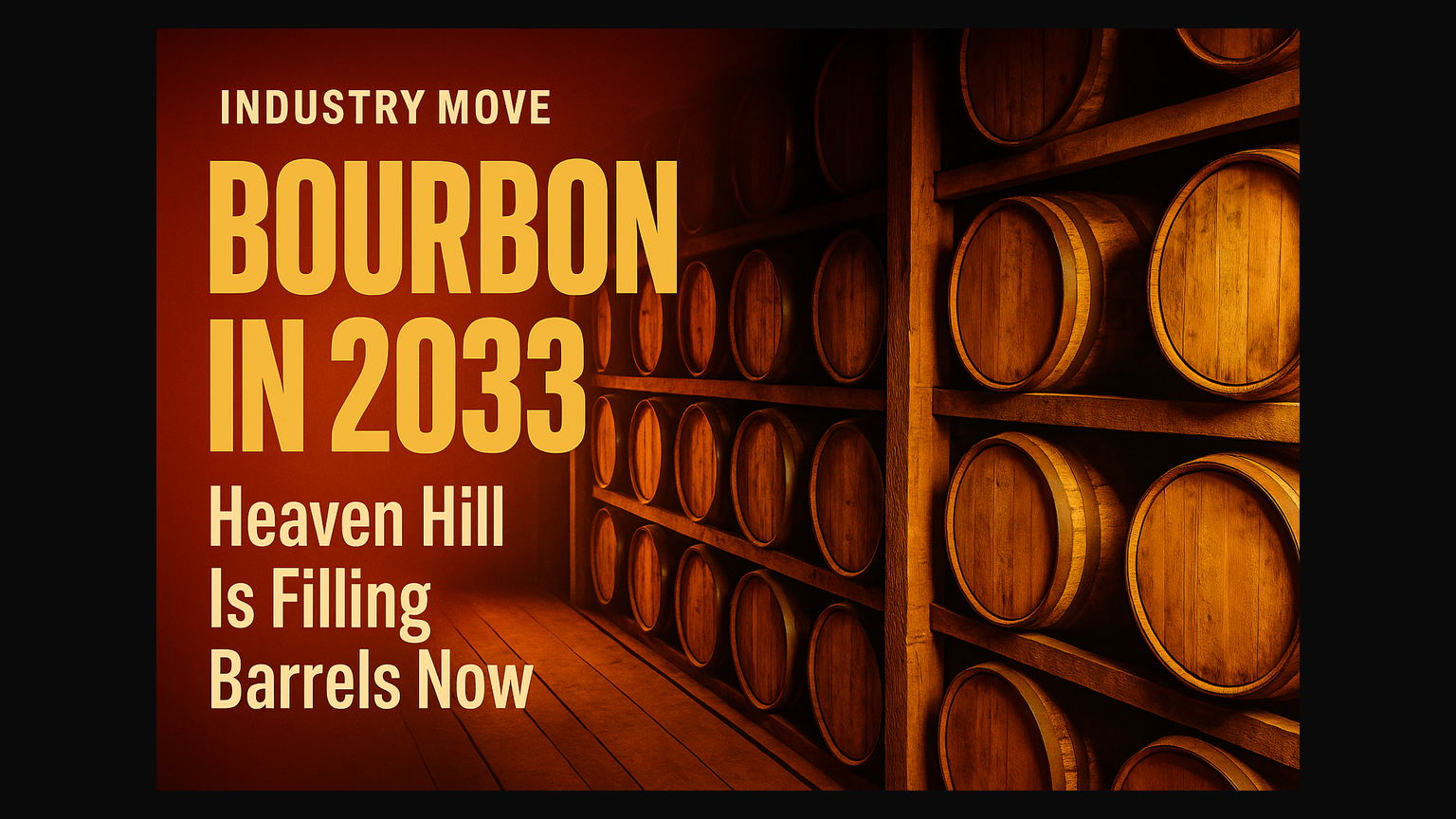
A tax law just expanded your bourbon shelf. Heaven Hill confirmed this week it’s adding distilling runs at its Bardstown, Kentucky campus — and the direct reason is the state’s 20-year barrel inventory tax phase-out, which just produced its first confirmed Big 4 production investment. The bourbon going into the still this quarter is what you drink in 2033.

I’m John from Chasing the Unicorn Podcast. Here’s what moved today. May 25, 2026.

Today’s Big Move — Heaven Hill’s Q3 Bardstown production expansion. Here’s what happened.

Monday on The Cut is Industry Move day. This one is textbook.

Kentucky House Bill 5 phases out the state’s per-barrel inventory tax over 20 years. Year 1 is a 5 percent reduction. Heaven Hill ages roughly 2 million barrels across its Bardstown campus and its Louisville Bernheim facility — one of the two largest barrel-aging inventories in the state. At 2025 assessment rates, a 5 percent cut on that inventory is a seven-figure annual improvement in the operating budget. Master Distiller Conor O’Driscoll said publicly, in the first fiscal quarter of implementation, that those dollars are going back into the still.

That’s specific. That’s deliberate.

The distinction O’Driscoll drew matters. He didn’t announce a new rickhouse. He didn’t announce a second still. He described the expansion as a reinvestment of HB 5 operating savings — more distilling runs in an already-planned quarter, not a new capital program that requires board approval and a multi-year construction window. That’s the mechanism the bill’s designers said they were trying to create. He confirmed it happened.

Now here’s the part that requires a longer view. New-make spirit going into barrel this summer needs two years to qualify as straight bourbon. It won’t appear in an age-stated Heaven Hill expression before 2033. O’Driscoll isn’t reacting to what’s moving off shelves this week. He’s placing a 10-year bet on where the premium American whiskey market stands at the end of the decade.

Heaven Hill makes the bottles enthusiasts eventually graduate into — Parker’s Heritage, Old Fitzgerald Decanter Series, Elijah Craig age-stated expressions. If the market assumptions hold, that shelf gets deeper in the early 2030s. No other Big 4 producer has drawn this line publicly: specific fiscal mechanism, specific facility, the master distiller’s name on it. The fiscal savings from a state tax law become the barrels that become the bottles. O’Driscoll connected those dots on the record.

Which connects directly to today’s First Sip — because why this matters to your wallet goes deeper than one distillery announcement.

Today’s First Sip — what actually moves bourbon prices. It’s not random.

So here’s what it is.

The same bottle at $45 in Kentucky can cost $85 in Utah. A bottle that was $60 last year and $80 this year reflects decisions made years upstream. Prices move from a short list of forces.

Glass shortages push bottling costs up when global supply tightens. Barrel costs have roughly tripled since 2010 as white oak supply constricts. Tariffs redirect export-oriented bourbon back onto domestic shelves, which pressures pricing and availability. Distillery idles — Beam Suntory and Heaven Hill have both reduced or paused production in recent years — make existing inventory more valuable as the supply math shifts.

And Kentucky’s barrel inventory tax, now in its first year of a 20-year phase-out, has reduced the carrying cost on every barrel aging in a Kentucky warehouse. Heaven Hill told us directly this week where those dollars went.

The analogy: imagine a restaurant that pays rent on every table in storage, not just the ones on the floor. Cut that storage rent and the kitchen can hire more prep cooks. More prep cooks means more dishes on the menu in seven years. The tax credit is the rent reduction. The production runs are the kitchen hiring. The bottles are the menu.

What this changes — the full AWIB tracks industry news because today’s production decision is next year’s shelf availability and next decade’s bottle price. Today’s barrel tax credit is 2033’s Parker’s Heritage.

Today’s Chase — three bottles across three tiers. Two Hunt deadlines in play this week. Let’s start with the one that matters most.

Parker’s Heritage Collection 2026 Barrel Proof Bottled-in-Bond — in the $80 to $200 tier at $129.99.

This is a TTB-confirmed COLA: 128.4 proof, Bottled-in-Bond designation. Barrel proof and Bottled-in-Bond is an uncommon combination at this price tier. The BiB credential anchors it to a single distilling season and federally bonded warehouse aging — there’s a legal chain of custody behind what’s in the bottle, and the flavor intensity you’re getting is from the spirit, not from a blending decision.

In the glass: concentrated dark caramel and baking spice on the nose, dried fruit and cinnamon on the palate, structural force at 128.4 proof without rough edges. The finish has the kind of integration that comes from age and care, not proof manipulation.

Here’s why it’s today’s spotlight. Pre-allocation windows are expected to open today at Seelbach’s and Binny’s — the week of May 25 is the confirmed window. This is the only MSRP-guaranteed access point before general specialty distribution takes over. Prior Parker’s Heritage barrel-proof limited releases have historically moved $30 to $50 above MSRP once pre-allocation closes. History on this variant shows windows fill within 48 to 72 hours of opening. Check the Seelbach’s and Binny’s portals before end of business today.

This is worth the chase.

Also on today’s Chase — Maker’s Mark 46 Cask Strength 2026 at $79.99, the house wheated style at full concentration with the French oak stave finishing program intact; first allocation wave is still in its first two weeks and distribution is uneven, so call ahead before making a trip. And the BTAC 2026 state lotteries — Ohio closes June 6, Pennsylvania closes June 5, Virginia expected to open this week; entry is free and takes three minutes per state portal. Full detail in today’s Cut Daily. If you want more, head to The Brief at chasingtheunicornpodcast.

Alright — today’s Bar Talk. The credit question.

Today’s Bar Talk — whether Kentucky’s barrel tax phase-out actually drove Heaven Hill’s production expansion, or whether O’Driscoll is thanking politicians for a vote his company helped lobby. Community’s split on whether the stated mechanism is genuine or convenient narrative. Here’s what’s actually going on.

The r/bourbon thread crossed 740 upvotes in 48 hours. The skeptic case is coherent: Heaven Hill was almost certainly modeling production expansion based on long-cycle inventory forecasting well before HB 5 passed. A 5 percent Year 1 reduction probably doesn’t tip a decision that plays out over a decade. Crediting the tax cut costs nothing and is good politics in Frankfort.

The counter is the specificity. A named master distiller, a named facility, a direct public attribution in the first fiscal quarter of implementation — that’s not boilerplate thank-you language. And the mechanism O’Driscoll described is operational, not capital. A recurring seven-figure improvement in the annual operating budget doesn’t require a board vote to redirect into additional distilling weeks. He wasn’t claiming HB 5 funded a new building. He was claiming it freed up running room in the existing calendar. That’s a credible claim with a traceable paper trail — the June 1 first-quarter HB 5 compliance filing deadline establishes the baseline for all 19 remaining annual credits.

Both things can be true: a decision that was directionally likely, confirmed faster because the operating budget improved.

Here’s what it means for the rest of us — more Heaven Hill spirit in barrel this quarter is the outcome. How much credit the tax deserves matters less than the barrels being filled.

Two more things before we close. First — today’s AWIB in The Brief has the full Flight comparison: Elijah Craig Small Batch 12-Year versus Four Roses Small Batch Original. Two of the most consistent sub-$40 bourbons on the accessible shelf, same price point, built from opposite production philosophies — a single-distillery 12-year Kentucky mash against Four Roses’ four-recipe matrix built from two mash bills and two yeast strains. The verdict on which one earns the permanent shelf slot for which kind of bourbon-curious drinker is in the brief. Second — today’s AWIB Label Room covers five COLA filings from the May 22 to 24 window, including the Old Fitzgerald Decanter Series Fall 2026 BiB 8-Year and the E.H. Taylor Warehouse C Bottled-in-Bond Small Batch — confirmed production decisions worth tracking before any of them reach shelves. Both are waiting at chasingtheunicornpodcast.com.

That’s The Cut. The full American Whiskey Industry Brief is waiting at chasingtheunicornpodcast.com/the-brief/. I’m John F. Schuster II. Thanks for joining me. Your unicorn is out there.


The Written Briefing

The Cut Daily

Monday’s biggest story isn’t a new product launch or an auction result — it’s a master distiller willing to connect a state tax law to a barrel-filling decision on the record. Heaven Hill’s Conor O’Driscoll confirmed this week that the distillery is adding distilling runs at its Bardstown, Kentucky campus for Q3 and Q4 2026, and he said publicly that the direct reason is Kentucky House Bill 5’s barrel inventory tax phase-out. Year 1 of a 20-year phase-out delivers a seven-figure annual operating improvement on Heaven Hill’s two-million-barrel inventory. O’Driscoll said those dollars are going back into the still. No other Big 4 producer has drawn that line publicly. The timeline: spirit entering barrel this summer qualifies as straight bourbon no earlier than 2028 and arrives as age-stated premium Heaven Hill — Parker’s Heritage, Old Fitzgerald Decanter Series, Elijah Craig age-stated expressions — in the early 2030s. O’Driscoll isn’t reacting to the current correction. He’s placing a decade-long bet on where the premium American whiskey market stands at the end of the decade. The fiscal savings from a state tax law become the barrels that become the bottles. Also in today’s Cut: Parker’s Heritage 2026 Barrel Proof Bottled-in-Bond pre-allocation opens today. Listen to the full Cut for every access window in play this week.

Listen to today’s episode and find us on Spotify and everywhere you listen at chasingtheunicornpodcast.com/podcast.

The Cut Daily
The pulse of American whiskey: What moved — and why it matters.
Chasing the Unicorn Podcast Edition · A Drunken Unicorn Production
Report Date: May 25, 2026
Reporting Period: May 23, 2026 through May 25, 2026
Classification: Free Edition · Share with Attribution
Free Edition · The Cut Daily · Chasing the Unicorn Podcast · A Drunken Unicorn Production · Drunken Unicorn Productions, LLC. The Cut Daily is the free gateway brief to the American Whiskey Industry Brief. Share, quote, and repost freely with attribution. Required attribution: “The Cut Daily · May 25, 2026 · Chasing the Unicorn Podcast · A Drunken Unicorn Production.” The full AWIB is published free every morning at chasingtheunicornpodcast.com. Permissions and inquiries: chasingtheunicornpodcast.com.

Informational and entertainment purposes only. Nothing here is investment advice. Verify before buying, trading, or bidding. We are not liable for errors or financial losses.
What Is The Cut Daily? — The Cut Daily is the free written brief from Chasing the Unicorn. Every weekday we translate the biggest moves in American whiskey into plain English, teach one bourbon concept you can use at the shelf today, flag one bottle under $60 worth knowing about, and curate three Hunt picks across three price tiers. Knowledge-first chase. No FOMO. Just what moved and why it matters.
The full American Whiskey Industry Brief — every story, every Hunt entry, every debate, every auction — is published free every morning. If you want the full pour, not just the taste, read it at chasingtheunicornpodcast.com/the-brief/.
The Cut Daily is the free written companion to today’s American Whiskey Industry Brief.
IN TODAY’S CUT

A tax law just expanded your bourbon shelf. Heaven Hill confirmed this week it’s adding distilling runs at its Bardstown, Kentucky campus — and the direct reason is the state’s 20-year barrel inventory tax phase-out, which just produced its first confirmed Big 4 production investment. The bourbon going into the still this quarter is what you drink in 2033.

Today’s biggest news came out of Bardstown. Heaven Hill Master Distiller Conor O’Driscoll announced expanded production at the Bardstown campus and named the reason out loud: Kentucky’s new barrel tax phase-out. That’s the first time a major distillery has drawn a public line from a fiscal policy change to a specific barrel-filling decision. Also moving today: Parker’s Heritage Collection 2026 Barrel Proof Bottled-in-Bond — the $129.99, 128.4-proof variant, separate from the standard $99.99 PHC Bottled-in-Bond and the American Blended Whiskey edition in the same 2026 series — opens pre-allocation at specialty accounts. The BTAC 2026 lottery portals in Ohio and Pennsylvania are still live through early June with free entry. And the secondary market delivered a sharp lesson about where mid-tier correction is actually landing.

THE BIG MOVE
Heaven Hill Is Expanding Bardstown Production — and Kentucky’s New Barrel Tax Law Is the Reason
Event Date: May 22, 2026

Heaven Hill is adding distilling runs at its Bardstown, Kentucky campus this summer. Master Distiller Conor O’Driscoll said the reason out loud: Kentucky’s new barrel inventory tax phase-out. That’s worth paying attention to. Distilleries don’t usually name the line item that paid for a production decision.

Kentucky House Bill 5, signed earlier this year, phases out the state’s per-barrel inventory tax over 20 years. Year 1 brings a 5 percent reduction. Heaven Hill ages roughly 2 million barrels across its Bardstown campus and the Louisville Bernheim facility — one of the two largest barrel-aging inventories in the industry. At 2025 assessment rates, that 5 percent Year 1 reduction translates to a seven-figure annual savings. O’Driscoll’s announcement said those dollars are going back into the still, not into the balance sheet.

Here’s what the timing tells you. New-make spirit entering a barrel this summer needs a minimum of two years to qualify as straight bourbon. Any age-stated premium expression from this expansion run arrives on shelves no earlier than 2033. O’Driscoll isn’t reacting to what’s selling this quarter. He’s placing a long bet on where the premium American whiskey market stands at the end of the decade.

Heaven Hill makes the bottles most enthusiasts eventually graduate into — Parker’s Heritage, Old Fitzgerald Decanter Series, Elijah Craig age-stated expressions. If the market assumptions behind this expansion are right, that shelf gets deeper in the early 2030s. The fiscal savings from a state tax law become the barrels that become the bottles. That’s a specific, traceable production chain, and O’Driscoll drew the line publicly.

This is a seven-figure recurring tax credit becoming a production commitment becoming the bourbon you pour in seven years.

What It Means For Your Shelf — Nothing changes this week. But what goes into the still at Bardstown this quarter becomes premium Heaven Hill bourbon in the early 2030s — and O’Driscoll just said publicly that’s the plan.
From today’s AWIB Opening Pour. This is one of four lead stories in today’s AWIB Opening Pour. The other three: MGP Ingredients CEO calls the 2026 correction floor — NDP restocking signal for Q4 and what it means for sourced-bourbon brands; BTAC 2026 Ohio and Pennsylvania lottery portals active through early June — free entry, one per person; Bardstown Bourbon Company Summer 2026 Distillery Dinner Series opens booking with the June 7 Elijah Craig date already showing limited seats. Read all four lead stories in The Brief →
Back to top story
FIRST SIP
Why the Price Went Up (or Down)
Paired with today’s: Heaven Hill’s Q3 2026 Bardstown production expansion — O’Driscoll’s public credit for Kentucky’s barrel tax phase-out is a real-time example of the specific fiscal mechanism this concept describes.

Heaven Hill’s announcement this week is a live example of what actually moves bourbon prices. A Kentucky tax change produced a production decision that will eventually reach your glass. That chain is worth understanding.

Bourbon prices don’t move randomly. The same bottle at $45 in Kentucky can cost $85 in Utah because of the three-tier distribution system and state liquor control rules. A bottle that was $60 last year and $80 this year reflects decisions made years upstream — and they’re usually one of a short list of forces.

Glass shortages push bottling costs up when global supply tightens. Barrel costs have roughly tripled since 2010 as white oak supply tightens. Tariffs redirect export-oriented bourbon to compete on domestic shelves, which moves what stays and what gets priced up. Distillery idles — Beam Suntory and Heaven Hill have both reduced or paused production in recent years — make existing inventory relatively more valuable as the supply math shifts.

And Kentucky’s barrel inventory tax, now in its first year of a 20-year phase-out, has reduced the carrying cost on every barrel aging in a Kentucky warehouse. Heaven Hill told us directly this week where those dollars went: back into the still.

What this changes: The AWIB tracks industry news because today’s production decision is next year’s shelf availability and next decade’s bottle price. Today’s barrel tax credit is 2033’s Parker’s Heritage.

The Perfect Pour app — coming soon. For the full deep-dive on why bourbon prices move — the three-tier economics, glass-supply chain mechanics, how distillery idles work through to the shelf, and the full barrel-tax-to-retail-price chain — get notified when the Perfect Pour app launches. Get notified when it launches →
Back to top story
TODAY’S ENTRY BOTTLE
Elijah Craig Small Batch 12-Year
~$35 Nationwide at major spirits retailers, Total Wine, and most grocery-store spirits sections — one of Heaven Hill’s most consistently available premium expressions at standard retail.
Flavor Profile — Dark caramel and dried cherry on the nose with an integrated vanilla backbone; the palate delivers brown sugar, baking spice, and a mocha-tinged finish with warm tannin structure that has had 12 years to settle into the whiskey rather than assert itself aggressively. No challenging heat at 94 proof.
Production Context — Distilled at Heaven Hill’s Bernheim Distillery in Louisville on a traditional high-corn mash bill (approximately 78% corn, 10% rye, 12% malted barley) and aged a minimum of 12 years — the oldest age statement on any mass-market Heaven Hill expression currently in standard nationwide distribution. The expanded 2026 distilling runs O’Driscoll announced this week are designed to eventually supply the age-stated tier this bottle anchors.
Why This Matters — If you want to understand what Heaven Hill’s 2026 production expansion is protecting and growing, this is the bottle — the accessible flagship that demonstrates what 12 years of Kentucky bourbon aging produces before the lottery expressions and the decanter series begin.
Back to top story
THE CHASE
How to read the chase ratings
YESworth chasing
WATCHhold for now
PASSskip this one
Bottle 1 — Under $80
Maker’s Mark 46 Cask Strength 2026
Window: Active now through current specialty distribution cycle; first wide specialty placement deploying the week of May 18–25, 2026; second allocation wave projected late June 2026
Where: Binny’s (Chicago metro and Illinois), Total Wine & More (national), Liquor Barn (Kentucky, multiple locations), Seelbach’s (seelbachs.com, ship-to-home where state law permits), participating Beam Suntory specialty accounts nationally
MSRP: $79.99
Flavor Profile — Concentrated caramel and French-oak vanilla from the stave-finishing program; richer mouthfeel than the standard 46, with baking spice and sustained caramel finish at barrel proof (approximately 108–114 proof cycle-variable, non-chill filtered)
YES
Rationale — Same wheated mash bill as standard Maker’s Mark, same distillery, same French oak stave finishing — what you’re buying at barrel proof is the house style at full concentration with no water added. The current specialty placement is in its first two weeks; call ahead before making a trip.
Bottle 2 — $80 to $200
Parker’s Heritage Collection 2026 Barrel Proof Bottled-in-Bond
Window: Pre-allocation windows expected to open the week of May 25, 2026 (today) at select specialty retailers; ship date projected mid-June 2026
Where: Seelbach’s (seelbachs.com) · Binny’s (binnys.com) · Bourbon Pursuit retail partner program (BCBP member tier) · participating Heaven Hill specialty accounts nationally
MSRP: $129.99
Flavor Profile — Concentrated dark caramel, baking spice, and aged oak on the nose; dried fruit and cinnamon on the palate with structural force at 128.4 proof; the Bottled-in-Bond credential anchors the expression to a single distilling season and federally bonded warehouse aging
YES
Rationale — The TTB-confirmed COLA at 128.4 proof with a Bottled-in-Bond designation is an uncommon combination at this price tier, and today’s pre-allocation window is the only MSRP-guaranteed access point before general specialty distribution. Prior PHC barrel-proof limited-format releases have historically launched at $30–$50 above MSRP once pre-allocation closes; history on this variant shows windows fill within 48–72 hours of opening — check Seelbach’s and Binny’s portals before end of business today.
Bottle 3 — $200 and up
Buffalo Trace Antique Collection 2026 — Multi-State Lottery (OH/PA/VA)
Window: Ohio OHLQ portal open through June 6, 2026; Pennsylvania PLCB portal open through June 5, 2026; Virginia ABC portal expected to open May 27–28, 2026
Where: Ohio: ohlq.com/lottery · Pennsylvania: lcbapps.lcb.state.pa.us · Virginia: abc.virginia.gov (expected) — free to enter, one entry per person per expression, state-issued ID required
MSRP: $99–$129 at retail; secondary floors from Unicorn Auctions May 2026 spring session: Eagle Rare 17-Year (2024) ~$415, William Larue Weller (2024) ~$1,375, George T. Stagg (2022, documented provenance) ~$1,475
Flavor Profile — George T. Stagg — deep caramel and black cherry on the nose, long wood-smoke and leather finish at barrel proof (~130–140+); William Larue Weller — rich butterscotch and apricot on entry, soft wheat-cream finish with no hard edges despite 125+ proof
YES
Rationale — Entry is free and takes three minutes per state portal. The MSRP-to-secondary spread across all five expressions remains 4x to 11x even at corrected May 2026 auction floors — the asymmetric math favors entering every state lottery you’re eligible for. Ohio and Pennsylvania windows are live right now; Virginia opens this week.
Today’s AWIB Hunt section covers 5 active drops, lotteries, and walk-up windows with full palate direction, rationale, and the Hunt Intelligence Note. See the full Hunt in The Brief →
Back to top story
THE BAR TALK
Is Kentucky’s Barrel Tax Phase-Out Actually Behind Heaven Hill’s Expansion, or Is HB 5 Just Useful Political Cover?

The r/bourbon thread on Heaven Hill’s production announcement crossed 740 upvotes in 48 hours, and the community organized around a question that sounds simple: is O’Driscoll’s public credit to Kentucky’s barrel tax phase-out a genuine fiscal trigger, or a manufacturer thanking a politician for a vote the manufacturer helped lobby through? The skeptic position is internally coherent: Heaven Hill was almost certainly planning production expansion based on its own long-cycle inventory forecasting well before HB 5 passed. A 5 percent Year 1 reduction on a major inventory tax is operationally meaningful but probably isn’t the variable that tips a production decision that plays out over 10 years. Framing it as HB 5-driven is excellent political relations in Frankfort. The optimist counter is that the announcement’s specificity — a named master distiller, a named facility, a direct attribution in the first fiscal quarter of implementation — makes pure narrative management implausible. Both things can be true.

First Sip Moment —

The term that clarifies the argument is “operational-budget reallocation.” A major capital program — a new still, a new rickhouse, a warehouse expansion — requires board-level approval and a multi-year capital commitment. A recurring seven-figure improvement in the annual operating budget doesn’t. It creates the kind of fiscal room that lets a master distiller add distilling weeks to an already-planned quarter without returning to the board for a capital vote. O’Driscoll described the expansion as a “reinvestment” of HB 5 savings rather than a new capital program — that language is specific and deliberate. He is not claiming Heaven Hill built a new facility because of the tax cut. He is claiming that an improvement in annual operating costs redirected existing capacity into more production runs. That is a credible mechanism, not a press release claim, and it is precisely what the phase-out’s legislative designers said they were trying to accomplish.

The Math —

Kentucky HB 5 phases out the state’s barrel inventory tax over 20 years starting in fiscal year 2026, reducing the rate by approximately 5 percent annually toward full elimination by 2046. Heaven Hill maintains approximately 2 million barrels across its Bardstown campus and Louisville Bernheim facility per the KDA’s 2025 Annual Economic Impact Report — one of the two most tax-exposed producers in the state. At 2025 per-barrel assessment rates, the Year 1 5 percent reduction produces a seven-figure annual operating budget improvement. O’Driscoll characterized the Bardstown expansion as a reinvestment of those savings rather than a new capital program. New-make spirit entering barrel in Q3 2026 reaches straight bourbon status no earlier than Q3 2028 and qualifies for any age-stated premium expression in the lineup no earlier than 2030, with meaningful age-stated releases in 2033 and beyond. The June 1 first-quarter HB 5 compliance filing deadline — which requires documented barrel counts for all Kentucky-aging inventory — will establish the baseline against which all 19 remaining annual credits are calculated.

What It Means For The Rest Of Us —

More Heaven Hill spirit in barrel this quarter is the outcome — how much credit the tax deserves matters less than the barrels being filled.

Today’s AWIB Bar Talk has 2 more debates with full source citations, fact-checked positions, and editorial assessment. Read the full debates in The Brief →
Back to top story
SECONDARY SPOTLIGHT
Blanton’s Gold Edition (2023 Bottling)
Realized Price
$115
Peak Price
$195
Floor Erosion
↓ 41.0%
($195 − $115) ÷ $195 × 100 = 41.0% erosion
What Floor Erosion Means —

Floor erosion is how far a bottle’s auction price has fallen from its all-time high. Forty-one percent erosion on Blanton’s Gold means the bottle now sells at auction for roughly 59 cents on the dollar compared to what it fetched in July 2022. At $115 realized against a $60 retail MSRP, Blanton’s Gold is currently trading at about 92 percent above retail at auction — a convenience premium, not a scarcity premium. The buyers paying $115 are paying for guaranteed acquisition without the allocation-queue friction, not for a bottle they believe is genuinely rare. Blanton’s Original is available at retail in many markets; Gold’s premium over Original is four proof points (93 to 103) and a slightly richer mid-palate profile — neither of which commands the collector-tier differential the 2022 peak price implied. The correction didn’t push Blanton’s Gold to MSRP. It pushed it off the collector shelf and onto the convenience shelf, which is a meaningful and specific distinction.

The lesson: Blanton’s Gold’s 41 percent floor erosion illustrates the mid-tier correction’s direction of travel precisely — from speculative premium to convenience premium, not to zero, but definitively no longer to the collector floor that peaked in summer 2022.
Today’s AWIB Secondary section grades 2 more bottles with realized prices, floor erosion math, lineage notes, and buy/hold/sell calls. Read the full secondary report in The Brief →
Back to top story
ALSO IN TODAY’S AWIB
Today’s Flight: Elijah Craig Small Batch 12-Year vs. Four Roses Small Batch Original — two of the most consistent sub-$40 bourbons on the accessible shelf, at the same price point, from opposite production philosophies: a single-distillery 12-year Kentucky mash against Four Roses’ four-recipe matrix built from two mash bills and two yeast strains. Full side-by-side tasting notes, the water-addition protocol for each, and the editorial verdict on which earns the permanent shelf slot are in today’s AWIB Flight section.
Today’s AWIB Label Room covers five COLA filings from the May 22–24 window: New Riff Distilling’s 6-Year own-distilled Single Barrel confirming a clean production milestone for the Bellevue, Kentucky craft producer that opened in 2014; the Old Fitzgerald Decanter Series Fall 2026 BiB 8-Year filing that confirms Heaven Hill’s twice-annual wheated BiB cadence continues unbroken; and the E.H. Taylor Warehouse C Bottled-in-Bond Small Batch — a third rickhouse designation added to Sazerac’s systematic warehouse-variation education series, extending a production comparison axis that Warehouse B and Warehouse K already established. Full COLA-by-COLA analysis in the AWIB Label Room.
Today’s AWIB Regional Report covers a Virginia three-signal cluster that arrived in a single 72-hour window: Virginia Distillery Company’s Courage & Conviction Port Cask Batch 6 expanding national distribution from 18 to 34 states, Catoctin Creek’s Roundstone Rye 26-state store-pick deployment doubling last year’s footprint, and Copper Fox Distillery’s permit filing for a second campus in Williamsburg — three craft producers investing in own-distilled infrastructure in the same window that Kentucky’s two largest production addresses announced capacity discipline. Full logistics, distribution timelines, and regional analysis in the AWIB Regional Report.
Today’s Full AWIB Includes (in reading order)
Opening Pour: 4 stories · Bar Talk: 3 debates · The Flight: 1 comparison · The Hunt: 5 active drops · Label Room: 5 items · The Secondary: 3 graded bottles
Rickhouse Report: 5 stories · Regional Report: 3 stories
The full AWIB walks today’s bourbon world in reader-forward order — the Opening Pour lead stories, the community Bar Talk, the side-by-side Flight comparison, every active Hunt window, the full Label Room pipeline, the Secondary market grading, and the industry-depth Rickhouse, Regional, and Research Notes coverage. Plus full source trail. Read the full Brief →
Back to top story

Want the full picture? The complete American Whiskey Industry Brief — every section, every source, every story — is published free every morning at chasingtheunicornpodcast.com. Read it at chasingtheunicornpodcast.com/the-brief/.

Read the Full Brief

About John F. Schuster II

John F. Schuster II is the host of Chasing the Unicorn Podcast and the editor and publisher of the American Whiskey Industry Brief. A retired U.S. Army Major who spent twenty-six years across the Navy and Army — and an Executive Bourbon Steward — he built a career on systems and on teaching, and now points both at American whiskey. The Cut is his daily take on what moved in bourbon and why it matters, made the way he makes everything: for someone, not everyone. More at momentfirst.com.

About Shauna Hann

Shauna Hann is the editor and a contributor across Chasing the Unicorn Podcast and the American Whiskey Industry Brief, and co-host of Beyond the Cut. A teacher of more than twenty years — including at West Point and across the U.S. Army — she brings historical depth and structural rigor to the work, and a gift for making complex things simple. More of her work is at shaunaonthego.com.

Similar Posts