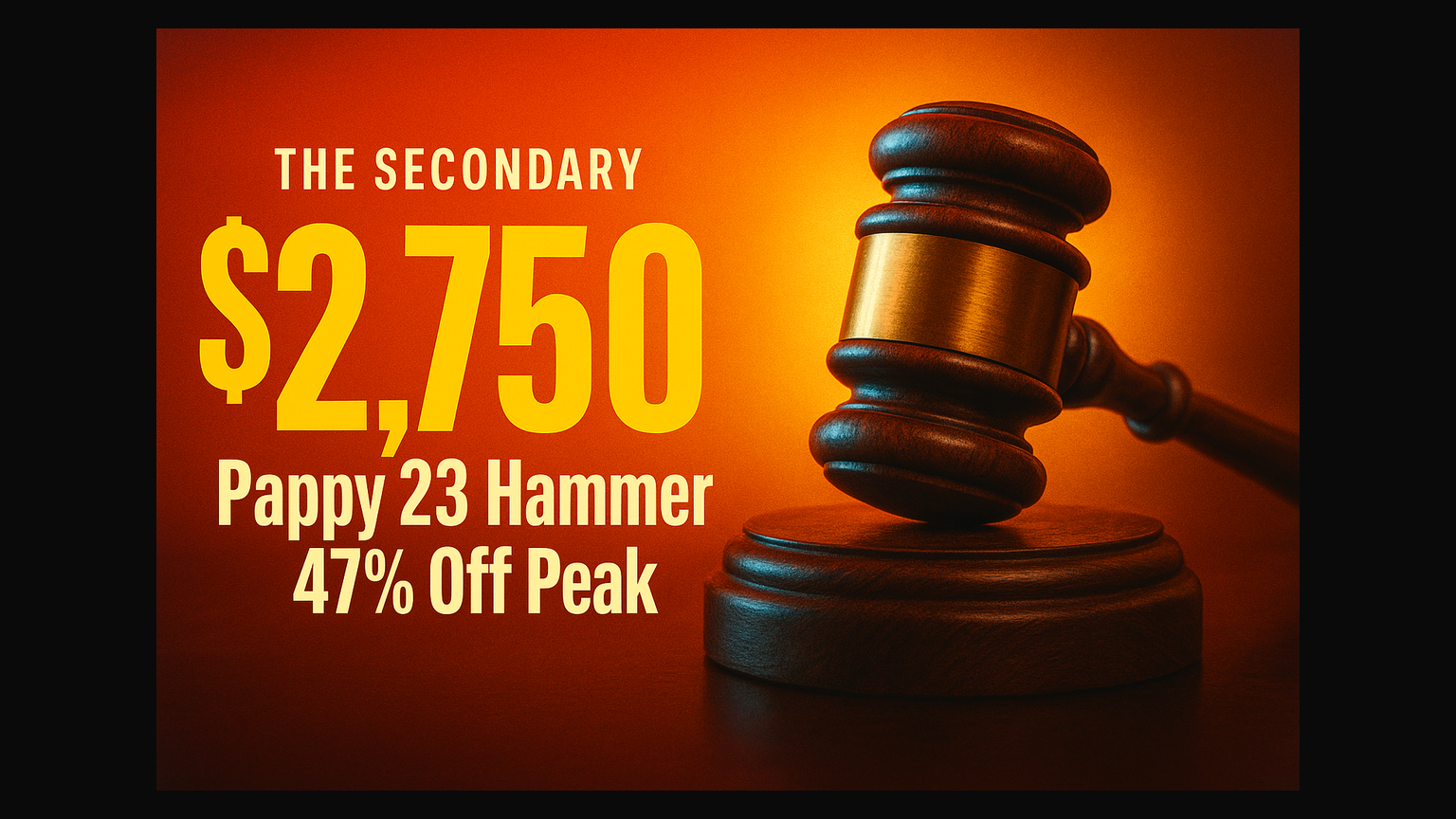
The Cut — April 13, 2026 — Pappy 23 Hammers at $2,750 — 47% Off Peak
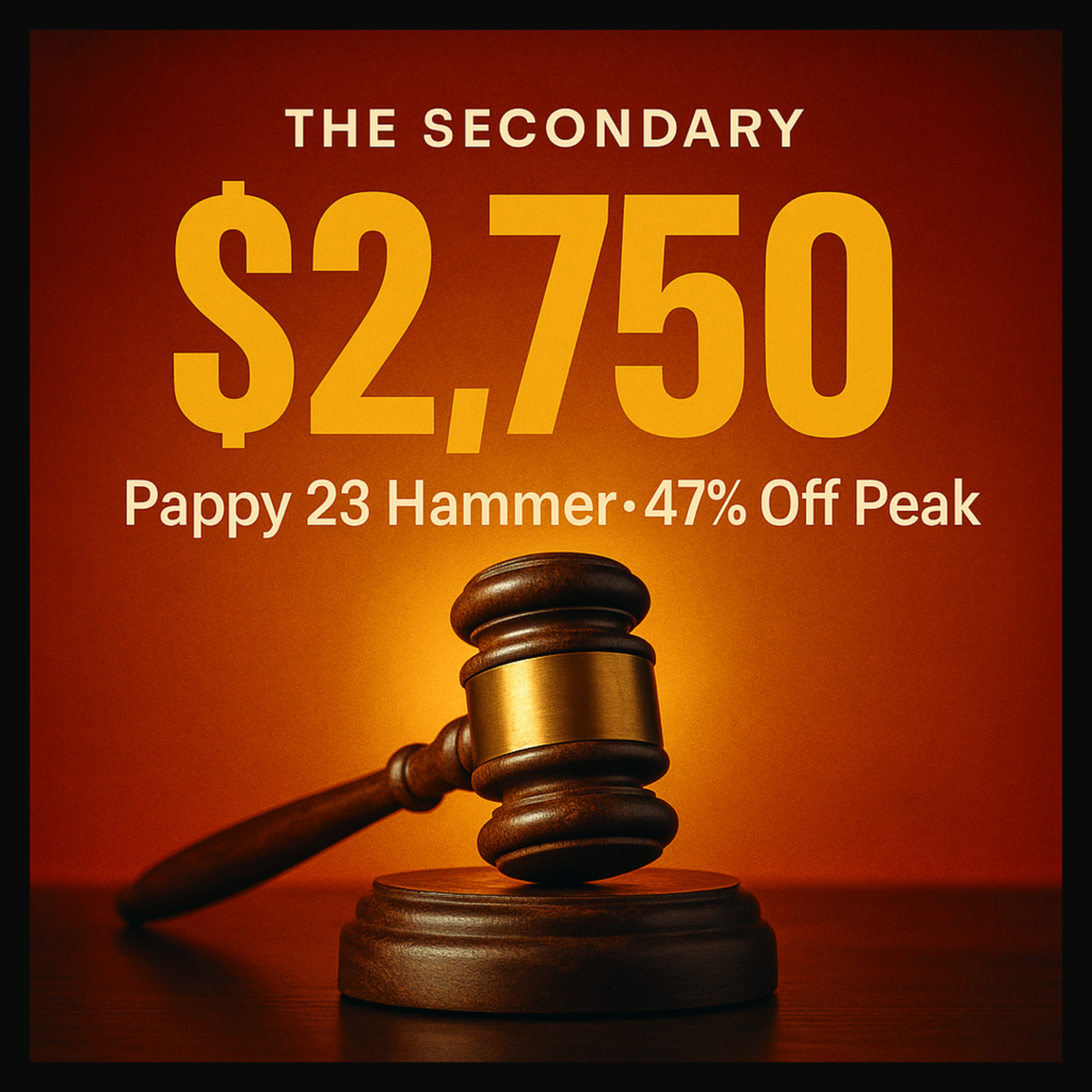
In this episode
▶ Listen to this episode on Spotify Pappy Van Winkle 23 Year hammered at $2,750 on Sunday’s April 12 online auction cycle — the bottle’s lowest multiple over MSRP at auction since 2019, about 8.3 times the $329.99 retail price, 47 percent off the 2022 peak of $5,200. That’s the spring’s first defensible Q2 reference…
Mentioned in this episode: Buffalo Trace, William Larue Weller, Pappy Van Winkle, Wild Turkey, Heaven Hill
Read the full transcript
Target runtime: 7:48 Word count: 1,213 Estimated runtime: 8:05 Source: The Cut Daily 2026-04-13
—
This is The Cut. American whiskey, daily.
Pappy 23 just hammered at $2,750. That’s 47 percent off the bottle’s 2022 peak — the spring’s first defensible Q2 reference point for the entire wheated-allocation tier. Here’s what that number actually says.
I’m John from Chasing the Unicorn Podcast. Here’s what moved today. April 13, 2026.
Today’s Big Move — Pappy 23 just hammered at $2,750, and that number means something. Here’s what happened.
On Sunday, an online auction tracked by Bottle Blue Book closed with a Pappy Van Winkle Family Reserve 23 Year hammering at $2,750. That’s the bottle’s lowest multiple over MSRP at auction since 2019 — about 8.3 times the $329.99 retail price, down from 13 to 16 times MSRP through the 2022 peak.
Here’s what that number does. It sets a defensible spring reference point for the entire wheated-allocation tier. Pappy, the rest of the Van Winkle line, the Weller family, William Larue Weller in the Buffalo Trace Antique Collection — they all calibrate against Pappy 23. When the benchmark moves, everything moves with it.
Two more comps from the same April 12 cycle. A Pappy 20 hammered at $1,475. The Van Winkle Family Reserve 13 Year Rye hammered at $1,425 — that’s 49 percent off its own 2022 peak. The pattern across the line is consistent. Compression of roughly 35 to 45 percent from peak, with the deepest compression on the lower-age expressions where collector demand is thinner.
Two things to watch over the next two weekends. The April 18-19 cycle and the April 25-26 cycle. If $2,500 to $3,000 holds across both of those, it’s the working corridor through Q2. If hammers slip below that band, the floor is still moving. April 12 is the data point. May is the confirmation.
For your shelf — nothing changes this week. What changed is the number you should pay if you were considering buying any wheated-allocation bottle at secondary. Above 2024 prices, you’re paying for a market that no longer exists. That number on Sunday only makes sense if you understand the room it landed in — which brings us to today’s First Sip.
Today’s First Sip — the secondary market. You won’t see it on a label, but it’s the room where the $2,750 number actually lives.
So here’s what it is.
The secondary market is private bourbon resale. Most states make it illegal to sell alcohol without a license, so most secondary trades happen in legal gray zones — Facebook groups, trading apps, auction sites, in-person swaps at bourbon clubs.
What it’s not is retail. A Pappy 23 that retailed at $329 might trade at $2,750 today. A William Larue Weller at $149 MSRP might trade at $1,200. The difference is the gap between retail supply, which is nearly zero, and collector demand, which is substantial.
Why it matters even if you never buy a bottle there — secondary prices tell you which MSRP deals are real. A store charging $450 for a bottle the secondary trades at $600 is a real discount. A store charging $800 for a bottle the secondary trades at $400 is gouging. Without the secondary number, you can’t tell.
Think of it like Kelley Blue Book for bourbon. You don’t have to sell your car to know what it’s worth — but you don’t want to overpay for the next one.
What this changes — you don’t have to participate in secondary to learn from it. The prices are a signal about what’s actually rare versus what’s just hype. And that signal is exactly what’s driving today’s Chase.
Today’s Chase — three bottles across three tiers. Let’s start with the one that matters most.
Heaven Hill Bottled-in-Bond 12-Year. Entry tier. $89.99. 100 proof. National specialty retail through the April 10-17 window.
Flavor direction — Heaven Hill’s bourbon mashbill, twelve years deep. Caramel, vanilla, baking spice, and oak that’s had real time to integrate. At 100 proof, you get full profile expression without barrel-strength heat. This is a slow Sunday pour, not a wrestling match.
Here’s why it’s the spotlight. Bottled-in-Bond at twelve years from Heaven Hill at $89.99 is one of the cleanest age-stated value propositions in the category. Bottled-in-Bond is a federal designation — one distillery, one distilling season, four-plus years in a federally bonded warehouse, exactly 100 proof. And Heaven Hill’s April 13 production-rollback briefing means future cadence at this age statement is tied to 2014 distillation volumes that predate the discipline phase. Translation — what’s on the shelf now may not stay on the shelf.
This is worth the chase. If you see one at MSRP, that’s the buy.
Also on today’s Chase — Wild Turkey Master’s Keep 2026 at $174.99, Eddie Russell’s flagship limited-edition program holding MSRP through 90 days on recent vintages. And Garrison Brothers Cowboy Bourbon 2026 at $269.99, Texas-aged barrel-strength at 140 proof — the clearest signal of Texas bourbon at scale. Full detail in today’s Cut Daily. If you want more, head to our Patreon at chasingtheunicornpodcast.
Which brings us to today’s Bar Talk — and it’s the same number we opened with.
Today’s Bar Talk — has the Pappy floor actually broken? Community’s split on whether the wheated-allocation premium era is over or whether April just hit a cyclical bottom. Here’s what’s actually going on.
Quick vocabulary anchor. The floor in the secondary market is the price below which a bottle stops trading — sellers pull listings rather than accept less. Floor erosion is how much that working price has dropped from the bottle’s all-time peak.
Here’s the math. April 12 hammer — $2,750. The Q1 2026 corridor across multiple cycles ran $2,500 to $3,000. The 2022 peak ran $4,500 to $5,200. Late 2023 averaged $4,000 to $4,800. April 12 is 47 percent compression from the 2022 peak midpoint and 12 percent compression from the late-2023 average. Same April 12 cycle — Pappy 20 at $1,475, Family Reserve 13 Year Rye at $1,425, a 49 percent erosion. The pattern across the entire Van Winkle line runs 35 to 45 percent compression from peak. Meanwhile, Kentucky aging inventory sits at an all-time high — about 14 million barrels per the April 11 KDA report. Production has been flat-to-down since 2024.
The tension is whether you read that as a regime change or a spring discount. One camp says the wheated-allocation premium era is over, that Pappy Floor was always sentiment-driven and is finally meeting production reality. Another says April auctions always set the year’s lower end because spring sellers are tax-motivated. At 8.3 times MSRP, Pappy 23 is still functionally allocated-tier pricing. The multiple is roughly half of what it was three years ago — but the multiple is still there.
Here’s what it means for the rest of us — the floor moved, the category didn’t break. Pay 2026 prices for a 2026 market and stop benchmarking against a retired peak.
One more for today — today’s full American Whiskey Industry Brief covers the DISCUS Q1 2026 export data drop. 19 percent year-over-year decline, $250 million in lost export value, Canadian exports off roughly 85 percent. It’s waiting on Patreon.
That’s The Cut. The full American Whiskey Industry Brief is waiting at patreon.com/ChasingTheUnicornPodcast. I’m John Schuster. Thanks for joining me. Your unicorn is out there.
The Cut Daily
▶ Listen to this episode on Spotify
Pappy Van Winkle 23 Year hammered at $2,750 on Sunday’s April 12 online auction cycle — the bottle’s lowest multiple over MSRP at auction since 2019, about 8.3 times the $329.99 retail price, 47 percent off the 2022 peak of $5,200. That’s the spring’s first defensible Q2 reference point for the entire wheated-allocation tier — Pappy, Weller, William Larue Weller in BTAC, the rest of the Van Winkle line. Two more comps from the same cycle reinforced the pattern: Pappy 20 at $1,475, Van Winkle Family Reserve 13 Year Rye at $1,425, a 49 percent erosion. Today’s Cut also covers Heaven Hill Bottled-in-Bond 12-Year at $89.99 as the spring’s cleanest age-stated value buy, the DISCUS Q1 2026 export data drop, and Heaven Hill’s production-rollback briefing. Listen to the full episode.Listen to this episode on Spotify, or find us wherever you get your podcasts.

Informational and entertainment purposes only. Nothing here is investment advice. Verify before buying, trading, or bidding. We are not liable for errors or financial losses.
Pappy 23 just hammered at $2,750. That’s 47 percent off the bottle’s 2022 peak — the spring’s first defensible Q2 reference point for the entire wheated-allocation tier. Here’s what that number actually says.
The biggest move in American whiskey this weekend wasn’t a new release — it was an auction result. Pappy Van Winkle 23 Year hammered at $2,750 on Sunday’s online auction cycle, the lowest multiple over MSRP the bottle has seen at auction since 2019. It’s the spring’s first hard reference point for what the wheated-allocation tier — Pappy, Weller, the William Larue Weller in BTAC — is actually worth in 2026, and the answer is roughly half of what it was three years ago. Today’s Cut also covers the DISCUS Q1 2026 export data drop, Heaven Hill’s production rollback despite a freshly completed $200 million expansion, and one accessible age-stated value play landing at specialty retail this week.
On Sunday, an online auction tracked by Bottle Blue Book closed with a Pappy Van Winkle Family Reserve 23 Year hammering at $2,750. That’s the bottle’s lowest multiple over MSRP at auction since 2019 — about 8.3 times the $329.99 retail price, down from 13 to 16 times MSRP through the 2022 peak. Here’s what that number does. It sets a defensible spring reference point for the entire wheated-allocation tier. Pappy, the rest of the Van Winkle line, the Weller family, William Larue Weller in the Buffalo Trace Antique Collection — they all calibrate against Pappy 23. When the benchmark moves, everything moves with it. Two more comps from the same April 12 cycle. A Pappy Van Winkle 20 Year hammered at $1,475. The Van Winkle Family Reserve 13 Year Rye hammered at $1,425 — that’s 49 percent off its own 2022 peak. The pattern across the line is consistent. Compression of roughly 35 to 45 percent from peak, with the deepest compression on the lower-age expressions where collector demand is thinner. Two things to watch over the next two weekends. The April 18-19 cycle and the April 25-26 cycle. If $2,500 to $3,000 holds across those, it’s the working corridor through Q2. If hammers slip below, the floor is still moving. April 12 is the data point. May is the confirmation.
The April 12 Pappy 23 hammer at $2,750 only makes sense if you understand the secondary market — which is what we’re going to do right now. The secondary market is private bourbon resale. Most states make it illegal to sell alcohol without a license, which means most secondary sales happen in legal gray zones — Facebook groups, specialized trading apps, auction sites, in-person bottle swaps at bourbon clubs. Secondary pricing moves based on real scarcity and perceived scarcity. A Pappy 23 that retailed at $329 might trade at $2,750 today. A William Larue Weller at $149 MSRP might trade at $1,200. The difference is the gap between retail supply, which is nearly zero, and collector demand, which is substantial. Understanding secondary pricing is useful even if you never buy a single bottle there. It tells you which MSRP deals are legitimate opportunities and which aren’t. A liquor store charging $450 for a bottle the secondary trades at $600 is offering you a real discount. A store charging $800 for a bottle the secondary trades at $400 is price-gouging. Without the secondary number, you can’t tell the difference. The secondary is also where bifurcation becomes visible. Right now, blue-chip allocated bottles like Pappy 23 are compressing 47 percent from peak. Mid-tier allocated bottles have collapsed back to MSRP or below. That’s information about where real scarcity actually lives. What this changes: You don’t have to participate in secondary to learn from it. The prices are a market signal about what’s actually rare versus what’s just hype.
Floor erosion is how much a bottle’s market value has dropped from its all-time high. A 47.1 percent erosion reading means Pappy 23 is trading at about 53 cents on the dollar compared to what it went for at peak. That’s the headline number for the entire wheated-allocation tier this spring. Pappy 23 is the benchmark — when its working price moves, the rest of the wheated-allocation category recalibrates against it. William Larue Weller, the Weller 12 Year, Old Rip Van Winkle 10, and the Pappy 15, 20, and 23 line all run on the same wheated-bourbon mashbill that traces back to Stitzel-Weller-era stock. The 2022 peak was the high-water mark of pandemic-era collector demand colliding with constrained supply. The 47 percent compression is what happens when collector demand normalizes and aging inventory catches up.
The Hunt: 6 active drops · Bar Talk: 2 debates · The Secondary: 3 graded bottles
◆ Full AWIB (Paid Patreon Subscriber): https://www.patreon.com/c/ChasingTheUnicornPodcast
◆ Listen on Spotify: https://open.spotify.com/show/56Lt67gvTPjifCyeqFW3IT
◆ YouTube: https://www.youtube.com/@chasingtheunicornpodcast
Want the full picture? The complete American Whiskey Industry Brief — every section, every source, every story — is published daily for subscribers on Patreon. Join us at patreon.com/ChasingTheUnicornPodcast.