The Cut — May 1, 2026 — Buffalo Trace’s 14-Year Science Project Is Now a Bourbon | The Cut
In this episode
A 14-year science experiment became a permanent bourbon today. Buffalo Trace launched the Single Oak Project in 2011 — 192 individual barrels, 12 tracked production variables, 100,000 consumer tastings, a fully published dataset. The goal was a production science study, not a marketing exercise: what actually makes bourbon taste the way it does at the…
Mentioned in this episode: Buffalo Trace, Eagle Rare, Heaven Hill, Larceny, Four Roses, Wilderness Trail, Blanton’s, Angel’s Envy, Sazerac, BTAC
Read the full transcript
Target runtime: 7:48 Word count: 1,221 Estimated runtime: 8:08 Source: The Cut Daily 2026-05-01
—
This is The Cut. American whiskey, daily.
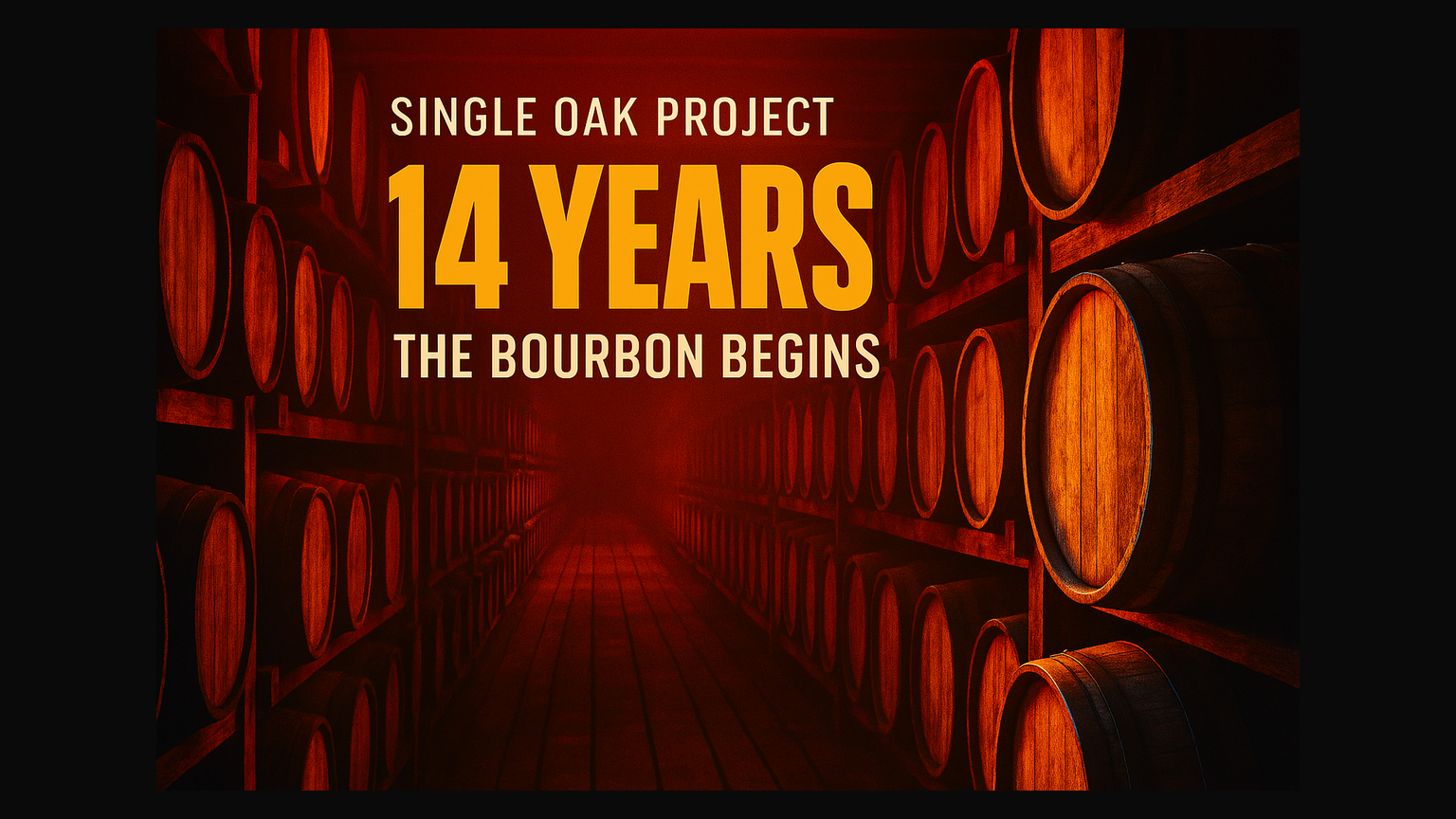
The experiment ended. The bourbon begins. Buffalo Trace studied 192 barrels over 14 years to answer every question they had about wood science. The Single Oak Project just became a permanent bourbon at $129.99.
I’m John from Chasing the Unicorn Podcast. Here’s what moved today. May 1, 2026.
Today’s Big Move — Buffalo Trace’s 14-year science project just became a permanent bourbon. Here’s what happened.
In 2011, Buffalo Trace launched something called the Single Oak Project. They pulled 192 individual barrels from their Frankfort, Kentucky warehouse. Each one was different — different grain recipes, different yeast strains, different char levels, different tree-grain density, different warehouse floors, different entry proof. Twelve variables, tracked through a full decade of aging.
Then they brought in 100,000 consumers to score each bottling. The goal wasn’t a marketing study. It was a production science study. What actually makes bourbon taste the way it does? They published the data.
The experiment ran from 2012 through 2024. Now it’s done.
On May 1, Buffalo Trace announced the Single Oak Project graduates into a permanent annual release. The bottle: Buffalo Trace Single Oak. Ten-year age statement. Each barrel built from single-tree Missouri white oak. Limited to approximately 18,000 bottles per year. $129.99 MSRP. First release arrives Q4 2026.
That $129.99 price point matters. It’s Buffalo Trace’s first new age-stated permanent expression since Eagle Rare 10 was repositioned in 2018. It sits between Eagle Rare and Blanton’s Gold in the lineup — but it comes with something neither of those carry: fourteen years of publicly documented production science behind every decision in the bottle.
Eighteen thousand bottles nationally means this will be allocated. But it’s not BTAC-level scarce, and it’s built to scale. Q4 2026 is the window — register on Buffalo Trace’s mailing list now so the lottery notification doesn’t catch you off guard. Which brings us to today’s First Sip — because the first four words on the Single Oak label, before you get to the age statement or the single-tree oak, are Kentucky Straight Bourbon. Most people skip right past them.
Today’s First Sip — straight bourbon versus plain bourbon. It’s a legal distinction, and it’s one the Single Oak Project carries on its label.
So here’s what it is.
Straight bourbon is not a marketing word. It’s a legal upgrade over plain bourbon, and it tells you three things the label might not say outright. To be called straight, a bourbon must be aged at least two years with no added color, flavoring, or other spirits blended in. If it’s aged less than four years, the label must state the exact age. And “Kentucky Straight Bourbon” means every drop was made in Kentucky — no sourced whiskey from another state can enter.
Plain bourbon without the straight designation can legally be young, blended with other spirits, or colored with caramel. That doesn’t make it bad. But it means you’re buying something with looser rules than what straight promises.
The Single Oak carries all four guarantees before you reach the 10-year age statement or the single-tree oak requirement. The fourteen-year research story is the compelling part. The straight label is the floor underneath it.
What this changes — when you’re choosing between two bottles at the same price and one says Kentucky Straight Bourbon and the other just says bourbon, the straight bottle is operating under stricter rules. That’s law, not marketing. Alright — today’s Chase. Three bottles, and one of them has a same-day deadline.
Today’s Chase — three bottles across three tiers. A last-call window, a pre-allocation deadline, and a live auction entering its final week. Let’s start with the one that matters most.
Angel’s Envy Cask Strength 2026. Mid-tier, $89.99, 118.2 proof. Kentucky straight bourbon finished in port wine casks. About 300 to 400 bottles remaining in soft-inventory markets as of this morning.
In the glass: dark cherry, dried plum, cocoa, and roasted oak on the nose. Concentrated dark fruit, bittersweet chocolate, caramelized brown sugar, and black pepper across the palate. The finish is long — port tannin and dried cherry that stays. At 118.2 proof, the port-finish character arrives at full intensity. This is the release where the Angel’s Envy flavor profile makes its clearest argument.
Today, May 1, is the terminal clearance date at MSRP. If your retailer is in Connecticut, New Jersey, or Georgia and received allocation this cycle, call ahead this morning — this is a same-day buy-or-pass. Outside those markets, secondary runs $130 to $155. That’s the remaining path.
Worth watching — and today is the last day that watching still means something.
Also on today’s Chase — Four Roses Single Barrel Collection Second Rotation in the under-$80 tier. Three expressions: OESQ, OESF, and OBSK at $79.99 each. Pre-allocation closes May 2, and today is the last day to submit state lottery entries in Ohio, Virginia, and Pennsylvania. And Eagle Rare 30 is live at Bonhams through May 8, current bid around $14,080. Final price action concentrates in the last 72 hours — establish bid position before May 5 if you’re tracking it. Full detail in today’s Cut Daily. If you want more, head to The Brief at chasingtheunicornpodcast.
Alright — today’s Bar Talk. A Kentucky craft distillery filed a wheated bourbon this week and priced it $20 above Larceny.
Today’s Bar Talk — Wilderness Trail filed a wheated Bottled-in-Bond at $54.99, and the community’s split on whether the price makes sense. Here’s what’s actually going on.
Wilderness Trail is a craft distillery out of Danville, Kentucky — founded in 2012 by Shane Baker and Pat Heist, both fermentation scientists. Their production differentiator is Sweet Mash fermentation: fresh yeast propagation rather than backset for pH control. That’s unusual in Kentucky bourbon production. Their lineup currently runs $34.99 to $79.99 depending on the expression.
The wheated BiB at $54.99 fills the gap between the base bourbon and the single-barrel tier. The comparison the community keeps returning to: Larceny Bottled-in-Bond at $34.99, Heaven Hill Bottled-in-Bond Wheated at $26.99. Wilderness Trail is asking $20 more than Larceny for a wheated BiB from a craft producer. The r/bourbon thread split roughly 45% calling it a smart extension, 35% saying it’s overpriced, 20% wanting more releases before forming an opinion.
Bottled-in-Bond is a federal standard from 1897 — the first consumer protection law in American whiskey history. One distillery, one distilling season, four years minimum in a federally bonded warehouse, bottled at exactly 100 proof. No ambiguity. At any price point, that certification is a transparency signal the government enforces. You can verify it. That’s the floor under the $54.99 label regardless of the craft premium debate.
Here’s what it means for the rest of us — at $54.99, you’re paying for Wilderness Trail’s Sweet Mash fermentation story. Taste it against Larceny BiB and let $20 answer itself.
One more for today — today’s full American Whiskey Industry Brief breaks down the Pernod Ricard acquisition situation: a second unnamed strategic acquirer just entered the Brown-Forman data room, Bernstein’s model now puts the Pernod scenario at 68%, and the Sazerac FTC response window expires May 9. It’s waiting at chasingtheunicornpodcast.com.
That’s The Cut. The full American Whiskey Industry Brief is waiting at chasingtheunicornpodcast.com/the-brief/. I’m John F. Schuster II. Thanks for joining me. Your unicorn is out there.
The Cut Daily
Listen to today’s episode and find us on Spotify and everywhere you listen at chasingtheunicornpodcast.com/podcast.

Informational and entertainment purposes only. Nothing here is investment advice. Verify before buying, trading, or bidding. We are not liable for errors or financial losses.
The experiment ended. The bourbon begins. Buffalo Trace studied 192 barrels over 14 years to answer every question they had about wood science. The Single Oak Project just became a permanent bourbon at $129.99.
The biggest thing that moved in American whiskey over the last 48 hours is a 14-year science project graduating into a bottle you can actually buy. Buffalo Trace announced the permanent graduation of the Single Oak Project from a research program into an annual lineup addition — a 10-year, single-tree-oak bourbon at $129.99 MSRP, arriving Q4 2026. Also in today’s edition: Heaven Hill just committed $35 million to the largest independent bourbon expansion in Kentucky in years; Texas whiskey made two significant distribution moves in a 24-hour window; and the bourbon auction writing the industry’s most consequential secondary reference price of 2026 enters its decisive final week.
Here’s a bourbon story that takes fourteen years to tell.
In 2011, Buffalo Trace launched an experiment called the Single Oak Project. They pulled 192 individual barrels from their Frankfort, Kentucky warehouse — each one different. Different grain recipes. Different yeast strains. Different char levels on the inside of the barrel. Different tree-grain density. Different warehouse floor locations. Different proof going in. Twelve variables, tracked through a full decade of aging.
Then they asked 100,000 consumers to score each bottling. What they were building was the most granular documented study of what actually makes bourbon taste the way it does — not a marketing study, a production science study. The data is published.
The experiment ran from 2012 through 2024. Now it’s done.
On May 1, Buffalo Trace announced the Single Oak Project is graduating from research into a permanent annual release. The bottle is called Buffalo Trace Single Oak — a 10-year age statement, each barrel built from single-tree Missouri white oak, limited to approximately 18,000 bottles per year at $129.99. First release arrives Q4 2026.
That $129.99 price point is significant. It’s Buffalo Trace’s first new age-stated permanent expression since Eagle Rare 10 was repositioned in 2018. It lands between Eagle Rare and Blanton’s Gold in the lineup — but it comes with something neither of those carries: fourteen years of publicly documented production science explaining exactly why every decision in the bottle was made.
For an 18,000-bottle national allocation, this will be allocated. But it’s not BTAC-level scarce, and it’s built to scale.
The Single Oak Project’s permanent expression carries four words on the label before you ever get to the age statement: Kentucky Straight Bourbon. Most people skip past them. They shouldn’t.
“Straight bourbon” is not a marketing word. It’s a legal upgrade over plain bourbon, and it tells you three things the label might not say outright.
To be called “straight,” a bourbon must be aged at least two years. It cannot have any added color, flavoring, or other spirits blended in. If it’s aged less than four years, the label must state the exact age. And if the label says “Kentucky Straight Bourbon,” every drop of whiskey in the bottle was made in Kentucky — no sourced whiskey from another state can sneak in.
Plain “bourbon” without the “straight” designation can legally be young, blended with other spirits, or colored with caramel. That doesn’t make it bad — but it means you’re buying something with looser rules than what “straight” promises.
Buffalo Trace Single Oak carries all of those guarantees before you even get to the 10-year age statement, the single-tree oak sourcing requirement, or the 14-year research file. The research is compelling. The “straight” label is the floor under it.
What this changes: When you’re choosing between two bottles at the same price and one says “Kentucky Straight Bourbon” and the other just says “bourbon,” you know the straight bottle is operating under stricter rules. That’s law, not marketing.
Floor erosion is the gap between what a bottle once sold for at its historical high and what it’s actually selling for today. A 56.6% floor erosion means Old Rip Van Winkle 10-Year — the entry-level bottle in the Pappy Van Winkle lineup — has lost more than half its peak value since 2021. In the pandemic-era peak, this bottle was hammering at $875 at auction. Today it averages $380. It still carries a 52% premium over its $249 MSRP, but that premium has been cut in half in four years and the direction is consistently downward. Buffalo Trace produces this bottle annually, in regular volumes, under an established allocation structure — and the secondary market is repricing it toward what regular, reproducible supply actually supports. The deeper erosion is at the entry Van Winkle tier; Pappy 20 and 23-Year hold materially better floors because those bottles are genuinely harder to produce in volume.
The Hunt: 5 active drops · Bar Talk: 2 debates · The Secondary: 3 graded bottles
◆ The Brief (free): https://chasingtheunicornpodcast.com/the-brief/
◆ Listen on Spotify: https://open.spotify.com/show/56Lt67gvTPjifCyeqFW3IT
◆ YouTube: https://www.youtube.com/@chasingtheunicornpodcast
Want the full picture? The complete American Whiskey Industry Brief — every section, every source, every story — is published free every morning at chasingtheunicornpodcast.com. Read it at chasingtheunicornpodcast.com/the-brief/.