The Cut — May 2, 2026 — Four Roses Drops 9,800 Bottles Monday — And Tells You Where the Barrel Sat | The Cut
In this episode
Four Roses just told you something distilleries almost never tell you — and they chose to do it on launch week. The Single Barrel Collection Second Rotation goes national Monday, May 4. Three barrel-proof expressions: OESQ at 110.2 proof, OESF at 112.4 proof, OBSK at 107.6 proof, all at $79.99 MSRP. Approximately 9,800 bottles across…
Mentioned in this episode: Heaven Hill, Elijah Craig, Larceny, Old Fitzgerald, Evan Williams, Four Roses, Bardstown, Old Grand-Dad, Sazerac
Read the full transcript
Target runtime: 7:48 Word count: 1,198 Estimated runtime: 7:59 Source: The Cut Daily 2026-05-02
—
This is The Cut. American whiskey, daily.
Nine thousand eight hundred bottles. Monday morning. Four Roses confirmed batch specs for the Single Barrel Collection second rotation — three barrel-proof expressions at $79.99, state lottery notifications starting Monday. If your name is on a list, check your inbox.
I’m John from Chasing the Unicorn Podcast. Here’s what moved today. May 2, 2026.
Today’s Big Move — Four Roses just launched three barrel-proof bourbons and told you exactly where the barrel sat. Here’s what happened.
Four Roses works differently than most Kentucky distilleries. They run ten distinct recipes — five yeast strains crossed with two mash bills — and their Single Barrel Collection exists to prove that those recipes produce genuinely different whiskey. Not different on a spec sheet. Different in the glass.
This week, the Second Rotation of the 2026 Single Barrel Collection goes national. Three expressions: OESQ, OESF, and OBSK. The letter codes are distillery shorthand. What matters is what they taste like. OESQ uses a high-rye mash bill with the Q yeast strain — that runs floral and fruity. OESF uses the same mash bill with the F yeast strain, which pulls toward baking spice and dried fruit, and prints at 112.4 proof — the highest in this batch. OBSK uses a low-rye mash bill with the K yeast strain — richest and most approachable of the three, at 107.6 proof.
Here’s the part that’s new. Four Roses confirmed all three Second Rotation barrels were drawn from the middle floors of their Cox’s Creek warehousing campus. That warehouse-position disclosure has never been made at the single-barrel collection batch level before. It matters because floor position shapes how bourbon ages. Middle floors run moderate heat cycles — no aggressive evaporation from upper-floor positioning — which produces more integrated wood character over time. That’s what you’re seeing in the proof range across all three expressions.
$79.99 per expression. Approximately 9,800 bottles total across all three, split roughly 3,200 to 3,300 per expression. State lottery winner notifications go out Monday morning through Ohio OHLQ, Virginia VABC, and Pennsylvania PLCB. Seelbach’s and Binny’s have national specialty allocation available without a lottery — pre-deadline requests honored at confirmed allocation.
If you’re new to Four Roses and want to understand the recipe system before committing to a lottery at $79.99, there’s a $28 starting point. Four Roses Small Batch blends four of the ten recipes — the same brand, the same distillery — and it’s on the shelf at most stores right now. That’s the bottle that shows you what Four Roses is before Monday. Which brings us to today’s First Sip — because the label on all three of these Second Rotation expressions carries a designation that most drinkers walk right past.
Today’s First Sip — Bottled-in-Bond. You’ll see it on Old Fitzgerald’s Spring 2026 release, arriving at specialty retail the week of May 11 — and most drinkers treat it like a marketing phrase when it’s actually federal law.
So here’s what it is.
In 1897, adulterated whiskey was a real problem. Producers were cutting bourbon with industrial alcohol, tobacco juice, and prune extract for color. People were getting hurt. Colonel Edmund Haynes Taylor, Jr. pushed Congress to pass the Bottled-in-Bond Act — the first consumer protection law in American history. It set four rules. One distillery. One distilling season — January through June, or July through December. Aged at least four years in a federally bonded warehouse. Bottled at exactly 100 proof. That’s it. No marketing language. A government-backed guarantee of provenance, age, and strength.
Here’s why it matters today: Bottled-in-Bond bourbons are almost always the best value on the shelf. Four years minimum, real 100 proof, no blending tricks — and they often cost less than bottles making bigger marketing claims. Think of it like a building code. You don’t have to understand every regulation in it to trust that the structure passed inspection. The BiB seal is the inspection stamp. Old Grand-Dad BiB, Evan Williams BiB, Heaven Hill BiB — all under $30, all legally transparent about what’s inside.
What this changes — next time you’re looking for a good bourbon under $35, “Bottled-in-Bond” on the label is the clearest value signal the government gives you. That’s law, not marketing. Alright — today’s Chase. Three bottles, and the most urgent one has a Monday morning window.
Today’s Chase — three bottles across three tiers. All three are worth-the-chase calls, and they span $79.99 to $299.99. Let’s start with the one that matters most.
Four Roses Single Barrel Collection Second Rotation — OESQ, OESF, and OBSK — under $80 tier, $79.99 per expression. This is a single Chase entry covering three bottles, each one barrel-proof and warehouse-position documented.
In the glass: OESQ runs floral and stone fruit with toasted oak at 110.2 proof. OESF leans baking spice and dried fruit at 112.4 — the highest proof in the batch and the expression that carried the strongest collector demand from the first rotation. OBSK is rich caramel and vanilla with approachable tannin at 107.6 — the cleanest entry for drinkers new to the Four Roses system.
The editorial heat here isn’t just the proof range. It’s the warehouse disclosure. Cox’s Creek middle-floor sourcing confirmed at the batch level — that’s a transparency move Four Roses has never made before at this tier. For a nationally recognized distillery at $79.99, that context is part of the value.
This is worth the chase. Claim your lottery notification the moment it arrives Monday morning — Ohio OHLQ, Virginia VABC, and Pennsylvania PLCB. If you’re outside the lottery system, Seelbach’s and Binny’s have specialty allocation at MSRP. Don’t wait on this one.
Also on today’s Chase — Westland Garryana Edition 8 in the mid-tier at $149.99. Garry oak is native to the Pacific Northwest coast and exists nowhere else in commercial cooperage — there’s no other American whiskey making casks from this wood at repeatable annual scale. Distillery mailing-list pre-sale is active now; national specialty retail arrives the week of May 11. And Bull Run Aged 15 Year American Whiskey at $299.99 — the last production run from the 2009–2011 vintage barrels, launching in Texas and Florida the week of May 4 with roughly 30 total bottles across both states. Full detail in today’s Cut Daily. If you want more, head to our Patreon at chasingtheunicornpodcast.
Alright — today’s Bar Talk. Heaven Hill just committed $35 million to new capacity in the middle of a production correction.
Today’s Bar Talk — Heaven Hill is betting $35 million against the current correction, and the community’s split on whether that’s smart capital planning or the wrong move at the wrong moment. Here’s what’s actually going on.
Heaven Hill just announced a $35 million expansion of its Bardstown campus — 120,000 new barrels of aging capacity, a new pot still building — announced while Beam Suntory is idling capacity at Clermont and producers across Kentucky are managing wholesale margin compression. The question is straightforward: counter-cycle investment, brilliant or reckless?
Here’s the logic. Bourbon requires years of aging before it can be sold. A distillery that builds capacity now — when construction costs are softer and contractor resources are more available — is betting that by the time that capacity produces saleable whiskey, the correction will have resolved. The risk is that the downturn runs longer than modeled and the distillery carries new debt on capacity it can’t profitably fill.
What changes the math this time: Kentucky’s barrel inventory tax phase-out, enacted in 2025, reduces the carrying cost of aging inventory incrementally every year for the next two decades. Heaven Hill CFO Todd Hafer confirmed that phase-out gave them financing confidence they didn’t previously have for a commitment this size. The Q1 2026 data release logged $18.7 million in aggregate relief across Kentucky’s distilling industry. For a producer in Heaven Hill’s inventory tier, that’s an estimated $3.2 to $4.1 million per quarter in relief going forward. The commercial engines — Elijah Craig, Larceny, Heaven Hill Bottled-in-Bond — all have documented national demand behind them. This isn’t a speculative new release. It’s a bet on brands that are already moving.
Here’s what it means for the rest of us — counter-cycle expansion is how Kentucky’s most durable independent distilleries have always built their next decade. Heaven Hill’s bet is that 2026 is the floor.
One more for today — today’s full American Whiskey Industry Brief has the complete LVMH Moët Hennessy development: a second party just signed an NDA with Brown-Forman’s Strategic Review Committee, turning the Jack Daniel’s situation into a three-way competitive process with a May 9 Sazerac deadline. It’s waiting on Patreon.
That’s The Cut. The full American Whiskey Industry Brief is waiting at patreon.com/ChasingTheUnicornPodcast. I’m John Schuster. Thanks for joining me. Your unicorn is out there.
The Cut Daily
Listen to today’s episode and find us on Spotify and everywhere you listen at chasingtheunicornpodcast.com/podcast.

Informational and entertainment purposes only. Nothing here is investment advice. Verify before buying, trading, or bidding. We are not liable for errors or financial losses.
Nine thousand eight hundred bottles. Monday morning. Four Roses confirmed batch specs for the Single Barrel Collection second rotation — three barrel-proof expressions at $79.99, state lottery notifications starting Monday. If your name is on a list, check your inbox.
The biggest move in American whiskey over the last 48 hours is a lottery launch you can still act on today. Four Roses confirmed the full batch specifications for its Single Barrel Collection Second Rotation ahead of Monday’s national release — three barrel-proof expressions at $79.99 each, with a warehouse-location disclosure attached that the distillery has never made at this level before. Also in today’s edition: Heaven Hill is betting $35 million against the current production correction; the Pacific Northwest sends three distilleries to new national markets in the same 72-hour window; and the bourbon secondary market shows what happens when an “allocated” bottle slowly loses its premium as annual supply catches up to demand.
Four Roses makes bourbon differently than most distilleries. They work with ten distinct recipes — five yeast strains crossed with two mash bills — and their Single Barrel Collection is built around proving that those recipes produce genuinely different whiskey in a single bottle.
This week, the Second Rotation of the 2026 Single Barrel Collection launches nationally. Three expressions: OESQ, OESF, and OBSK. The letter codes are distillery shorthand — what matters is what they taste like. OESQ uses a high-rye mash bill with the Q yeast strain, which runs floral and fruity. OESF uses the same mash bill with the F yeast strain, which leans toward baking spice and dried fruit, and prints at 112.4 proof — the highest in this batch. OBSK uses a low-rye mash bill with the K yeast strain — the richest, most approachable of the three, at 107.6 proof.
Here’s the part that’s new. Four Roses confirmed that all three Second Rotation barrels were drawn from the middle floors of their Cox’s Creek warehousing campus. That warehouse-position disclosure has never been made at the single-barrel collection batch level before. It matters because floor position affects how bourbon ages — middle floors run moderate heat cycles without the aggressive evaporation of upper-floor positions, which produces more integrated wood character over time and contributes to the proof range you’re seeing here.
$79.99 per expression. Approximately 9,800 bottles total across all three, split roughly 3,200 to 3,300 per expression. State lottery winner notifications go out Monday morning through Ohio OHLQ, Virginia VABC, and Pennsylvania PLCB. National specialty allocation through Seelbach’s and Binny’s is available without a lottery; pre-deadline requests honored at confirmed allocation.
Old Fitzgerald Bottled-in-Bond Spring 2026 is active in this week’s Hunt, arriving at specialty retail the week of May 11. The BiB designation on that label is worth understanding before you decide whether to chase it.
In 1897, adulterated whiskey was killing people. Unscrupulous producers were cutting real bourbon with industrial alcohol, tobacco juice, and prune extract for color. Colonel Edmund Haynes Taylor, Jr. pushed Congress to pass the Bottled-in-Bond Act — the first consumer protection law in American history. It said: if you want to call your whiskey “Bottled-in-Bond,” you have to meet four rules.
One distillery. One distilling season — either January through June or July through December. Aged at least four years in a federally bonded warehouse. Bottled at exactly 100 proof.
That’s it. No bureaucracy, no marketing — just a guarantee of provenance, age, and strength.
Here’s why it matters today: Bottled-in-Bond bourbons are almost always the best value on the shelf. Four years minimum, real 100 proof, no blending tricks — and they often cost less than the bottles making bigger marketing claims. Old Grand-Dad BiB, Evan Williams BiB, Heaven Hill BiB. All under $30, all legally transparent about what’s inside.
What this changes: Look for “Bottled-in-Bond” on the label next time you’re trying to find a good bourbon under $35. The rules aren’t marketing — they’re law.
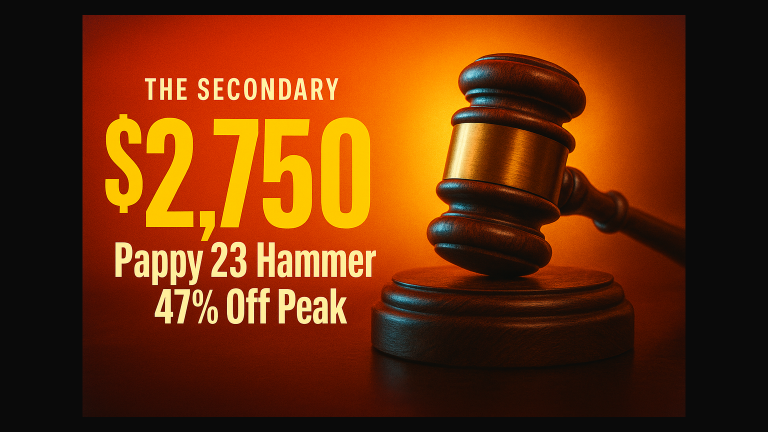
Floor erosion measures how far a bottle’s realized secondary price has fallen from its all-time high. W.L. Weller Full Proof — a wheated Buffalo Trace bourbon at 114 proof — peaked at $165 in secondary during the 2021–2022 bourbon boom. Today it averages $88. That’s less than twice its $49.99 MSRP, and the direction has been consistently downward for four years. The bottle is still technically allocated — you cannot walk into most stores and find it on the shelf — but the secondary market is repricing it toward the level that consistent, reproducible annual supply actually supports. The deeper erosion at the standard-tier Weller expressions contrasts with Old Rip Van Winkle 10-Year’s erosion pattern: both are declining, but the Van Winkle line holds its floor higher because the genuinely aged, genuinely scarce bottles within the Van Winkle family are harder to replicate at volume.
The Hunt: 5 active drops · Bar Talk: 6 debates · The Secondary: 3 graded bottles
◆ Full AWIB (Paid Patreon Subscriber): https://www.patreon.com/c/ChasingTheUnicornPodcast
◆ Listen on Spotify: https://open.spotify.com/show/56Lt67gvTPjifCyeqFW3IT
◆ YouTube: https://www.youtube.com/@chasingtheunicornpodcast
Want the full picture? The complete American Whiskey Industry Brief — every section, every source, every story — is published daily for subscribers on Patreon. Join us at patreon.com/ChasingTheUnicornPodcast.