The Cut — May 16, 2026 — Brent Elliott Broke the Recipe’s Rules | Four Roses “Reunion” | The Cut
In this episode
Saturday’s biggest shelf-level move is a pre-order call you need to make this week. Four Roses master distiller Brent Elliott selected OBSV recipe barrels at 11 years — one to three years past the V-yeast’s documented performance window — because those specific barrels held their stone-fruit and floral character when most don’t. He named the…
Mentioned in this episode: Buffalo Trace, Elijah Craig, Larceny, Four Roses, Bardstown, Booker’s
Read the full transcript
Target runtime: 7:48 Word count: 1,211 Estimated runtime: 8:04 Source: The Cut Daily 2026-05-16
—
This is The Cut. American whiskey, daily.
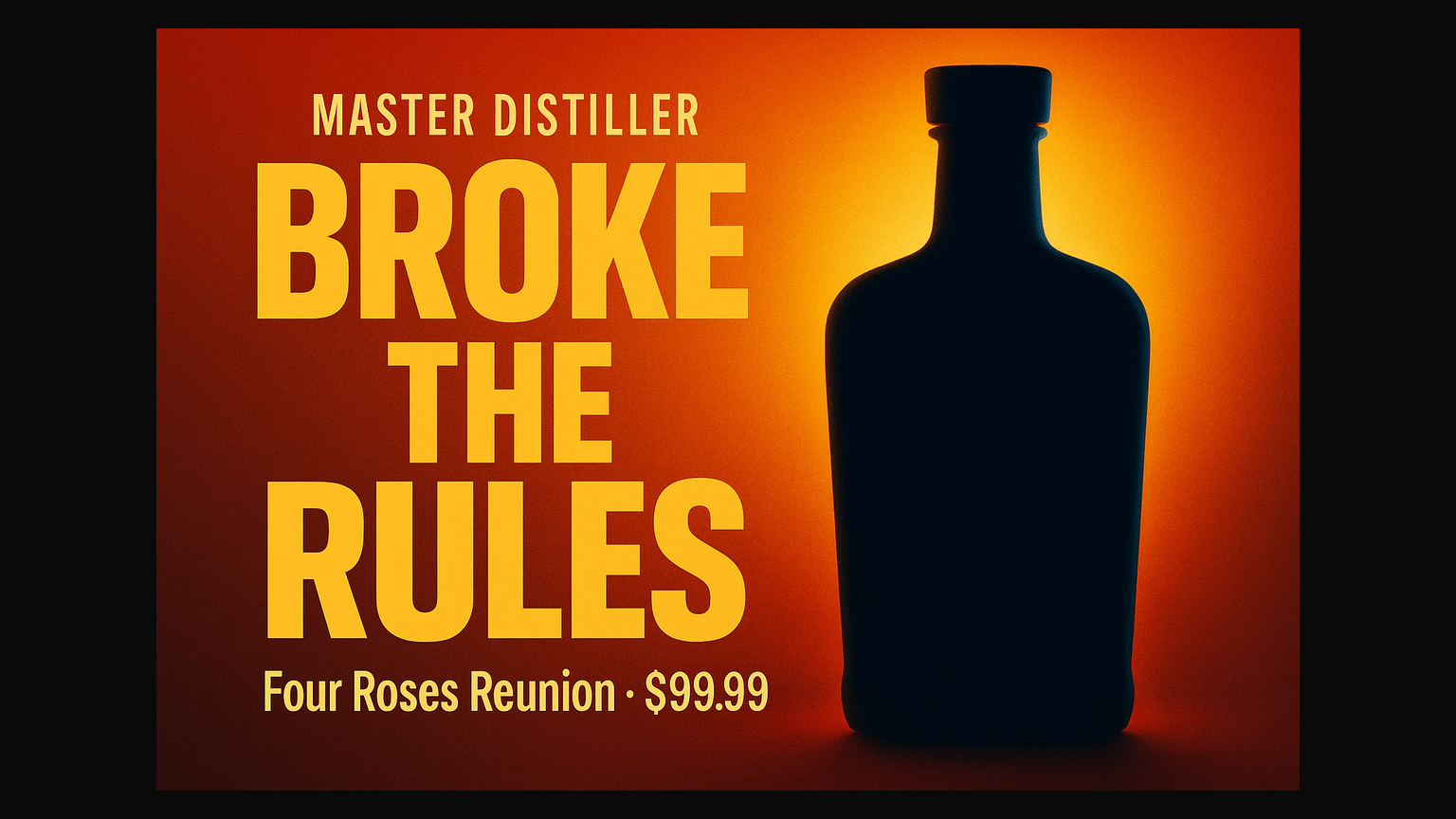
Brent Elliott broke the recipe’s rules. The Four Roses master distiller took OBSV barrels to 11 years — past the V-yeast’s typical window — because those specific barrels held their character. He named them “Reunion.” Ninety-nine ninety-nine, Memorial Day ship, pre-orders open now.
I’m John from Chasing the Unicorn Podcast. Here’s what moved today. May 16, 2026.
Today’s Big Move — Four Roses ships an 11-year OBSV single barrel that survived its own performance window, and the pre-order window is open now. Here’s what happened.
Saturday is Events and Auctions day. Today’s most universally actionable move isn’t in Bardstown — it’s the pre-order call you need to make to your specialty retailer before Memorial Day. That’s where this starts.
Four Roses runs a system nobody else uses. Five yeast strains, two mash bills, ten possible recipe combinations. Every Single Barrel Select that leaves Lawrenceburg carries a four-letter code that tells you what’s inside.
The code on this bottle is OBSV. High-rye mash bill crossed with the V-yeast strain — stone fruit, rose petal, light rye baking spice. That V-yeast character is what people hunt OBSV barrels for. It’s also why those barrels have a documented performance window: typically 8 to 10 years. After that, the light aromatic compounds integrate into wood extraction and the oak takes over. The delicate-fruit character doesn’t disappear — it weaves into the caramel and vanilla — but it’s no longer the lead voice.
Brent Elliott found barrels where that didn’t happen on schedule. The stone-fruit and floral character held at 11 years — one to three past the recipe’s typical window. He selected those specific barrels because of that survival. He named the result “Reunion.”
Breaking Bourbon’s pre-ship projection is 4.1 to 4.3 out of 5. National ship is the week of May 25. Most specialty accounts receive single-digit allocations. Pre-order lists at major accounts close before the May 21 distribution date.
At $99.99 MSRP, this isn’t a post-ship scramble. The action is calling your retailer this week. And understanding why those barrels are worth $99 means understanding what that four-letter code actually tells you.
Today’s First Sip — the Four Roses recipe system. You’ll see it on the back label of “Reunion” and on every Four Roses single barrel, and most drinkers skip right past it.
So here’s what it is.
Four Roses is the exception in American bourbon. Most distilleries use one proprietary yeast and never discuss it. Four Roses uses five yeast strains crossed with two mash bills, giving them ten distinct recipe combinations.
The mash bills: Mash B is high-rye — 60% corn, 35% rye, 5% malted barley. Mash E is lower-rye — 75% corn, 20% rye, 5% malted barley. The yeasts each add a signature. V produces delicate fruit and floral notes. K adds spice. O gives rich fruit. Q contributes floral essence. F adds herbal notes. The codes combine: OBSV is Mash B plus V-yeast — stone fruit, rose petal, restrained rye spice at peak maturity.
“Reunion” is what OBSV looks like when the V-yeast character holds through a longer maturation window than most barrels sustain it. That’s the selection Elliott documented — not a stylistic gamble, a filtration call on barrels that were exceptions to the rule.
What this changes — when you see a Four Roses recipe code on the back label, you can predict the flavor direction before you open it. OBSV is the delicate-fruit, high-rye family. OESF — low-rye, herbal yeast — is a different bottle entirely. The code is a map, not decoration. Speaking of today’s Chase — an under-$80 wheated barrel-strength closes its pre-order window tomorrow.
Today’s Chase — three bottles across three tiers. One deadline is tomorrow, one is today only. Let’s start with the one that matters most.
Larceny Barrel Proof C926. Under-$80 tier at $69.99. Sunday COB is the hard pre-order deadline — specialty receipt lands Tuesday, May 18 to 19.
In the glass: rich stone fruit and soft vanilla on the nose, creamy wheat-driven mid-palate, warm baking spice and persistent oak on the finish. At 124.6 proof, the barrel selection reads integrated over raw — not a heat bomb.
Here’s why it’s today’s spotlight. This is the most accessible wheated barrel-strength expression at MSRP in the current window. At $69.99 it sits $10 below Elijah Craig Barrel Proof C926. Twenty-two thousand bottles in 50-state distribution — Total Wine nationally, Binny’s Chicago metro, Westport Whiskey and Wine in Louisville, Big Red Liquors in Bloomington and Indianapolis, Hi-Time Wine Cellars in Costa Mesa, Liquor Barn in Kentucky. Sunday COB is not a guideline. Tuesday specialty receipt means today and tomorrow are the pre-order days. Call your account.
This is worth the chase.
Also on today’s Chase — Booker’s “Charlie’s Batch” 2026-01 at $99.99 MSRP, named for Fred Noe’s son and the first Booker’s batch with documented three-generation family production notes in the bottle; Day 4, with 10 to 14 days of open specialty window remaining. And the Kentucky Bourbon Affair 2026 closing-day floor access in Bardstown — today only, doors at 12:45 PM CT, $175 general or $250 VIP; the 2:00 PM capacity wall is not a guideline, arrive before then. Full detail in today’s Cut Daily. If you want more, head to our Patreon at chasingtheunicornpodcast.
Alright — today’s Bar Talk. The debate that’s been running since the “Reunion” pre-ship framing hit this week.
Today’s Bar Talk — “Reunion” at 11 years: did Brent Elliott find the V-yeast recipe’s ceiling, or push a barrel past its optimal window? Community’s split on whether the $99.99 pre-order is trust the distiller or wait for the reviews. Here’s what’s actually going on.
The r/bourbon thread isn’t arguing about whether the bottle is good. It’s arguing about whether you commit $100 before the first post-ship reviews land May 25.
One camp treats Elliott’s selection criteria as sufficient. He filtered for barrels that held the V-yeast character through extended maturation, documented that in the release communication, and Breaking Bourbon projected 4.1 to 4.3 out of 5 on the pre-ship assessment. The other camp holds that 11-year OBSV is the leading edge of the recipe’s over-oaking risk — and $99.99 isn’t the price to pay for an experiment that resolves in nine days anyway.
That second camp has the framing wrong. Elliott isn’t claiming all 11-year OBSV barrels perform this way. He’s claiming these specific barrels survived the integration window with the stone-fruit and rose-petal character intact as the lead voice. That’s a documented selection criterion. The “past the window” argument applies to the average OBSV barrel at 11 years. It doesn’t apply to barrels specifically filtered to be exceptions.
Here’s what it means for the rest of us — if you trust the master distiller’s filtering, $99.99 is the right price to act on that trust. Pre-order before the reviews land.
Two more things before we close. First — today’s AWIB on Patreon has the full Flight comparison: Four Roses Small Batch Select 2026 versus Four Roses Single Barrel Select “Reunion” 2026. Same V-yeast family, entirely different formats, $50 apart — the sipper versus the collector versus the cocktail use case, side by side. The verdict on which one wins for which kind of bourbon-curious drinker is in the brief. Second — the Kentucky Bourbon Affair’s closing-day barrel-selection results post end of day today — three Buffalo Trace picks across Warehouse H, Warehouse D, and Warehouse K, designated to 340 specialty accounts in 38 states; if your account attended, confirm the designation by Wednesday. Both are waiting on Patreon.
That’s The Cut. The full American Whiskey Industry Brief is waiting at patreon.com/ChasingTheUnicornPodcast. I’m John Schuster. Thanks for joining me. Your unicorn is out there.
The Cut Daily
The Cut podcast runs Monday through Friday — catch the next episode Monday morning on Spotify and everywhere you listen at chasingtheunicornpodcast.com/podcast.

Informational and entertainment purposes only. Nothing here is investment advice. Verify before buying, trading, or bidding. We are not liable for errors or financial losses.
Brent Elliott broke the recipe’s rules. The Four Roses master distiller took OBSV barrels to 11 years — past the V-yeast’s typical window — because those specific barrels held their character. He named them “Reunion.” Ninety-nine ninety-nine, Memorial Day ship, pre-orders open now.
Four Roses master distiller Brent Elliott selected OBSV recipe barrels past their typical 8-to-10-year performance window and ships the result — “Reunion” 2026 — the week of May 25 at $99.99, making this the pre-order conversation to have with your specialty retailer before the Memorial Day allocation arrives. Today’s Saturday Events and Auctions window also closes on the Kentucky Bourbon Affair’s final day in Bardstown — Buffalo Trace barrel selections, master-distiller floor access, and a capacity-capped closing dinner that does not exist anywhere else, on any other day. Also in today’s edition: the Brown-Forman board’s formal rejection of Sazerac’s $15 billion bid ends Phase One of the bourbon industry’s biggest M&A cycle in a generation, the Eagle Rare 17 and Pappy 15 secondary floor tests land Sunday morning, and Texas posts a three-producer milestone Saturday.
Four Roses makes bourbon with a system nobody else uses. Five yeast strains, two mash bills, ten possible recipe combinations — every bottle that leaves the Lawrenceburg distillery as a Single Barrel Select carries a four-letter code that tells you exactly what’s inside.
The code on this bottle is OBSV. High-rye mash bill — 60% corn, 35% rye, 5% malted barley — crossed with the V-yeast strain, which produces delicate fruit and floral character: stone fruit, rose petal, a light baking-spice finish from the rye. That V-yeast character is what people seek OBSV barrels out for. It is also why those barrels have a documented performance window. Typically 8 to 10 years. After that, the light aromatic compounds from V-yeast fermentation integrate into wood extraction, and the oak takes over as the dominant flavor architecture. The delicate-fruit character doesn’t disappear — it weaves into the caramel and vanilla — but it’s no longer the lead voice.
Brent Elliott, Four Roses’ master distiller, found barrels where that integration didn’t happen on schedule. The V-yeast stone-fruit and floral character held at 11 years — one to three past the recipe’s typical window — and he selected those specific barrels because of that survival. He named the result “Reunion.”
Breaking Bourbon’s pre-ship projection is 4.1 to 4.3 out of 5. The COLA was confirmed May 12. National ship is the week of May 25, with Memorial Day weekend as the retail activation window. Most specialty accounts receive single-digit allocations; pre-order lists at major accounts close before the May 21 distribution date.
The action is the same everywhere: contact your specialty retailer this week.
Today’s Big Move is built around a four-letter recipe code — OBSV — and understanding what that code means explains both what Brent Elliott found in those 11-year barrels and why “Reunion” costs what it does.
Four Roses is the exception in American bourbon. Most distilleries use one proprietary yeast and never discuss it. Four Roses uses five yeast strains crossed with two mash bills, giving them ten distinct recipe combinations.
The mash bills: Mash B is high-rye (60% corn, 35% rye, 5% malted barley). Mash E is lower-rye (75% corn, 20% rye, 5% malted barley). The yeasts each add a signature — V produces delicate fruit and floral notes; K adds slight spice; O gives rich fruit; Q contributes floral essence; F adds herbal notes. The codes combine: OBSV means Mash B plus V-yeast. That combination is why OBSV barrels lead with stone fruit, rose petal, and restrained rye spice at peak maturity. “Reunion” is what OBSV looks like when the V-yeast character holds through a longer maturation window than most barrels sustain it — which is exactly the selection Elliott documented.
What this changes: when you see a Four Roses Single Barrel with a recipe code on the back label, you can predict the flavor direction before you open it. OBSV is the delicate-fruit and high-rye family. OESF (low-rye, herbal yeast) is a different bottle entirely. The code is information, not decoration.
Floor erosion is how far a bottle’s secondary market price has fallen from its all-time high. Eagle Rare 17-Year (2025 Buffalo Trace Antique Collection release) peaked at $2,850 in 2022, when demand compressed every BTAC expression above $2,000 regardless of proof or format. Today’s realized price at Bottle Spot is $1,485 — 47.9% below peak, meaning the bottle is now selling for roughly half its 2022 secondary high. That looks like a collapse, but the trajectory matters as much as the number. Eagle Rare 17 has now held the $1,450 to $1,520 band approaching Sunday’s four-week floor threshold — the interval secondary analysts use to distinguish a stabilizing floor from a bottle still in active erosion. The correction is partly structural: during the 2020-2023 compression period, Eagle Rare 17’s 90-proof format was trading above $2,000 alongside the barrel-proof BTAC expressions, despite the proof differential. The current $1,450-$1,520 band reflects a post-correction market that prices the 90-proof, 17-year format separately from the barrel-proof cohort. Sunday’s print tells you whether that repricing has found its structural bottom.
Rickhouse Report: 5 stories · Regional Report: 3 stories · Research Notes: complete
◆ Full AWIB (Paid Patreon Subscriber): https://www.patreon.com/c/ChasingTheUnicornPodcast
◆ Listen on Spotify: https://open.spotify.com/show/56Lt67gvTPjifCyeqFW3IT
◆ YouTube: https://www.youtube.com/@chasingtheunicornpodcast
Want the full picture? The complete American Whiskey Industry Brief — every section, every source, every story — is published daily for subscribers on Patreon. Join us at patreon.com/ChasingTheUnicornPodcast.