The Cut — April 16, 2026 — Bardstown Lottery Opens — More Bottles Than Entrants
In this episode
▶ Listen to this episode on Spotify More bottles than entrants. Bardstown Bourbon Company opened the Discovery Series 11 distillery lottery Thursday morning, and the math is the headline — 7,800 bottles available against 6,200 first-day entrants. That’s a 1.26 ratio, meaning roughly four in five entrants will win an allocation if the pool holds…
Mentioned in this episode: Buffalo Trace, Pappy Van Winkle, Wild Turkey, Parker’s Heritage, Four Roses, Bardstown, Old Forester
Read the full transcript
Target runtime: 7:48 Word count: 1,170 Estimated runtime: 7:48 Source: The Cut Daily 2026-04-16
—
This is The Cut. American whiskey, daily.
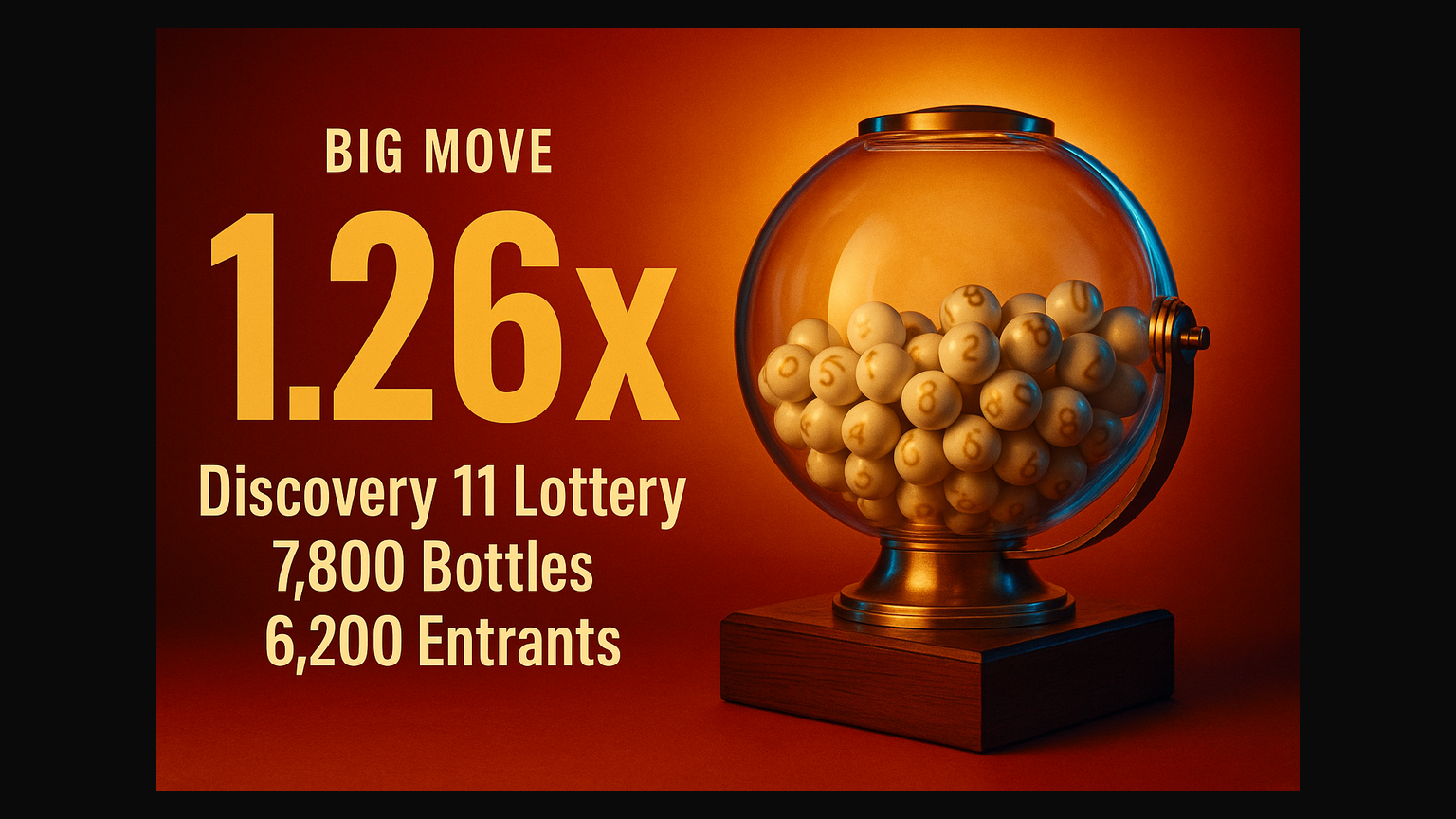
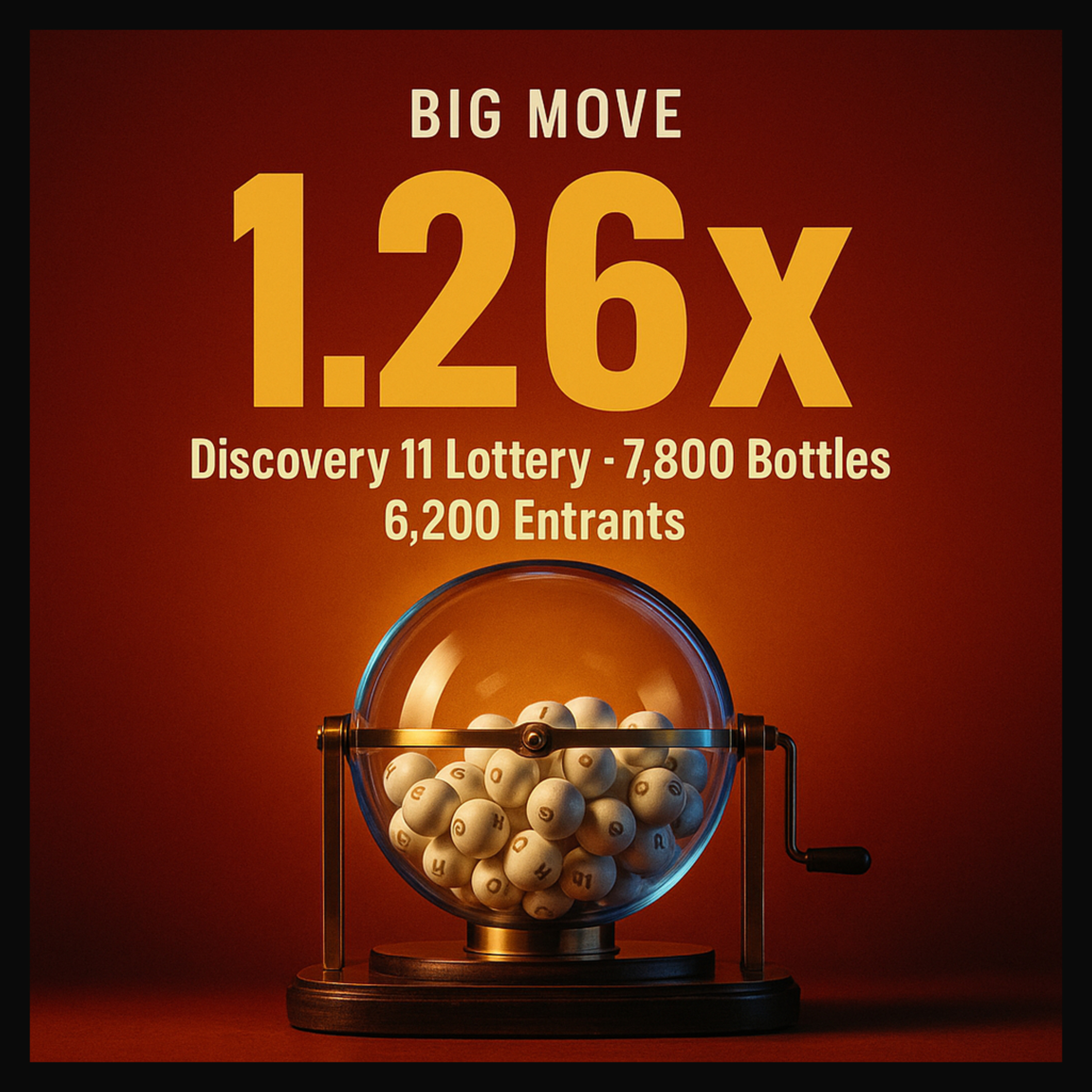
More bottles than entrants. Bardstown’s lottery. Discovery Series 11 opened Thursday at 6,200 first-day entrants against 7,800 bottles — a 1.26 ratio that means roughly four in five people who sign up will actually win an allocation. That’s the cleanest lottery math the program has ever run.
I’m John from Chasing the Unicorn Podcast. Here’s what moved today. April 16, 2026.
Today’s Big Move — Bardstown opened a lottery with more bottles than people in line for them. Here’s what happened.
Bardstown Bourbon Company opened the Discovery Series 11 distillery lottery Thursday morning. Two facts worth tracking. The first is the math. 6,200 first-day entrants. 7,800 bottles. That works out to 1.26 bottles available for every person who signed up — meaning roughly four in five entrants will actually win an allocation if the entrant pool holds through Sunday’s close.
The second is the comparison. The 2024 Discovery Series 9 lottery cleared at 3.4 entrants per bottle. The 2025 Discovery Series 10 lottery cleared at 2.1. This year’s 1.26 isn’t an incremental improvement — it’s the cleanest allocation math the program has produced in six years of running the format.
Mark Erwin, Bardstown’s CEO, called it the cleanest allocation discipline the Discovery Series has executed at scale. That’s not marketing language. That’s an explicit acknowledgement that the prior walk-in formats produced complaints — and the lottery format converts a velocity-and-position contest into a probability calculation. The release itself is a 14-year MGP wheated bourbon at cask strength, $169.99 distillery direct. Lottery entrants have through 11:59 p.m. Eastern on April 19 to register. Winners get notified April 21. The distillery-direct event runs April 22.
For your shelf, nothing changes this week. What just changed is that one of the cleaner allocated wheated releases of the spring is genuinely accessible — sign up by Sunday night, and you have roughly four-in-five odds at MSRP. And while we’re talking allocation — that word is doing real work, which is exactly where today’s First Sip lands.
Today’s First Sip — allocated versus regular release. You’ll see the word “allocated” on the Bardstown Discovery Series 11 lottery page, and most drinkers use the term wrong.
So here’s what it is.
Allocated describes how a bottle is distributed — not how good it is. Allocated bottles come from distilleries running limited quantities, where demand exceeds supply, so distributors ration them to retailers in small numbers. Pappy Van Winkle, the Buffalo Trace Antique Collection, Four Roses Limited Edition, Old Forester Birthday, Parker’s Heritage — those are the classic allocated bourbons. They’re allocated because production is genuinely constrained.
Now — not everything called rare is actually allocated. Marketing loves the word rare. Allocation is a distribution reality. You can tell a bottle is actually allocated when retailers run a lottery or wait list for it, when MSRPs exist but retail prices vary wildly by region, and when the secondary market commands multiples of retail.
Think of it the way you’d read a concert ticket. A sold-out show is allocated. A small-venue acoustic set with limited capacity is genuinely scarce. A “VIP-only” release with no clear cap is just marketing.
What this changes — hard-to-find is a shelf description. Allocated is a production reality. The second is worth chasing. The first sometimes is, sometimes isn’t. And speaking of — today’s Chase has the cleanest allocated lottery the year has produced.
Today’s Chase — three bottles across three tiers. Let’s start with the one that matters most.
Bardstown Bourbon Company Discovery Series 11. The $80 to $200 tier. $169.99 distillery, $179.99 specialty retail. 14 years, 118.6 proof, cask strength. The lottery opened Thursday at 9 a.m. Eastern. The entrant window closes 11:59 p.m. Eastern Sunday, April 19. Winners get notified April 21. Distillery-direct event April 22.
Flavor direction — MGP wheated bourbon profile. Caramel, vanilla, soft baking spice, dried orchard fruit, integrated oak. 14 years gives you tannin depth without the wood taking over. At 118.6 proof, the full profile comes through, and a few drops of water open it up.
Here’s why it’s the spotlight. The 1.26x bottle-to-entrant ratio is the cleanest allocation math the program has produced in six years. Discovery Series 9 cleared at 3.4 entrants per bottle. Discovery Series 10 at 2.1. This year, four in five entrants will win an allocation if the pool holds. The lottery format converts the chase from a velocity contest into a probability calculation — and at $169.99 for a 14-year cask-strength MGP wheated bourbon, the price is below where the comparable wheated allocations live.
This is worth the chase. The action is simple. Register at the Bardstown lottery portal by Sunday night. Pick up at the distillery April 22 if you win.
Also on today’s Chase — Wyoming Whiskey Outryder Bottled-in-Bond at $59.99, the brand’s first BiB designation in 14 years and the cleanest under-60-dollar BiB value of the spring. And Wild Turkey Master’s Keep 2026 at $249.99, releasing nationally April 30. Full detail in today’s Cut Daily. If you want more, head to our Patreon at chasingtheunicornpodcast.
Which brings us to today’s Bar Talk — and it’s the question that landed when three Mountain West bottles hit retail on the same day.
Today’s Bar Talk — Mountain West bourbon and whether altitude-aging is a real production variable or a marketing convenience. Community’s split on whether the regional label captures anything real or papers over three different distilleries doing three different things. Here’s what’s actually going on.
Quick vocabulary anchor. Angel’s share is the bourbon industry’s name for the liquid that evaporates out of a barrel during aging. In Kentucky, that loss runs roughly 3 to 5 percent annually. At Denver’s mile-high elevation, lower atmospheric pressure means barrels breathe harder — and Stranahan’s published angel’s-share figures average 6 to 8 percent annually. Less liquid means more concentration of the wood-derived flavors. That’s the production fact altitude actually changes.
Here’s the math. Stranahan’s Denver location sits at 5,280 feet with 6 to 8 percent annual losses. Wyoming Whiskey at Kirby sits at 4,400 feet with rates closer to 4 to 6 percent. Santa Fe Spirits in Santa Fe sits at 7,200 feet with losses averaging 7 to 9 percent. So the Mountain West label spans 4,400 to 7,200 feet across three active producers — a range that produces genuinely variable aging environments inside a single regional category.
Here’s what it means for the rest of us — altitude is real, but Mountain West is too coarse. The bottle in your glass aged at one elevation, not three.
One more for today — today’s full American Whiskey Industry Brief grades the Old Forester Birthday Bourbon 2024 secondary print at $462. That’s 61.5 percent erosion from a $1,200 peak — the deepest compression in the entire heritage-allocated tier, and the floor below it isn’t visible yet. It’s waiting on Patreon.
That’s The Cut. The full American Whiskey Industry Brief is waiting at patreon.com/ChasingTheUnicornPodcast. I’m John Schuster. Thanks for joining me. Your unicorn is out there.
The Cut Daily
▶ Listen to this episode on Spotify
More bottles than entrants. Bardstown Bourbon Company opened the Discovery Series 11 distillery lottery Thursday morning, and the math is the headline — 7,800 bottles available against 6,200 first-day entrants. That’s a 1.26 ratio, meaning roughly four in five entrants will win an allocation if the pool holds through Sunday’s close. The 2024 lottery cleared at 3.4 entrants per bottle. The 2025 lottery cleared at 2.1. This year’s 1.26 is the cleanest allocation math the program has produced in six years of running the format. The release is a 14-year MGP wheated bourbon at cask strength, $169.99 distillery direct, with the distillery-direct event April 22. Today’s Cut also covers Wyoming Whiskey Outryder Bottled-in-Bond at $59.99, the Mountain West altitude-aging debate, and the Old Forester Birthday Bourbon 2024 hammer at $462 (61.5% floor erosion). Listen to the full episode.Listen to this episode on Spotify, or find us wherever you get your podcasts.

Informational and entertainment purposes only. Nothing here is investment advice. Verify before buying, trading, or bidding. We are not liable for errors or financial losses.
More bottles than entrants. Bardstown’s lottery. Discovery Series 11 opened Thursday at 6,200 first-day entrants against 7,800 bottles — a 1.26 ratio that means roughly four in five people who sign up will actually win an allocation. That’s the cleanest lottery math the program has ever run.
The biggest move in American whiskey this window is a lottery that reverses the usual setup. Bardstown Bourbon Company’s Discovery Series 11 distillery lottery opened Thursday morning, and the first-day count came in at 6,200 entrants for 7,800 bottles — meaning the program has more bottles available than people asking for them. That’s the cleanest allocation math Bardstown has produced in six years of running the program, and it converts a velocity-and-position contest into a probability calculation any reader can run. Today’s Cut also covers Wild Turkey publishing the state-by-state allocation depth for the April 30 Master’s Keep 2026 rollout, the Heaven Hill Bottled-in-Bond 12-Year closing Day 3 at 96 percent sellthrough, and three Mountain West craft releases — Stranahan’s, Wyoming Whiskey, and Santa Fe Spirits — landing at retail on the same day.
Bardstown Bourbon Company opened the Discovery Series 11 distillery lottery on Thursday morning. Two facts worth tracking. The first is the math. 6,200 first-day entrants. 7,800 bottles. That works out to 1.26 bottles available for every person who signed up — meaning roughly four in five entrants will actually win an allocation if the entrant pool holds through Sunday’s close. The second fact is the comparison. The 2024 Discovery Series 9 lottery cleared at 3.4 entrants per bottle. The 2025 Discovery Series 10 lottery cleared at 2.1. This year’s 1.26 isn’t an incremental improvement — it’s the cleanest allocation math the program has produced in six years of running the format. Mark Erwin, Bardstown’s CEO, called it “the cleanest allocation discipline the Discovery Series has executed at scale.” That’s not marketing language. That’s an explicit acknowledgement that prior cycles’ walk-in formats produced complaints — and the lottery format converts a velocity-and-position contest into a probability calculation. The release itself is a 14-year MGP wheated bourbon at cask strength, $169.99 distillery direct. Lottery entrants have through 11:59 p.m. Eastern on April 19 to register. Winners get notified April 21. The distillery-direct event runs April 22.
Bardstown’s Discovery Series 11 lottery is allocated — and the 1.26x bottle-to-entrant ratio is a useful moment to clarify what that word actually means. “Allocated” describes how a bottle is distributed — not how good it is. Allocated bottles are bottles the distillery produces in limited quantities, where demand exceeds supply, so distributors ration them to retailers in small numbers. The classic allocated bourbons are Pappy Van Winkle, Buffalo Trace Antique Collection (BTAC), Four Roses Limited Edition, Old Forester Birthday, Parker’s Heritage. These are allocated because their production is legitimately constrained — aging cycles are long, the barrels that qualify are limited, and the distillery’s output is fixed. Not everything called “rare” is actually allocated. Marketing loves the word “rare.” Allocation is a distribution reality — you can tell a bottle is actually allocated when retailers announce it as part of a lottery or wait list, when MSRPs exist but retail prices vary wildly by region, and when the secondary market commands multiples of retail. A bottle that’s hard to find and a bottle that’s allocated are not always the same thing. Some bottles are genuinely rare (small production, long aging). Some bottles are manufactured-scarce (held back from distribution, released in artificial batches). Allocation is the honest version. What this changes: “Hard to find” is a shelf description. “Allocated” is a production reality. The second is worth chasing. The first sometimes is, sometimes isn’t.
Floor erosion is how much a bottle’s market value has dropped from its all-time high. A 61.5 percent erosion reading means Old Forester Birthday Bourbon 2024 is trading at about 38 cents on the dollar compared to what it went for at peak — and it’s the deepest erosion in the entire heritage-allocated tier. That matters beyond this one bottle. Birthday Bourbon is Brown-Forman’s annual September allocated release commemorating the company’s founder, with each edition drawn from a single day of distillation. The April 15 hammer at $462 came in below the April 13 hammer at $475 — meaning the Birthday Bourbon corridor is still actively compressing rather than settling at a floor. Compare that to the Pappy 23 corridor (50-55% erosion) and the BTAC barrel-strength bottles (50-60% erosion), and Birthday Bourbon is the deepest-compressed expression in the heritage-allocated tier — and the only one whose floor hasn’t yet calibrated.
The Hunt: 5 active drops · Bar Talk: 2 debates · The Secondary: 3 graded bottles
◆ Full AWIB (Paid Patreon Subscriber): https://www.patreon.com/c/ChasingTheUnicornPodcast
◆ Listen on Spotify: https://open.spotify.com/show/56Lt67gvTPjifCyeqFW3IT
◆ YouTube: https://www.youtube.com/@chasingtheunicornpodcast
Want the full picture? The complete American Whiskey Industry Brief — every section, every source, every story — is published daily for subscribers on Patreon. Join us at patreon.com/ChasingTheUnicornPodcast.